


Affective personality predictors of disrupted reward learning and pursuit in major depressive disorder
- PMID: 26319737
- PMCID: PMC4601921
- DOI: 10.1016/j.psychres.2015.08.011
Affective personality predictors of disrupted reward learning and pursuit in major depressive disorder
Abstract
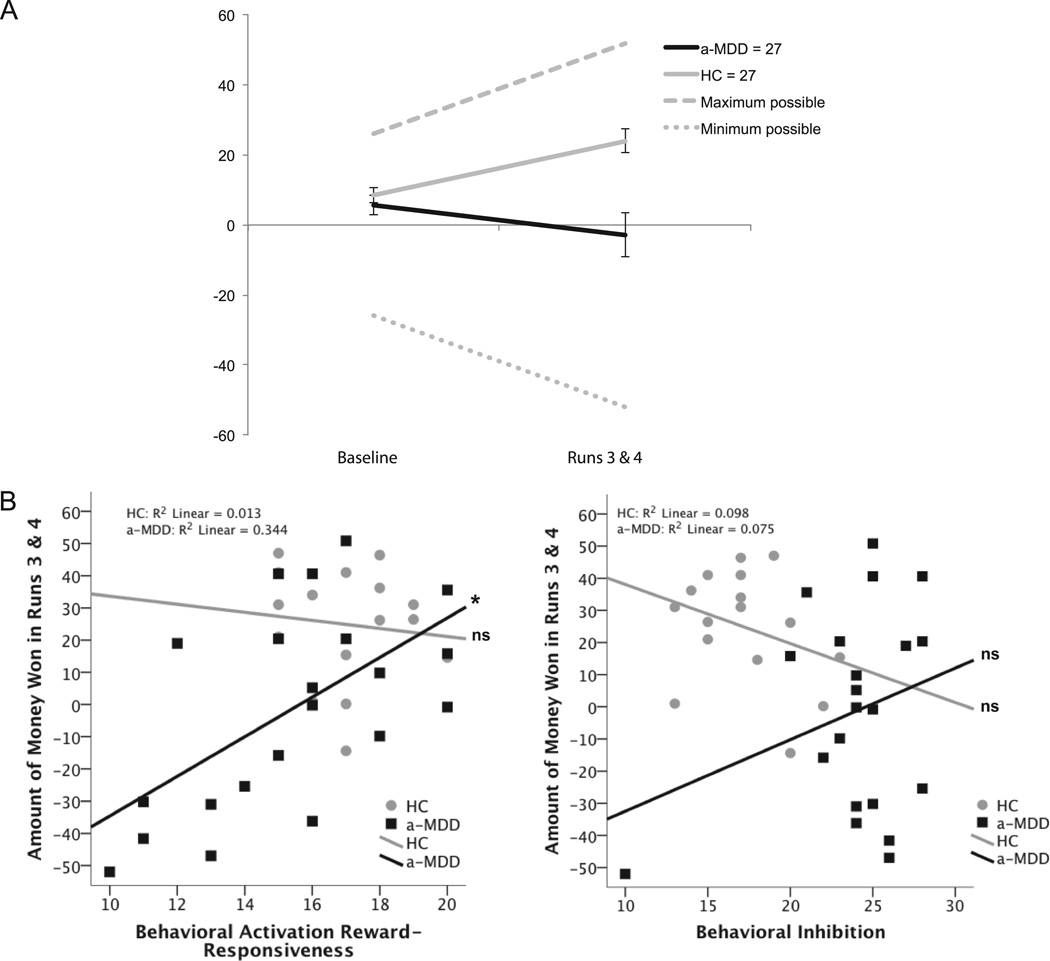
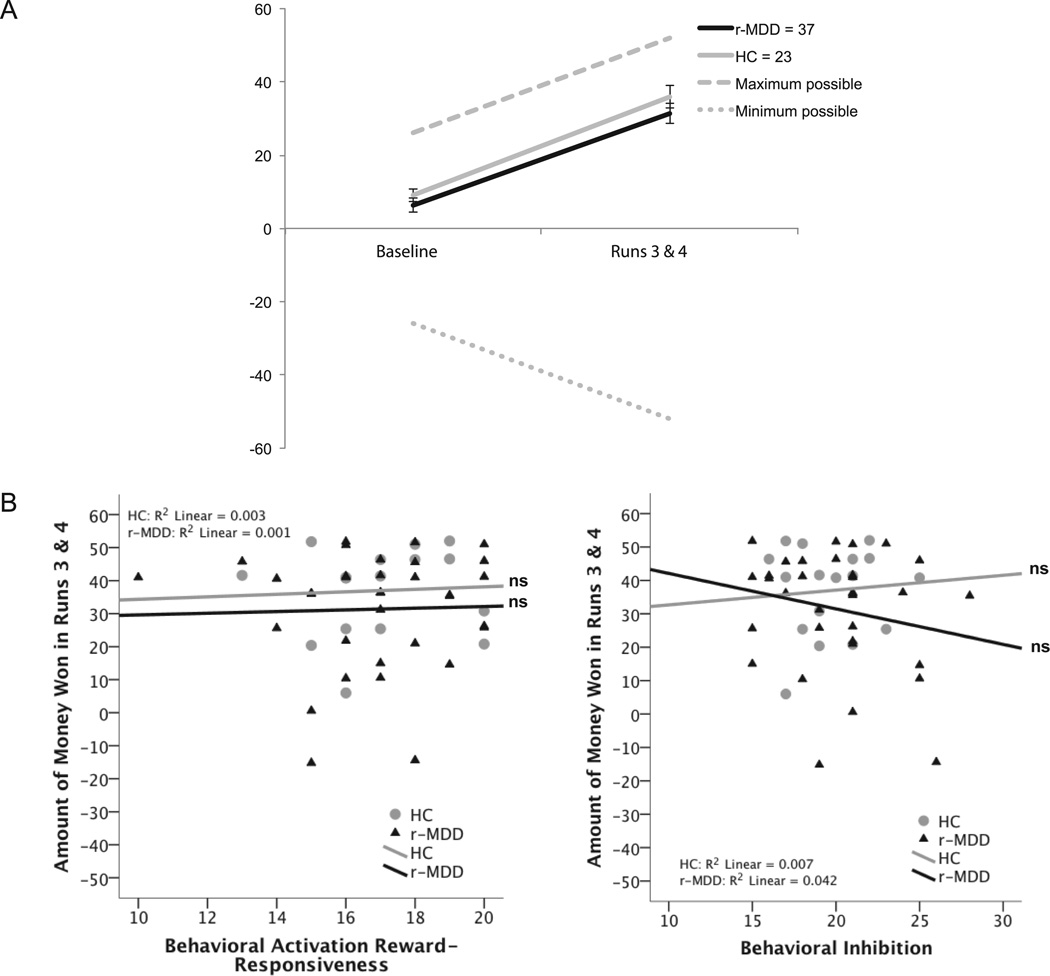
Anhedonia, the diminished anticipation and pursuit of reward, is a core symptom of major depressive disorder (MDD). Trait behavioral activation (BA), as a proxy for anhedonia, and behavioral inhibition (BI) may moderate the relationship between MDD and reward-seeking. The present studies probed for reward learning deficits, potentially due to aberrant BA and/or BI, in active or remitted MDD individuals compared to healthy controls (HC). Active MDD (Study 1) and remitted MDD (Study 2) participants completed the modified monetary incentive delay task (mMIDT), a behavioral reward-seeking task whose response window parameters were individually titrated to theoretically elicit equivalent accuracy between groups. Participants completed the BI Scale and BA Reward-Responsiveness and Drive Scales. Despite individual titration, active MDD participants won significantly less money than HCs. Higher Reward-Responsiveness scores predicted more won; Drive and BI were not predictive. Remitted MDD participants' performance did not differ from controls', and trait BA and BI measures did not predict r-MDD performance. These results suggest that diminished reward-responsiveness may contribute to decreased motivation and reward pursuit during active MDD, but that reward learning is intact in remission. Understanding individual reward processing deficits in MDD may inform personalized intervention addressing anhedonia and motivation deficits in select MDD patients.
Keywords: Behavioral activation; Behavioral inhibition; Depression; Remitted MDD; Reward processing.
Copyright © 2015 Elsevier Ireland Ltd. All rights reserved.
Conflict of interest statement
Figures
References
-
- American Psychiatric Association. Diagnostic and Statistical Manual of Mental Disorders. fifth ed. Arlington, VA: American Psychiatric Publishing; 2013.
-
- Berridge KC, Robinson TE. Parsing reward. TRENDS in Neurosciences. 2003;26:507–513. - PubMed
-
- Bouhuys AL, Geerts E, Gordijn MC. Depressed patients’ perceptions of facial emotions in depressed and remitted states are associated with relapse: a longitudinal study. The Journal of Nervous and Mental Disease. 1999;187:595–602. - PubMed
-
- Campbell-Sills L, Liverant GI, Brown TA. Psychometric evaluation of the behavioral inhibition/behavioral activation scales in a large sample of outpatients with anxiety and mood disorders. Psychological Assessment. 2004;16:244. - PubMed
Publication types
MeSH terms
Grants and funding
- K23 MH074459/MH/NIMH NIH HHS/United States
- RR024987/RR/NCRR NIH HHS/United States
- R01MH081911/MH/NIMH NIH HHS/United States
- R01 MH091811/MH/NIMH NIH HHS/United States
- T32 MH067631/MH/NIMH NIH HHS/United States
- K23MH074459/MH/NIMH NIH HHS/United States
- L30 MH084296/MH/NIMH NIH HHS/United States
- R01 MH101487/MH/NIMH NIH HHS/United States
- R01MH050030/MH/NIMH NIH HHS/United States
- R01 HL081911/HL/NHLBI NIH HHS/United States
- T32MH067631/MH/NIMH NIH HHS/United States
- R01 MH050030/MH/NIMH NIH HHS/United States
- KL2 RR024987/RR/NCRR NIH HHS/United States
LinkOut - more resources
Full Text Sources
Other Literature Sources
