


Host-pathogen reorganisation during host cell entry by Chlamydia trachomatis
- PMID: 26320027
- PMCID: PMC4670903
- DOI: 10.1016/j.micinf.2015.08.004
Host-pathogen reorganisation during host cell entry by Chlamydia trachomatis
Abstract
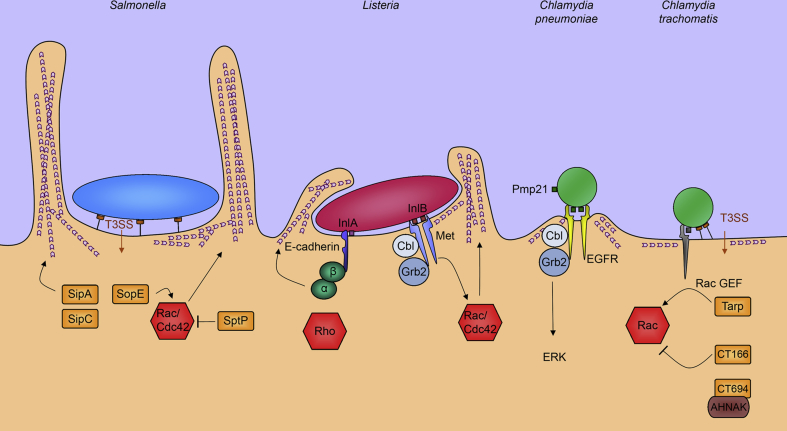
Chlamydia trachomatis is obligate intracellular bacterial pathogen that remains a significant public health burden worldwide. A critical early event during infection is chlamydial entry into non-phagocytic host epithelial cells. Like other Gram-negative bacteria, C. trachomatis uses a type III secretion system (T3SS) to deliver virulence effector proteins into host cells. These effectors trigger bacterial uptake and promote bacterial survival and replication within the host cell. In this review, we highlight recent cryo-electron tomography that has provided striking insights into the initial interactions between Chlamydia and its host. We describe the polarised structure of extracellular C. trachomatis elementary bodies (EBs), and the supramolecular organisation of T3SS complexes on the EB surface, in addition to the changes in host and pathogen architecture that accompany bacterial internalisation and EB encapsulation into early intracellular vacuoles. Finally, we consider the implications for further understanding the mechanism of C. trachomatis entry and how this might relate to those of other bacteria and viruses.
Keywords: Chlamydia; Cryo-electron tomography; Cytoskeleton; Entry; Type III secretion.
Copyright © 2015 The Authors. Published by Elsevier Masson SAS.. All rights reserved.
Figures


References
-
- Latest World Health Organisation figures.
-
- Huang Z., Chen M., Li K., Dong X., Han J., Zhang Q. Cryo-electron tomography of Chlamydia trachomatis gives a clue to the mechanism of outer membrane changes. J Electron Microsc (Tokyo) 2010;59:237–241. - PubMed
Publication types
MeSH terms
Substances
Grants and funding
LinkOut - more resources
Full Text Sources
Other Literature Sources
Medical
