


Review
doi: 10.1152/ajplung.00266.2015.
Epub 2015 Aug 28.
Platelets in the pathogenesis of acute respiratory distress syndrome
Affiliations
- PMID: 26320157
- PMCID: PMC4628982
- DOI: 10.1152/ajplung.00266.2015
Item in Clipboard
Review
Platelets in the pathogenesis of acute respiratory distress syndrome
Am J Physiol Lung Cell Mol Physiol.
.
Abstract
Platelets have an emerging and incompletely understood role in a myriad of host immune responses, extending their role well beyond regulating thrombosis. Acute respiratory distress syndrome is a complex disease process characterized by a range of pathophysiologic processes including oxidative stress, lung deformation, inflammation, and intravascular coagulation. The objective of this review is to summarize existing knowledge on platelets and their putative role in the development and resolution of lung injury.
Keywords: ALI; ARDS; aspirin; lung injury; platelet.
Copyright © 2015 the American Physiological Society.
Figures
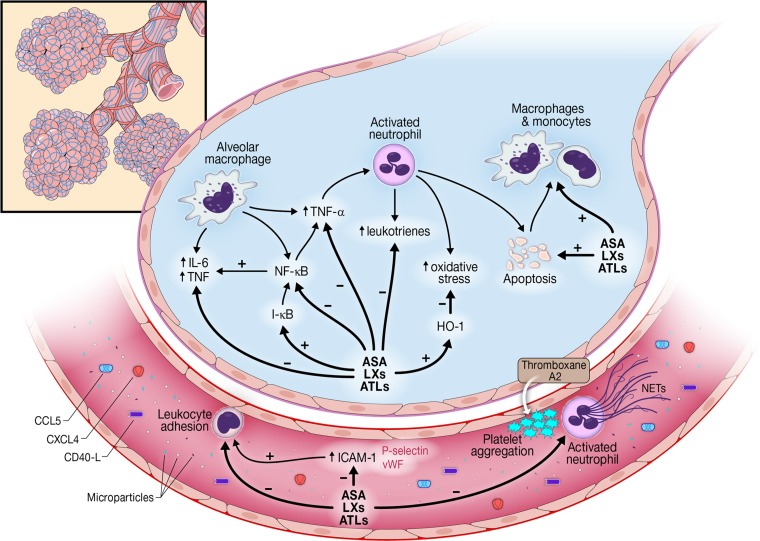
Mechanisms by which platelets may contribute to the development and resolution of acute respiratory distress syndrome (ARDS). IL-6, interleukin-6; TNF, tumor necrosis factor; NF-кB, nuclear factor-к-light-chain-enhancer of activated B cells; ASA, aspirin; LXs, lipoxins; ATLs, aspirin-triggered lipoxins; HO-1, heme oxygenase-1; ICAM-1, intercellular adhesion molecule; CCL-5, chemokine (C-C motif) ligand-5; CXCL4, chemokine (C-X-C motif) ligand-4; vWF, von-Willebrand factor; NETs, neutrophil extracellular traps.
References
-
- Acute Respiratory Distress Syndrome Network. Ventilation with lower tidal volumes as compared with traditional tidal volumes for acute lung injury, and the acute respiratory distress syndrome. The Acute Respiratory Distress Syndrome Network N Engl J Med 342: 1301–1308, 2000. - PubMed
-
- Andersson PO, Olsson A, Wadenvik H. Reduced transforming growth factor-beta1 production by mononuclear cells from patients with active chronic idiopathic thrombocytopenic purpura. Br J Haematol 116: 862–867, 2002. - PubMed
-
- Andersson PO, Stockelberg D, Jacobsson S, Wadenvik H. A transforming growth factor-beta1-mediated bystander immune suppression could be associated with remission of chronic idiopathic thrombocytopenic purpura. Ann Hematol 79: 507–513, 2000. - PubMed
-
- Andre P, Nannizzi-Alaimo L, Prasad SK, Phillips DR. Platelet-derived CD40L: the switch-hitting player of cardiovascular disease. Circulation 106: 896–899, 2002. - PubMed
Publication types
MeSH terms
Grants and funding
LinkOut - more resources
Full Text Sources
Other Literature Sources
