


doi: 10.1016/j.drudis.2015.08.005.
Epub 2015 Aug 28.
Precision medicine at Memorial Sloan Kettering Cancer Center: clinical next-generation sequencing enabling next-generation targeted therapy trials
Affiliations
- PMID: 26320725
- PMCID: PMC4940024
- DOI: 10.1016/j.drudis.2015.08.005
Item in Clipboard
Precision medicine at Memorial Sloan Kettering Cancer Center: clinical next-generation sequencing enabling next-generation targeted therapy trials
Drug Discov Today.
2015 Dec.
Abstract
Implementing a center-wide precision medicine strategy at a major cancer center is a true multidisciplinary effort and requires comprehensive alignment of a broad screening strategy with a clinical research enterprise that can use these data to accelerate development of new treatments. Here, we describe the genomic screening approach at Memorial Sloan Kettering Cancer Center, a hybridization capture-based next-generation sequencing clinical assay for solid tumor molecular oncology designated MSK-IMPACT, and how it enables and supports a large clinical trial portfolio enriched for multi-histology, biomarker-selected, 'basket' studies of targeted therapies.
Copyright © 2015 Elsevier Ltd. All rights reserved.
Figures
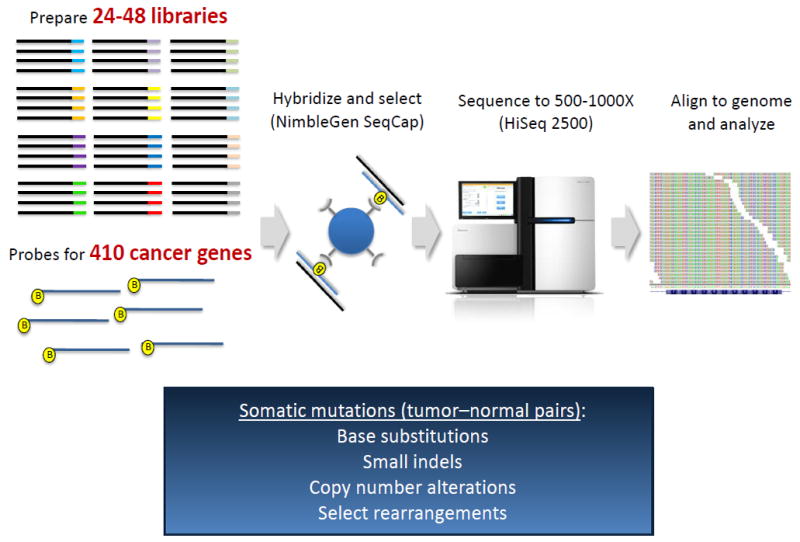
[s4]. Schematic Overview of MSK-IMPACT. MSK-IMPACT is a custom designed hybridization capture-based next-generation sequencing assay that utilizes biotinylated synthetic DNA probes or baits that are complementary for the targeted genomic DNA regions, allowing their subsequent enrichment. Tumor and matched normal are sequenced in parallel using an Illumina® HiSeq 2500. The assay includes full exon coverage of 410 genes, in addition to select intronic regions. MSK-IMPACT can detect all classes of genomic alterations including base substitutions, small indels, copy number alterations and select rearrangements. Up to 48 libraries, representing paired tumor–normal samples from 24 unique patients, can be sequenced simultaneously. Testing is performed in a Clinical Laboratory Improvement Amendments (CLIA)-certified laboratory and results entered into the medical record.
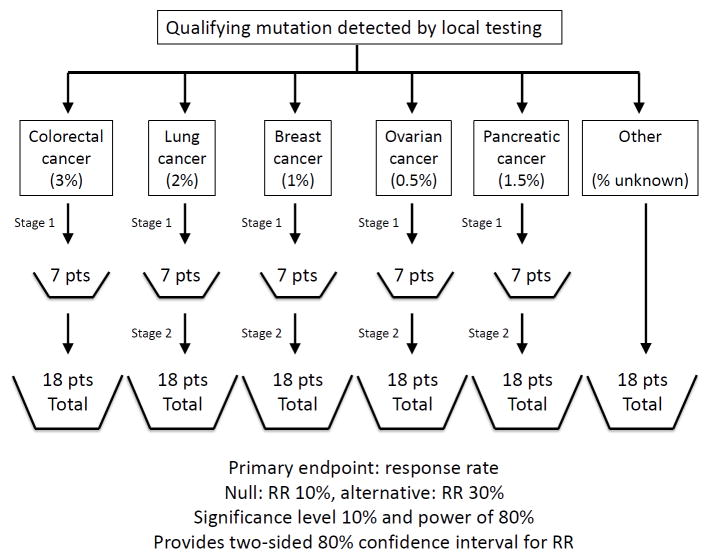
Sample basket study schema. The typical study design and biostatistical plan for a multi-histology, biomarker-selected, basket study is shown. Several disease cohorts are pre-specified and another all-comers ‘other’ cohort allows enrollment of remaining disease types. Pertains[s5] indicate the expected frequency of the biomarker of interest within each disease type. Basket studies typically utilize a two-stage design targeting a response rate of at least 30% enabling relatively small sample sizes.
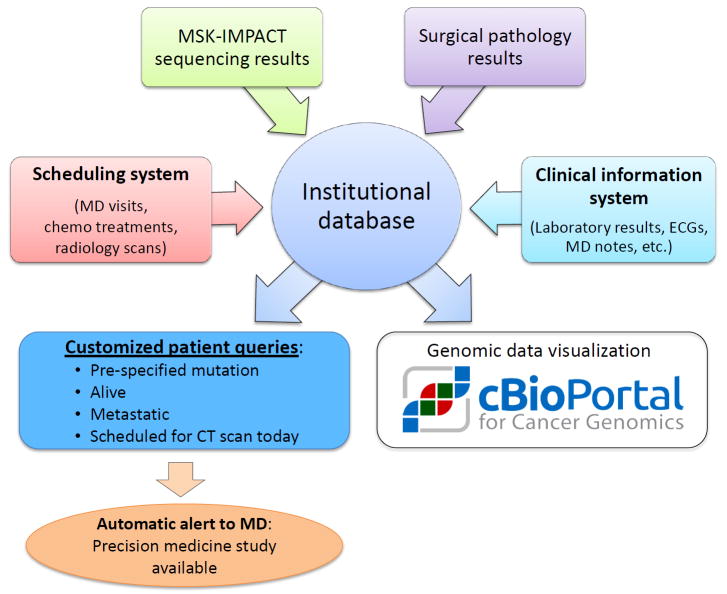
Schematic overview of protocol matching system. The protocol matching system at Memorial Sloan Kettering Cancer Center is based on multiple canonical data stores including a scheduling system, molecular and surgical pathology reports, and electronic medical records feeding into a centralized institutional database. This database is in turn used to create automated queries that can use genomic and clinical data to identify patients potentially eligible for a precision medicine study and to notify the study Principal Investigator and the treating physician. Patient genomic and clinical data are also fed in a de-identified fashion into the cBioPortal for investigational data mining and visualization.
References
-
- Slamon DJ, et al. Use of chemotherapy plus a monoclonal antibody against HER2 for metastatic breast cancer that overexpresses HER2. N Engl J Med. 2001;344:783–792. - PubMed
-
- Zhou C, et al. Erlotinib versus chemotherapy as first-line treatment for patients with advanced EGFR mutation-positive non-small-cell lung cancer (OPTIMAL, CTONG-0802): a multicentre, open-label, randomised, phase 3 study. Lancet Oncol. 2011;12:735–742. - PubMed
-
- Shaw AT, et al. Crizotinib versus chemotherapy in advanced ALK-positive lung cancer. N Engl J Med. 2013;368:2385–2394. - PubMed
MeSH terms
Grants and funding
LinkOut - more resources
Full Text Sources
Other Literature Sources
