


Prevalence and characteristics of fetal alcohol syndrome and partial fetal alcohol syndrome in a Rocky Mountain Region City
- PMID: 26321671
- PMCID: PMC4581993
- DOI: 10.1016/j.drugalcdep.2015.08.006
Prevalence and characteristics of fetal alcohol syndrome and partial fetal alcohol syndrome in a Rocky Mountain Region City
Abstract
Background: The prevalence and characteristics of fetal alcohol syndrome (FAS) and partial FAS (PFAS) in the United States (US) are not well known.
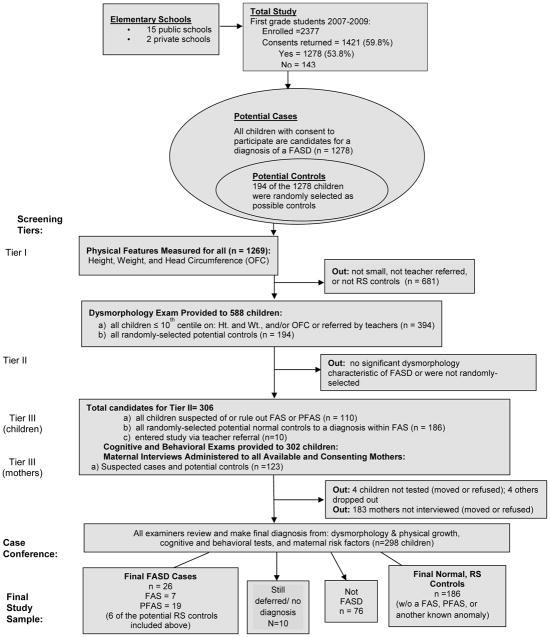
Methods: This active case ascertainment study in a Rocky Mountain Region City assessed the prevalence and traits of children with FAS and PFAS and linked them to maternal risk factors. Diagnoses made by expert clinical dysmorphologists in multidisciplinary case conferences utilized all components of the study: dysmorphology and physical growth, neurobehavior, and maternal risk interviews.
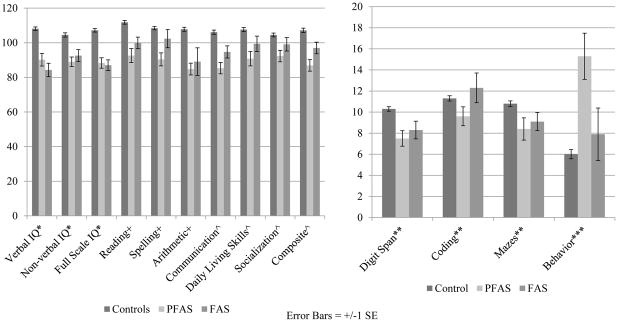
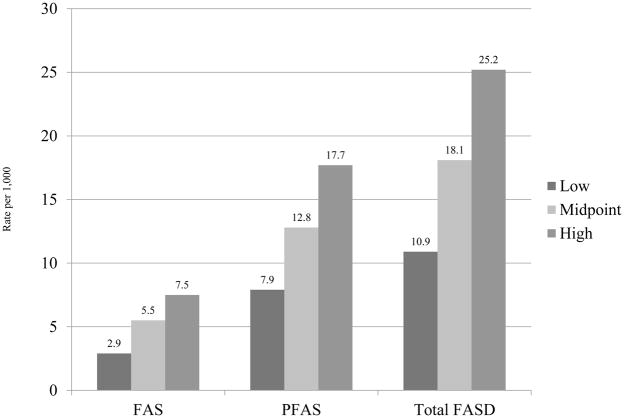
Results: Direct parental (active) consent was obtained for 1278 children. Averages for key physical diagnostic traits and several other minor anomalies were significantly different among FAS, PFAS, and randomly-selected, normal controls. Cognitive tests and behavioral checklists discriminated the diagnostic groups from controls on 12 of 14 instruments. Mothers of children with FAS and PFAS were significantly lower in educational attainment, shorter, later in pregnancy recognition, and suffered more depression, and used marijuana and methamphetamine during their pregnancy. Most pre-pregnancy and pregnancy drinking measures were worse for mothers of FAS and PFAS. Excluding a significant difference in simply admitting drinking during the index pregnancy (FAS and PFAS=75% vs. 39.4% for controls), most quantitative intergroup differences merely approached significance. This community's prevalence of FAS is 2.9-7.5 per 1000, PFAS is 7.9-17.7 per 1000, and combined prevalence is 10.9-25.2 per 1000 or 1.1-2.5%.
Conclusions: Comprehensive, active case ascertainment methods produced rates of FAS and PFAS higher than predicted by long-standing, popular estimates.
Keywords: Alcohol use and abuse; Children with FAS and PFAS; Fetal alcohol spectrum disorders; Maternal risk factors; Prenatal alcohol use; Prevalence; United States.
Copyright © 2015 Elsevier Ireland Ltd. All rights reserved.
Conflict of interest statement
None of the authors have any conflicts of interest to declare.
Figures
References
-
- Abel EL. Fetal Alcohol Abuse Syndrome. Plenum Press; New York: 1998.
-
- Abel EL, Sokol RJ. Incidence of Fetal Alcohol Syndrome and economic impact of FAS related anomalies. Drug Alcohol Depend. 1987;19:51–70. - PubMed
-
- Abel EL, Sokol RJ. A revised conservative estimate of the incidence of FAS and its economic impact. Alcohol Clin Exp Res. 1991;15:514–524. - PubMed
-
- Abel EL, Hannigan JH. Maternal risk factors in fetal alcohol syndrome: provocative and permissive influences. Neurotoxicol Teratol. 1995;17:445–462. - PubMed
-
- Alvik A, Haldorsen T, Lindemann R. Consistency of reported alcohol use by pregnant women: anonymous versus confidential questionnaires with item nonresponse differences. Alcohol Clin Exp Res. 2005;29:1444–1449. - PubMed
Publication types
MeSH terms
Grants and funding
LinkOut - more resources
Full Text Sources
Other Literature Sources
Medical
Research Materials
Miscellaneous
