. 2015 Aug 11:6:1193.
doi: 10.3389/fpsyg.2015.01193. eCollection 2015.

Self-control depletion in tufted capuchin monkeys (Sapajus spp.): does delay of gratification rely on a limited resource?

Affiliations

Self-control depletion in tufted capuchin monkeys (Sapajus spp.): does delay of gratification rely on a limited resource?

Francesca De Petrillo et al. Front Psychol. .

Abstract

Self-control failure has enormous personal and societal consequences. One of the most debated models explaining why self-control breaks down is the Strength Model, according to which self-control depends on a limited resource. Either previous acts of self-control or taking part in highly demanding cognitive tasks have been shown to reduce self-control, possibly due to a reduction in blood glucose levels. However, several studies yielded negative findings, and recent meta-analyses questioned the robustness of the depletion effect in humans. We investigated, for the first time, whether the Strength Model applies to a non-human primate species, the tufted capuchin monkey. We tested five capuchins in a self-control task (the Accumulation task) in which food items were accumulated within individual's reach for as long as the subject refrained from taking them. We evaluated whether capuchins' performance decreases: (i) when tested before receiving their daily meal rather than after consuming it (Energy Depletion Experiment), and (ii) after being tested in two tasks with different levels of cognitive complexity (Cognitive Depletion Experiment). We also tested, in both experiments, how implementing self-control in each trial of the Accumulation task affected this capacity within each session and/or across consecutive sessions. Repeated acts of self-control in each trial of the Accumulation task progressively reduced this capacity within each session, as predicted by the Strength Model. However, neither experiencing a reduction in energy level nor taking part in a highly demanding cognitive task decreased performance in the subsequent Accumulation task. Thus, whereas capuchins seem to be vulnerable to within-session depletion effects, to other extents our findings are in line with the growing body of studies that failed to find a depletion effect in humans. Methodological issues potentially affecting the lack of depletion effects in capuchins are discussed.

Keywords: capuchin monkeys; depletion; non-human primates; self-control; strength model.


Figures
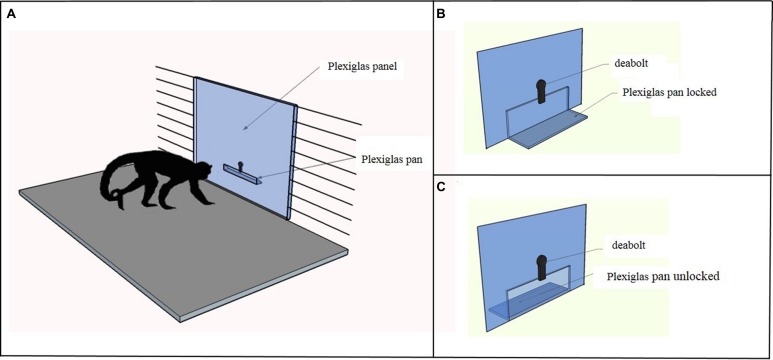
FIGURE 1
FIGURE 1
(A) The figure depicts the apparatus used in the Accumulation task. The experimenter placed the food items in a Plexiglas pan, which could be locked with a deadbolt. (B) In the single forced-accumulation trial of the Accumulation task the Plexiglas pan was locked and the experimenter accumulated 10 food items before unlocking the pan and allowing the subject to take all the items. The subject could observe the accumulation process but reaching for food was prevented until the experimenter unlocked the pan. (C) In the three free-accumulation trials of the Accumulation task the Plexiglas pan was unlocked and the subject could have access to the food items during the accumulation process.
FIGURE 2
FIGURE 2
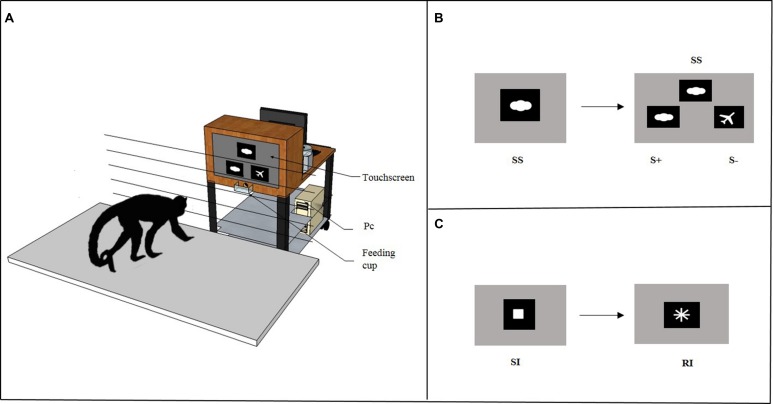
(A) The figure depicts the apparatus used in the Cognitive Depletion Experiment. It consisted in a computerized system mounted on the top shelf of a trolley connected to a 19″ touchscreen and to an automatic food dispenser. When the subject provided a correct response, the food dispenser delivered one banana-flavored pellet as reward into a Plexiglas feeding cup. (B) High Cognitive Depletion/Identity Matching-to-Sample task. At the beginning of each trial, an image was presented as a sample stimulus (SS) on the upper central half of the screen. When the subject touched the SS, two comparison stimuli were immediately displayed on the right and on the left, below the sample. The comparison stimuli included one matching stimulus (S+), identical to SS, and one non-matching stimulus (S-), different from SS. (C) Low Cognitive Depletion/Simple Touching task. At the beginning of each trial a white square was presented as a starting image (SI) in the center of a black background screen. When the subject touched the SI, it vanished and was immediately replaced by a rewarding image (RI), a white cross.
FIGURE 3
FIGURE 3
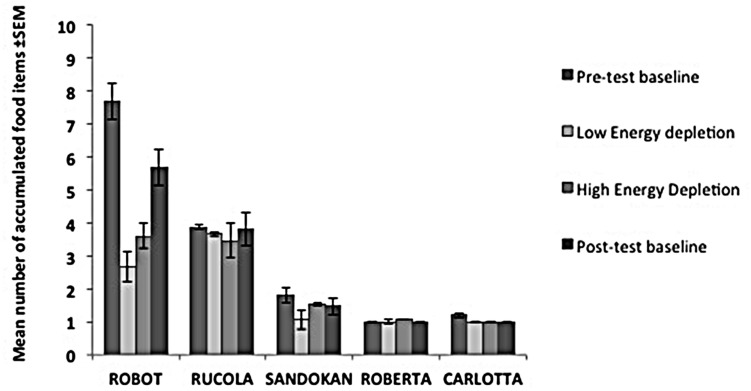
Performance of each subject in the Energy Depletion Experiment. The histograms report the mean number of food items accumulated (and SEM) for each condition in the Accumulation task.
FIGURE 4
FIGURE 4
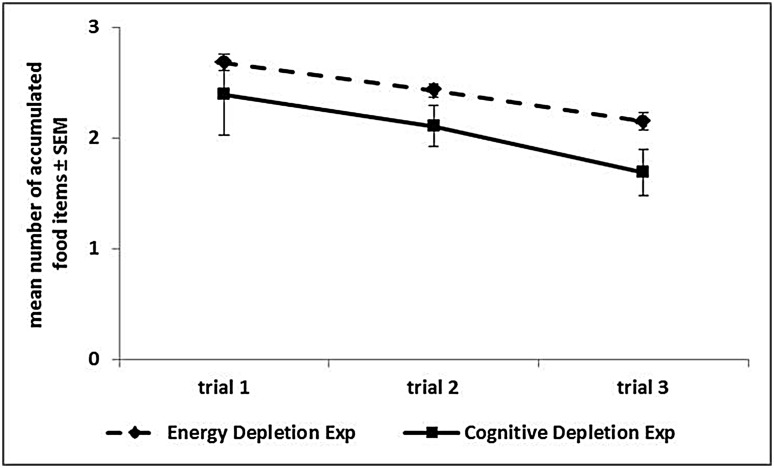
Performance over trials in the Accumulation task. The graph reports, for each experiment, the mean number (and SEM) of food items accumulated in each of the three trials, averaged across sessions, and experimental phases.
FIGURE 5
FIGURE 5
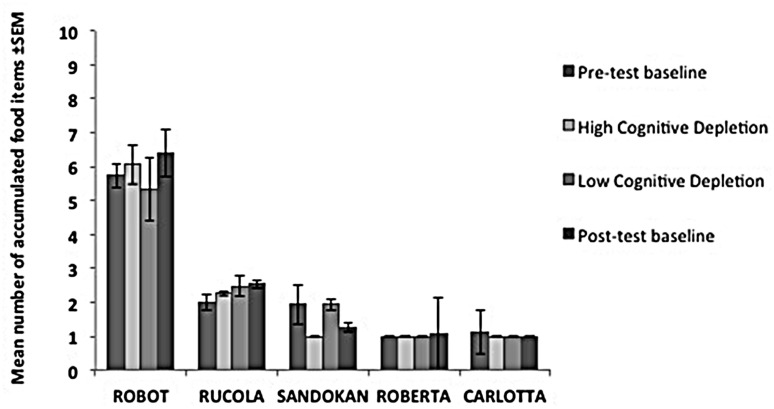
Performance of each subject in the Cognitive Depletion Experiment. The histograms report the mean number of food items accumulated (and SEM) for each condition in the Accumulation task.

References

    1. Addessi E., Bellagamba F., Delfino A., De Petrillo F., Focaroli V., Macchitella L., et al. (2014). Waiting by mistake: symbolic representation of rewards modulate intertemporal choice in capuchin monkeys (Cebus apella), preschool children and adult humans. Cognition 130 428–441. 10.1016/j.cognition.2013.11.019 - DOI - PubMed
    1. Addessi E., Crescimbene L., Visalberghi E. (2007). Do capuchin monkeys (Cebus apella) use token as symbols? Proc. R. Soc. Lond. [Biol.] 274 2579–2585. 10.1098/rspb.2007.0726 - DOI - PMC - PubMed
    1. Addessi E., Mancini A., Crescimbene L., Padoa-Schioppa L., Visalberghi E. (2008). Preference transitivity and symbolic representation in capuchin monkeys (Cebus apella). PLoS ONE 3:e2414 10.1371/journal.pone.0002414 - DOI - PMC - PubMed
    1. Addessi E., Paglieri F., Beran M., Evans T., Macchitella L., De Petrillo F., et al. (2013). Delay choice vs. delay maintenance: different measures of delayed gratification in capuchin monkeys (Cebus apella). J. Comp. Psychol. 127 392–398. 10.1037/a0031869 - DOI - PMC - PubMed
    1. Addessi E., Paglieri F., Focaroli V. (2011). The ecological rationality of delay tolerance: insights from capuchin monkeys. Cognition 119 142–147. 10.1016/j.cognition.2010.10.021 - DOI - PubMed

LinkOut - more resources