. 2015 Aug 26;6(3):48-56.
doi: 10.4331/wjbc.v6.i3.48.

Mechanism of DNA damage tolerance

Affiliations

Mechanism of DNA damage tolerance

Xin Bi. World J Biol Chem. .

Abstract

DNA damage may compromise genome integrity and lead to cell death. Cells have evolved a variety of processes to respond to DNA damage including damage repair and tolerance mechanisms, as well as damage checkpoints. The DNA damage tolerance (DDT) pathway promotes the bypass of single-stranded DNA lesions encountered by DNA polymerases during DNA replication. This prevents the stalling of DNA replication. Two mechanistically distinct DDT branches have been characterized. One is translesion synthesis (TLS) in which a replicative DNA polymerase is temporarily replaced by a specialized TLS polymerase that has the ability to replicate across DNA lesions. TLS is mechanistically simple and straightforward, but it is intrinsically error-prone. The other is the error-free template switching (TS) mechanism in which the stalled nascent strand switches from the damaged template to the undamaged newly synthesized sister strand for extension past the lesion. Error-free TS is a complex but preferable process for bypassing DNA lesions. However, our current understanding of this pathway is sketchy. An increasing number of factors are being found to participate or regulate this important mechanism, which is the focus of this editorial.

Keywords: DNA damage bypass; DNA damage tolerance; DNA replication; Replicative stress; Sumoylation; Template switching; Translesion synthesis; Ubiquitination.


Figures
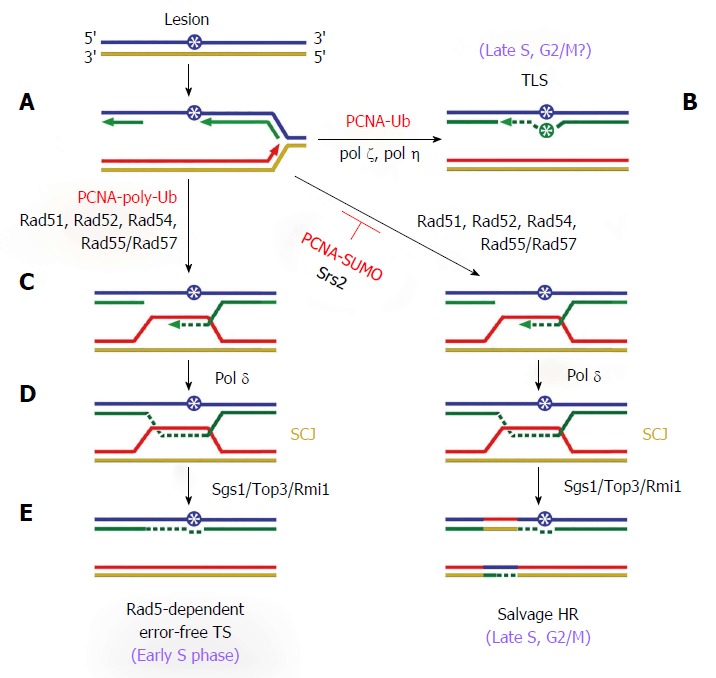
Figure 1
Figure 1
DNA damage tolerance mechanisms. DNA damage (asterisk in blue circle) stalls DNA replication. A: Reinitiation of DNA synthesis results in the formation of a ssDNA gap. Shown is a ssDNA gap on the lagging strand; B: PCNA mono-ubiquitination induces a switch from replicative polymerase to a TLS polymerase Pol ζ or Pol η, resulting in gap filling via TLS, which may incorporate the wrong nucleotide (asterisk in green circle); C-E: PCNA poly-ubiquitination activates the Rad5-dependent error-free TS pathway. Gap filling is achieved by strand invasion mediated by Rad51, Rad52, Rad54, and Rad55/Rad57 and repair synthesis carried out by Pol δ (C), followed by the formation of SCJ (D), and resolution of the SCJ by Sgs1/Top3/Rmi1 (E). DDT can also proceed through the salvage HR pathway that also produces the SCJ intermediate. The salvage pathway is hyper-recombinogenic and prone to crossover as indicated. It is normally inhibited by sumoylated PCNA and Srs2. G2: Gap 2; M: Mitotic; PCNA: Proliferating cell nuclear antigen; S: Synthesis; SUMO: Small ubiquitin-like modifier; TLS: Translesion synthesis; SCJ: Sister chromatid junction; Ub: Ubiquitin.
Figure 2
Figure 2
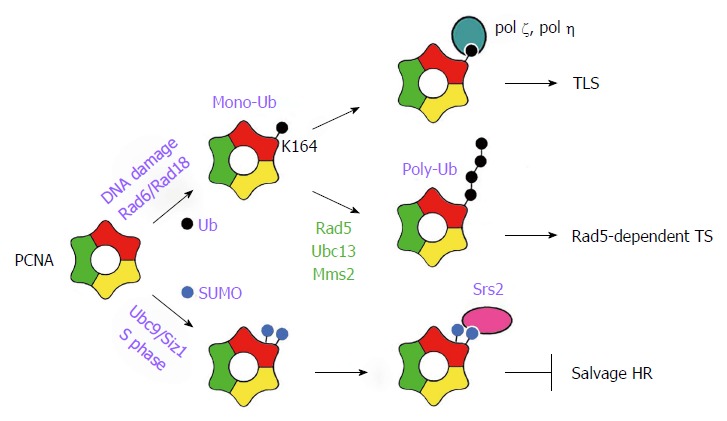
Regulation of DNA damage tolerance by proliferating cell nuclear antigen modification. PCNA is a homotrimer that can be modified at K164 by either ubiquitin or SUMO. It can also be sumoylated at K127. PCNA mono-ubiquitination (mono-Ub) by Rad6/Rad18 facilitates the recruitment of TLS polymerases thereby promoting TLS. Extension of mono-Ub with a K63-linked Ub chain (poly-Ub) by Rad5/Ubc13/Mms2 promotes Rad5-dependent error-free TS pathway. PCNA sumoylation recruits Srs2 that inhibits the salvage HR pathway. HR: Homologous recombination; K: Lysine; PCNA: Proliferating cell nuclear antigen; S: Synthesis; SUMO: Small ubiquitin-like modifier; TLS: Translesion synthesis; TS: Template switching; Ub: Ubiquitin.

References

    1. Ciccia A, Elledge SJ. The DNA damage response: making it safe to play with knives. Mol Cell. 2010;40:179–204. - PMC - PubMed
    1. Krejci L, Altmannova V, Spirek M, Zhao X. Homologous recombination and its regulation. Nucleic Acids Res. 2012;40:5795–5818. - PMC - PubMed
    1. Chiruvella KK, Liang Z, Wilson TE. Repair of double-strand breaks by end joining. Cold Spring Harb Perspect Biol. 2013;5:a012757. - PMC - PubMed
    1. Krokan HE, Bjørås M. Base excision repair. Cold Spring Harb Perspect Biol. 2013;5:a012583. - PMC - PubMed
    1. Nouspikel T. DNA repair in mammalian cells: Nucleotide excision repair: variations on versatility. Cell Mol Life Sci. 2009;66:994–1009. - PMC - PubMed