


Face Value: Towards Robust Estimates of Snow Leopard Densities
- PMID: 26322682
- PMCID: PMC4554729
- DOI: 10.1371/journal.pone.0134815
Face Value: Towards Robust Estimates of Snow Leopard Densities
Abstract
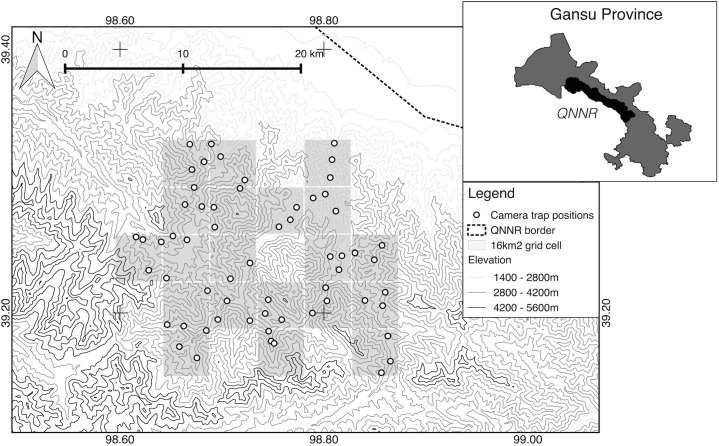
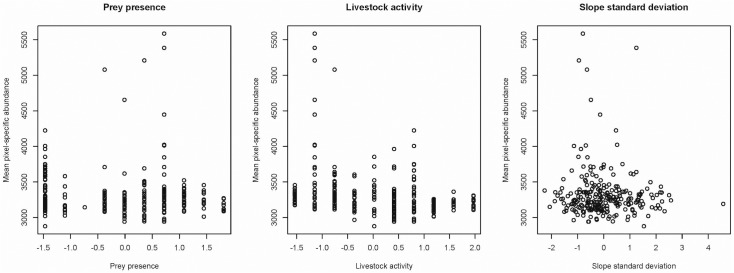
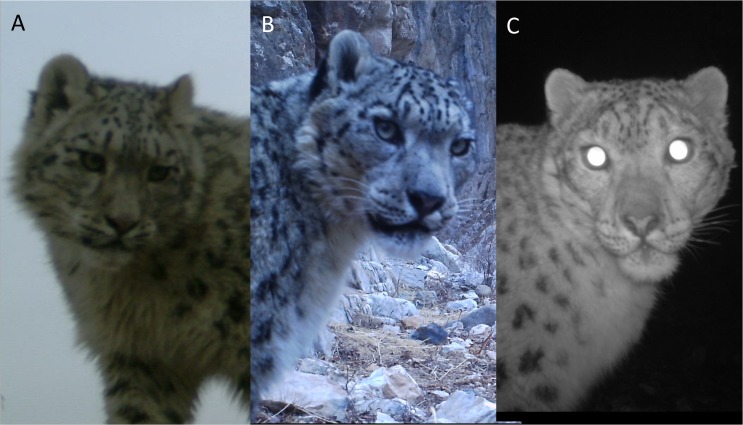
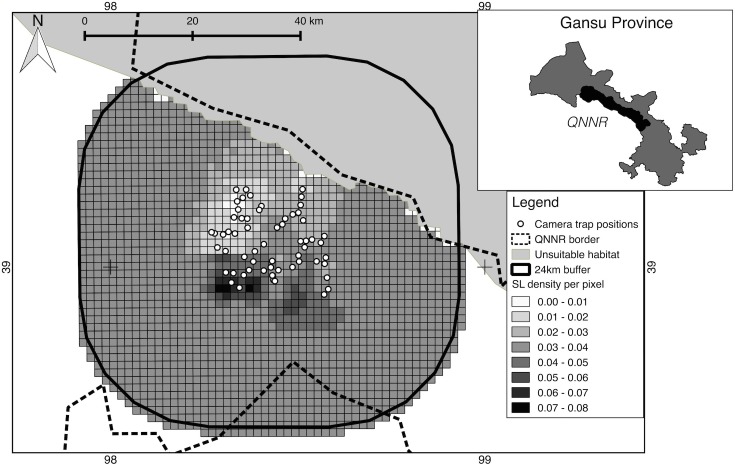
When densities of large carnivores fall below certain thresholds, dramatic ecological effects can follow, leading to oversimplified ecosystems. Understanding the population status of such species remains a major challenge as they occur in low densities and their ranges are wide. This paper describes the use of non-invasive data collection techniques combined with recent spatial capture-recapture methods to estimate the density of snow leopards Panthera uncia. It also investigates the influence of environmental and human activity indicators on their spatial distribution. A total of 60 camera traps were systematically set up during a three-month period over a 480 km2 study area in Qilianshan National Nature Reserve, Gansu Province, China. We recorded 76 separate snow leopard captures over 2,906 trap-days, representing an average capture success of 2.62 captures/100 trap-days. We identified a total number of 20 unique individuals from photographs and estimated snow leopard density at 3.31 (SE = 1.01) individuals per 100 km2. Results of our simulation exercise indicate that our estimates from the Spatial Capture Recapture models were not optimal to respect to bias and precision (RMSEs for density parameters less or equal to 0.87). Our results underline the critical challenge in achieving sufficient sample sizes of snow leopard captures and recaptures. Possible performance improvements are discussed, principally by optimising effective camera capture and photographic data quality.
Conflict of interest statement
Figures
References
-
- Miller B, Dugelby B, Foreman D, del Rio CM, Noss R, Phillips M, et al. (2001) The importance of large carnivores to healthy ecosystems. Endanger Species Updat 18: 202–210.
-
- Soulé ME, Estes JA, Berger J, Del Rio CM, Martinez C del R (2003) Ecological effectiveness: conservation goals for interactive species. Conserv Biol 17: 1238–1250.
-
- Estes JA, Palmisano JF (1974) Sea Otters: Their role in structuring nearshore communities. Science (80-) 185: 1058–1060. - PubMed
-
- Terborgh J, Lopez L, Nuñez P, Rao M, Shahabuddin G, Orihuela G, et al. (2001) Ecological Meltdown in Predator-Free Forest Fragments. Science (80-) 294: 1923–1926. - PubMed
-
- McNab BK (2000) The standard energetics of mammalian carnivores: Felidae and Hyaenidae. Can J Zool 78: 2227–2239.
Publication types
MeSH terms
LinkOut - more resources
Full Text Sources
Other Literature Sources
