


doi: 10.1038/nmeth.3554.
Epub 2015 Aug 31.
Functional footprinting of regulatory DNA
Affiliations
- PMID: 26322838
- PMCID: PMC5381659
- DOI: 10.1038/nmeth.3554
Item in Clipboard
Functional footprinting of regulatory DNA
Nat Methods.
2015 Oct.
Abstract
Regulatory regions harbor multiple transcription factor (TF) recognition sites; however, the contribution of individual sites to regulatory function remains challenging to define. We describe an approach that exploits the error-prone nature of genome editing-induced double-strand break repair to map functional elements within regulatory DNA at nucleotide resolution. We demonstrate the approach on a human erythroid enhancer, revealing single TF recognition sites that gate the majority of downstream regulatory function.
Figures
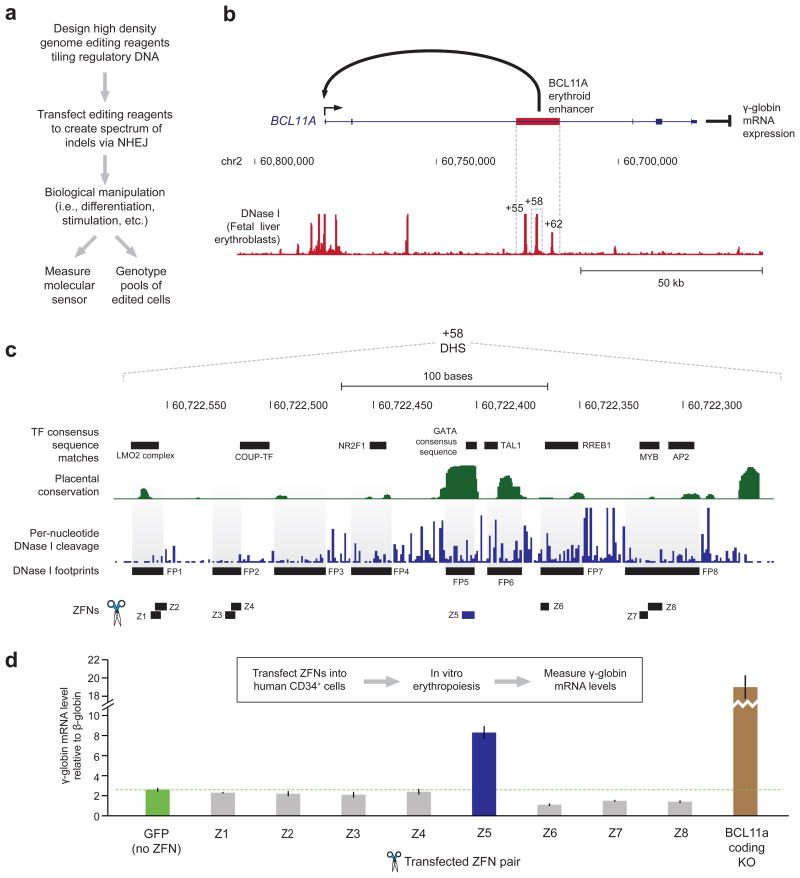
a) Overview of the functional footprinting approach to determine function of regulatory DNA. b) Schematic of γ-globin gene regulation by BCL11A. An erythroid specific intron enhancer activates BCL11A expression, which represses γ-globin expression. c) Per-nucleotide conservation, DNase I cleavage and computationally predicted protein-DNA interactions (motifs and footprints) within the +58 DNase I hypersensitive site (DHS) of the BCL11A erythroid enhancer. d) Effect of engineered zinc-finger nucleases (ZFNs) editing on γ-globin mRNA expression relative to that of β-globin. Both γ-globin and β-globin were measured independently in replicate (each n = 2) and then combinatorially normalized to each other (total n = 4). Bars indicate the mean and error bars indicate the standard deviation of the normalized data.
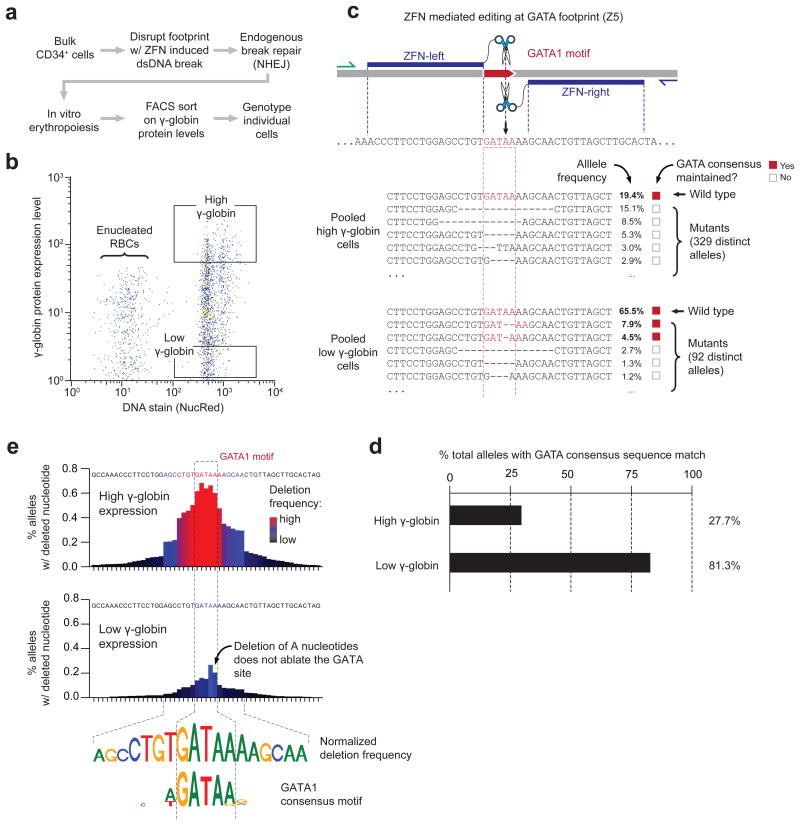
a) Experimental outline to link BCL11A enhancer genotypes to molecular phenotypes. b) Scatterplot of fluorescence-activated cell sorting (FACS) of in vitro generated erythrocytes following targeted disruption of footprint 5 within the +58 DHS using ZFNs. Boxes indicated the FACS gates used to isolate populations of erythroblasts bearing high and low levels of γ-globin protein. c) Top, diagram of the engineered specificity of ZFN pair Z5. Blue indicates the predicted binding sites for the individual ZFN monomers. Bottom, genotypes derived from the alleles present in the low and high γ-globin protein expressing cells edited with ZFN Z5. d) Proportion of total alleles genotyped that retain a match to the GATA1 consensus sequence in low and high γ-globin protein expressing cells. e) Meta-analysis of deep sequencing data on cells containing high vs. low levels of γ-globin reveals the precise boundaries of a GATA1 binding site. The two bar charts plot the frequency for which a given base pair is deleted in high and low γ-globin-containing erythroblasts (top and bottom, respectively). The top panel on the right plots the difference between the data in the left two panels for each base pair. The weblogos (bottom) show the normalized (high minus low γ-globin) nucleotide deletion frequency compared to the idealized GATA1 consensus sequence.
References
Publication types
MeSH terms
Substances
Grants and funding
LinkOut - more resources
Full Text Sources
Other Literature Sources
Miscellaneous
