Increased B-type-natriuretic peptide promotes myocardial cell apoptosis via the B-type-natriuretic peptide/long non-coding RNA LSINCT5/caspase-1/interleukin 1β signaling pathway
- PMID: 26323562
- PMCID: PMC4626192
- DOI: 10.3892/mmr.2015.4247
Increased B-type-natriuretic peptide promotes myocardial cell apoptosis via the B-type-natriuretic peptide/long non-coding RNA LSINCT5/caspase-1/interleukin 1β signaling pathway
Abstract
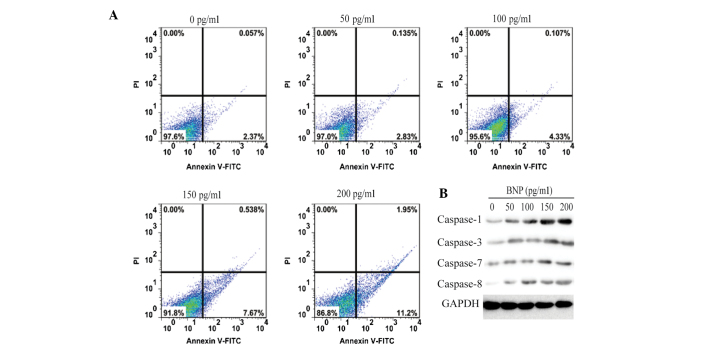
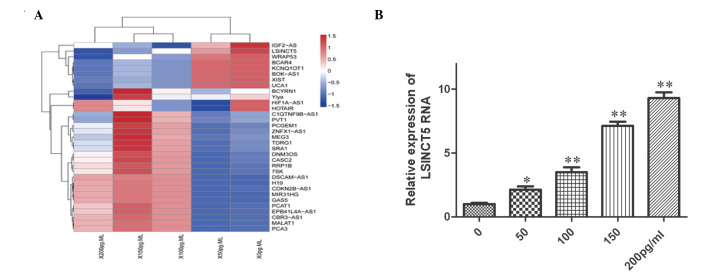
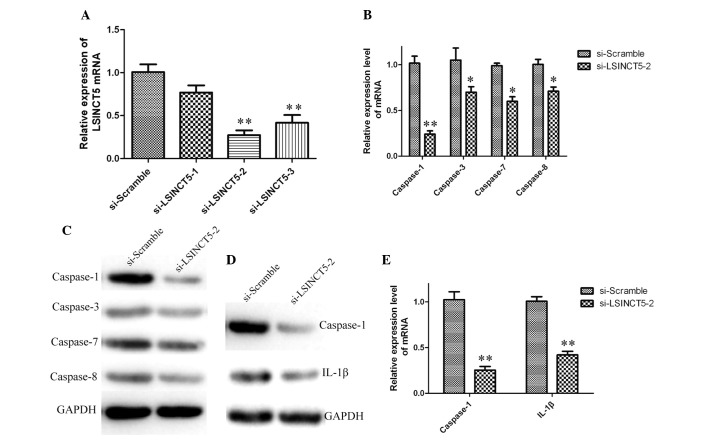
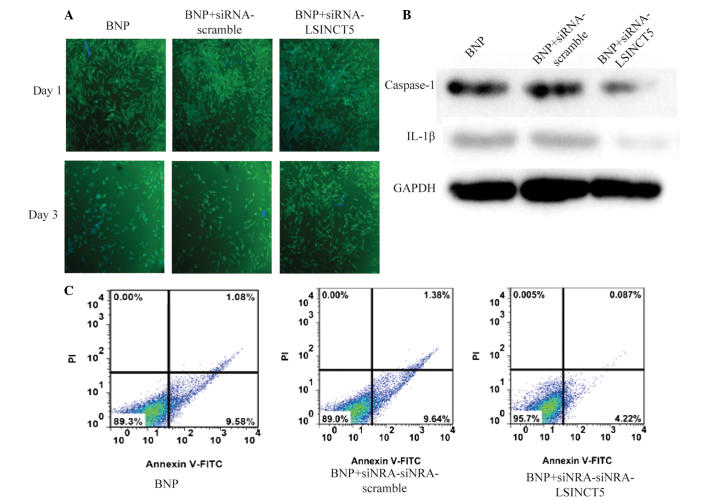
Chronic heart failure (CHF) is the final stage of various heart diseases, and is increasingly recognized as a major health problem in the elderly. Previous studies demonstrated that B‑type‑natriuretic peptide (BNP) is an established biomarker of CHF. Furthermore, BNP also regulates cell proliferation, differentiation and apoptosis. Recent evidence has revealed that BNP affects myocardial cell apoptosis during myocardial ischemia‑reperfusion injury. Long non‑coding RNAs (lncRNAs) are emerging as novel molecular compounds involved in gene regulation, and have important roles in numerous human diseases. However, the mechanism underlying the BNP and lncRNA-induced regulation of myocardial cell apoptosis remains to be elucidated. The present study reported that lncRNA LSINCT5, upregulated by BNP, is able to regulate myocardial cell apoptosis via the activation of the caspase‑1/interleukin (IL)‑1β signaling pathway. BNP-induced apoptosis of HCM cells was observed using flow cytometry, and involved caspase‑1. In addition, expression profiling using a human lncRNA polymerase chain reaction array revealed that LSINCT5 was highly expressed in BNP-treated myocardial cells, as compared with untreated cells. The role of lncRNA LSINCT5 in HCM cell apoptosis was also investigated. The results of the present study indicated that LSINCT5 silencing by small interfering RNA inhibits caspase‑1/IL‑1β signaling, and suppresses apoptosis in BNP-treated HCM cells. Therefore, high expression levels of BNP promote the apoptosis of myocardial cells through the lncRNA LSINCT5 mediator, which activates the caspase‑1/IL‑1β signaling pathway. These findings uncovered a novel pathogenic mechanism, and provided a potential therapeutic target for CHF.
Figures
References
-
- Granger CB, McMurray JJ, Yusuf S, Held P, Michelson EL, Olofsson B, Ostergren J, Pfeffer MA, Swedberg K, CHARM Investigators Committees Effects of candesartan in patients with chronic heart failure and reduced left-ventricular systolic function intolerant to angiotensin-converting-enzyme inhibitors: The CHARM-Alternative trial. Lancet. 2003;362:772–776. doi: 10.1016/S0140-6736(03)14284-5. - DOI - PubMed
-
- Gu D, Huang G, He J. Investigation of prevalence and distributing feature of chronic heart failure in Chinese adult population. Zhonghua Xin Xue Guan Bing Za Zhi. 2002;31:3–6. In Chinese.
-
- Yancy CW, Jessup M, Bozkurt B, Butler J, Casey DE, Jr, Drazner MH, Fonarow GC, Geraci SA, Horwich T, Januzzi JL, et al. American College of Cardiology Foundation. American Heart Association Task Force on Practice Guidelines: 2013 ACCF/AHA guideline for the management of heart failure: A report of the American college of cardiology foundation/american heart association task force on practice guidelines. J Am Coll Cardiol. 2013;62:e147–e239. doi: 10.1016/j.jacc.2013.05.019. - DOI - PubMed
-
- Ishino M, Takeishi Y, Niizeki T, Watanabe T, Nitobe J, Miyamoto T, Miyashita T, Kitahara T, Suzuki S, Sasaki T, et al. Risk stratification of chronic heart failure patients by multiple biomarkers: Implications of BNP, H-FABP and PTX3. Circ J. 2008;72:1800–1805. doi: 10.1253/circj.CJ-08-0157. - DOI - PubMed
MeSH terms
Substances
LinkOut - more resources
Full Text Sources
Other Literature Sources