. 2016 Apr;48(2):698-707.
doi: 10.4143/crt.2015.118. Epub 2015 Aug 12.

BRAF-Activated Long Noncoding RNA Modulates Papillary Thyroid Carcinoma Cell Proliferation through Regulating Thyroid Stimulating Hormone Receptor

Affiliations

BRAF-Activated Long Noncoding RNA Modulates Papillary Thyroid Carcinoma Cell Proliferation through Regulating Thyroid Stimulating Hormone Receptor

Haitao Zheng et al. Cancer Res Treat. 2016 Apr.

Abstract

Purpose: The importance of long noncoding RNAs (lncRNAs) in tumorigenesis has recently been demonstrated. However, the role of lncRNAs in development of thyroid cancer remains largely unknown.

Materials and methods: Using quantitative reverse transcription polymerase chain reaction, expression of three lncRNAs, including BRAF-activated long noncoding RNA (BANCR), papillary thyroid cancer susceptibility candidate 3 (PTCSC3), and noncoding RNA associated with mitogen-activated protein kinase pathway and growth arrest (NAMA), was investigated in the current study.

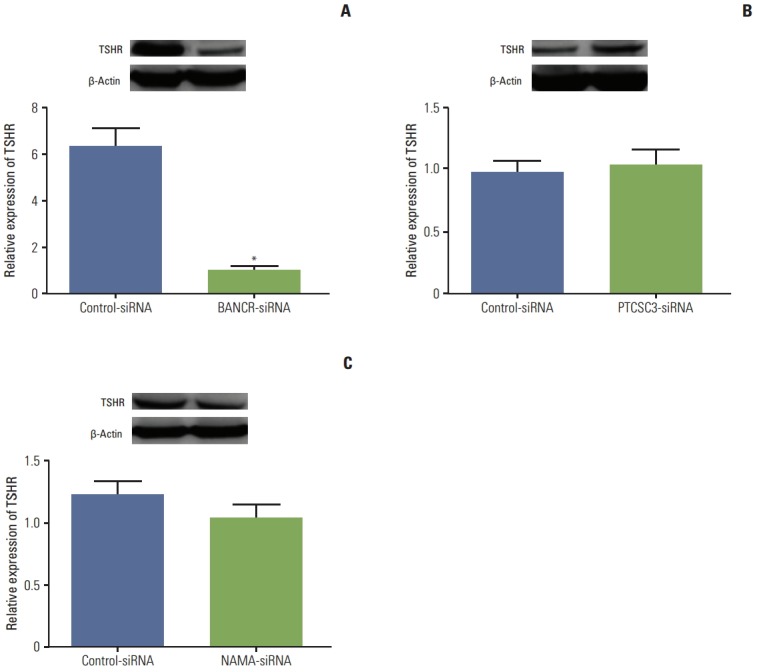
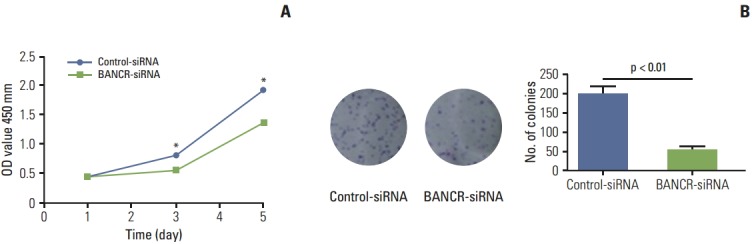
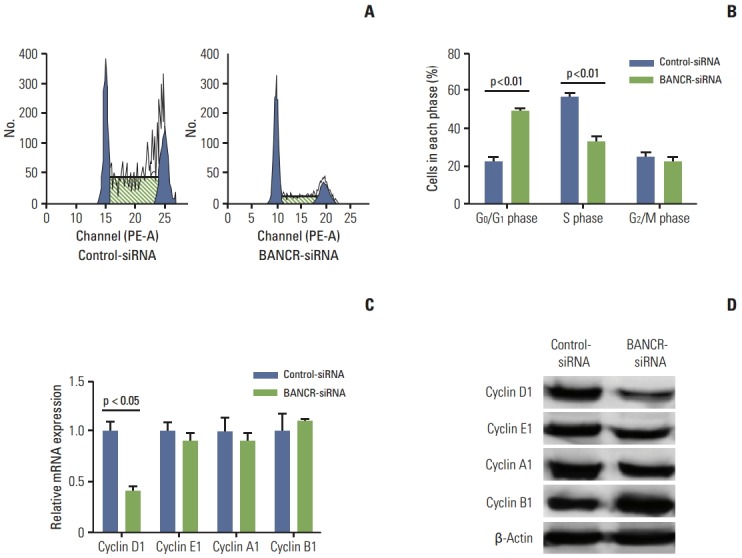
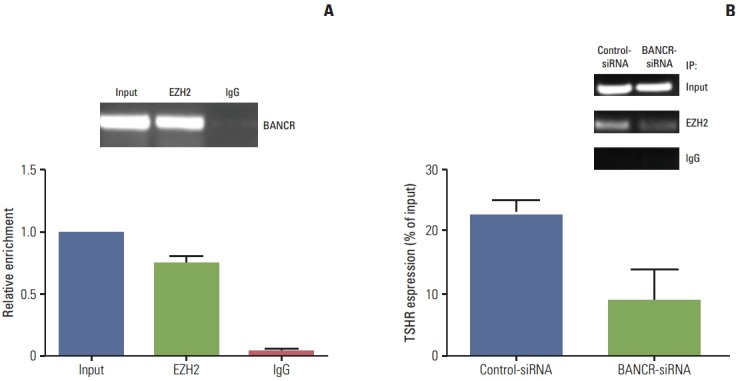
Results: Of the three lncRNAs (BANCR, PTCSC3, and NAMA), expression of BANCR was significantly up-regulated while PTCSC3 and NAMA were significantly down-regulated in papillary thyroid carcinoma (PTC) compared to that in normal tissue. BANCR-knockdown in a PTC-derived cell line (IHH-4) resulted in significant suppression of thyroid stimulating hormone receptor (TSHR). BANCR-knockdown also led to inhibition of cell growth and cell cycle arrest at G0/G1 phase through down-regulation of cyclin D1. In addition, BANCR was enriched by polycomb enhancer of zeste homolog 2 (EZH2), and silencing BANCR led to decreased chromatin recruitment of EZH2, which resulted significantly reduced expression of TSHR.

Conclusion: These findings indicate that BANCR may contribute to the tumorigenesis of PTC through regulation of cyclin D1 and TSHR.

Keywords: BRAF-activated long noncoding RNA; Long noncoding RNA; Thyroid neoplasms.


Conflict of interest statement

Conflict of interest relevant to this article was not reported.

Figures
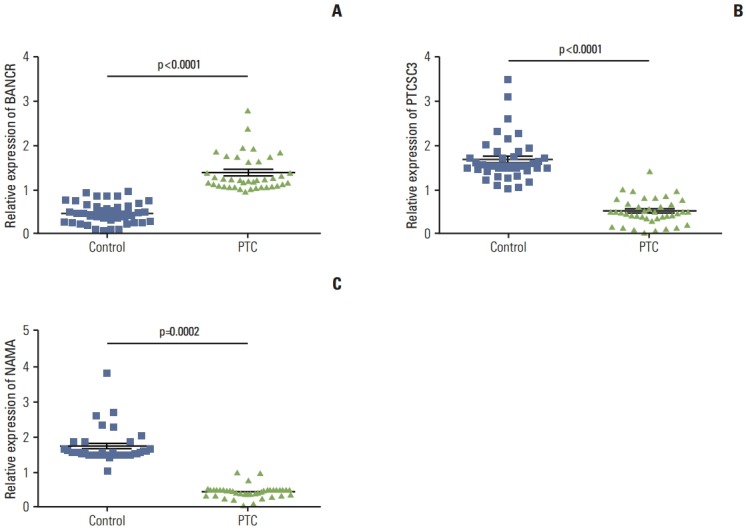
Fig. 1.
Fig. 1.
Expression of long noncoding RNAs (lncRNAs) in papillary thyroid carcinoma (PTC) in comparison to adjacent normal tissue. Total RNA was extracted from PTC tissue and its adjacent normal tissue, and expression of BRAF-activated long noncoding RNA (BANCR) (A), papillary thyroid cancer susceptibility candidate 3 (PTCSC3) (B), and noncoding RNA associated with mitogen-activated protein kinase pathway and growth arrest (NAMA) (C) was quantified as described in the methods. 18s RNA was used as an internal control and data were expressed as relative expression of the lncRNA in the tumor versus respective adjacent normal tissue. n=40 each comparison. Student’s t test was used for comparison of statistical difference.
Fig. 2.
Fig. 2.
Effect of lncRNAs on TSHR expression in in vitro cell culture. A PTC cell line (IHH-4) was transfected with either control-siRNA or a siRNA targeting BANCR (BANCR-siRNA) (A), PTCSC3 (PTCSC3-siRNA) (B), or NAMA (NAMA-siRNA) (C) as described in the methods. Total cell lysate was harvested after 48 hours additional culture. Expression of TSHR protein level was assessed by immunoblotting (inserts) followed by density analysis. β-Actin was used as a loading control. Data presented was an average of three separate experiments. lncRNAs, long noncoding RNAs; TSHR, thyroid stimulating hormone receptor; PTC, papillary thyroid carcinoma; BANCR, BRAF-activated long noncoding RNA; PTCSC3, papillary thyroid cancer susceptibility candidate 3; NAMA, noncoding RNA associated with MAP kinase pathway and growth arrest. *p < 0.01 compared to control-siRNA treated cells.
Fig. 3.
Fig. 3.
Effect of BANCR suppression on cell proliferation. A PTC cell line (IHH-4) was transfected with either control-siRNA or a siRNA targeting BANCR (BANCR-siRNA), cell proliferation was then assessed. (A) Cell proliferation assay by CCK-8. Following siRNA transfection, cells were plated into 96-well plates and allowed to grow for 5 days. Cell number was counted using a commercial kit (CCK-8) as described in the methods. *p < 0.05, **p < 0.01 by multi-group t test. (B) Clonogenic assay. Following transfection with siRNAs, cells were plated into 60-mm dishes and allowed to grow for 14 days and the number of colonies was counted as described in the methods. Data presented was representative of three separate experiments. BANCR, BRAF-activated long noncoding RNA; PTC, papillary thyroid carcinoma.
Fig. 4.
Fig. 4.
Effect of BANCR suppression on expression of cyclin proteins. (A, B) Cell cycle analysis by flow cytometry. IHH-4 cells were transfected with control-siRNA or a siRNA targeting BANCR (BANCR-siRNA). Following transfection with siRNAs, cells were allowed to grow for 48 hours and then trypsinized. After fixation and staining with propidium iodide, cell cycle and DNA content were analyzed by flow cytometry. Data presented was representative (analysis of triplicate samples) of three separate experiments. (C) mRNA expression. Total RNA was extracted 24 hours after completing transfection and mRNA expression of indicated cyclins was quantified by real time RT-PCR. (D) Immunoblotting for cyclin proteins. Cell lysate was harvested 48 hours after completing transfection, and levels of cyclin proteins were assessed by immunoblot as described in the methods. β-Actin was used as a loading control. Data presented was representative of three separate experiments. BANCR, BRAF-activated long noncoding RNA; RT-PCR, reverse transcription polymerase chain reaction.
Fig. 5.
Fig. 5.
Role of EZH2 in mediating BANCR regulation on TSHR. (A) RIP assay. Quantitative RT-PCR analysis of lncBANCR in the RIP from IHH-4 cells was performed using anti-EZH2 antibody and IgG as a negative control. Data presented was representative of three separate experiments. (B) ChIP assay. ChIP assay for IHH-4 cells transfected with control-siRNA or BANCR-siRNA was performed using anti-EZH2 antibody. Semi-quantitative polymerase chain reaction analysis was performed for amplification of associated DNA using primers specific for the TSHR promoter region. IgG indicated the negative control of immunoprecipitation. EZH2, enhancer of zeste homolog 2; BANCR, BRAF-activated long noncoding RNA; TSHR, thyroid stimulating hormone receptor; RIP, RNA immunoprecipitation; RT-PCR, reverse transcription polymerase chain reaction; ChIP, chromatin immunoprecipitation.
Fig. 6.
Fig. 6.
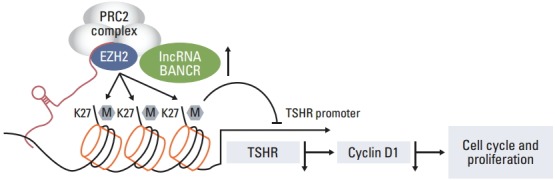
Schematic illustration of BANCR and EZH2 regulation on cyclin D1 expression. BANCR, BRAF-activated long noncoding RNA; EZH2, enhancer of zeste homolog 2. TSHR, thyroid stimulating hormone receptor.

References

    1. Davies L, Welch HG. Increasing incidence of thyroid cancer in the United States, 1973-2002. JAMA. 2006;295:2164–7. - PubMed
    1. Davies L, Welch HG. Current thyroid cancer trends in the United States. JAMA Otolaryngol Head Neck Surg. 2014;140:317–22. - PubMed
    1. Wang Y, Guo Q, Zhao Y, Chen J, Wang S, Hu J, et al. BRAF-activated long non-coding RNA contributes to cell proliferation and activates autophagy in papillary thyroid carcinoma. Oncol Lett. 2014;8:1947–52. - PMC - PubMed
    1. Fan M, Li X, Jiang W, Huang Y, Li J, Wang Z. A long non-coding RNA, PTCSC3, as a tumor suppressor and a target of miRNAs in thyroid cancer cells. Exp Ther Med. 2013;5:1143–6. - PMC - PubMed
    1. Yoon H, He H, Nagy R, Davuluri R, Suster S, Schoenberg D, et al. Identification of a novel noncoding RNA gene, NAMA, that is downregulated in papillary thyroid carcinoma with BRAF mutation and associated with growth arrest. Int J Cancer. 2007;121:767–75. - PubMed

MeSH terms