


Association between work-related biomechanical risk factors and the occurrence of carpal tunnel syndrome: an overview of systematic reviews and a meta-analysis of current research
- PMID: 26323649
- PMCID: PMC4553935
- DOI: 10.1186/s12891-015-0685-0
Association between work-related biomechanical risk factors and the occurrence of carpal tunnel syndrome: an overview of systematic reviews and a meta-analysis of current research
Abstract
Background: Occupational risks for carpal tunnel syndrome (CTS) have been examined in various occupations, and several systematic reviews (SRs) have been published on this topic. There has been no critical appraisal or synthesis of the evidence in the SRs. The aims of this study are (1) to synthesise the observational evidence and evaluate the methodological quality of SRs that assess the effect of biomechanical risk factors on the development of CTS in workers, (2) to provide an update of current primary research on this association, (3) to assess a potential dose-response relationship.
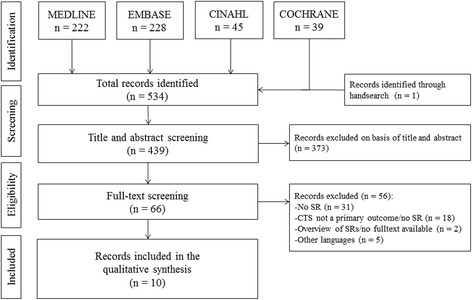
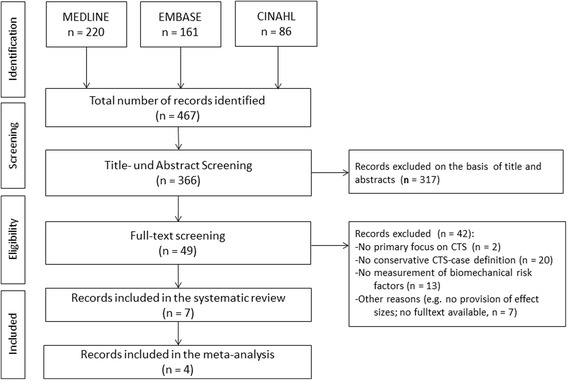
Methods: We searched MEDLINE, EMBASE, CINAHL, the Cochrane Library and the reference lists of articles. The first step covered SRs (1998-2014), and the second step covered current primary studies (2011-2014). The methodological quality of the SRs was evaluated by using the AMSTAR-R tool; primary studies were assessed using a list of 20 items. A qualitative approach was used for synthesising evidence. In addition, we undertook a meta-analysis of the primary studies to determine risk ratios in the dose-response relationship.
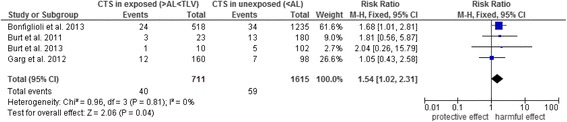
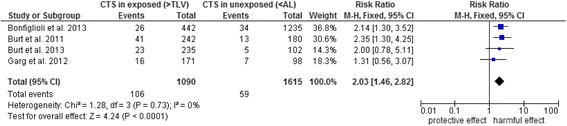
Results: We identified ten SRs that covered a total of 143 original studies. Seven primary studies met the criteria for inclusion, of which four provided longitudinal data. We found high quality of evidence for risk factors such as repetition, force and combined exposures. Moderate quality of evidence was observed for vibration, and low quality of evidence was found for wrist postures. An association between computer use and CTS could not be established. Recent primary studies supported the existence of a significant relationship between CTS and repetition, force and combined exposure. The meta-analysis of current research revealed a dose-response relationship between CTS and the American Conference of Governmental Industrial Hygienists' (ACGIH) threshold limit value (TLV) for hand-activity level (HAL). Those between the action limit and TLV and above TLV had RR of 1.5 (95% CI 1.02-2.31) and RR 2.0 (95% CI 1.46-2.82), respectively.
Conclusions: Occupational biomechanical factors play a substantial role in the causation of CTS. Data from current primary studies on dose-response suggest that the risk of CTS increases with the ACGIH TLV levels.
Figures
References
-
- Hegmann KT, Thiese MS, Wood EM, Garg A, Kapellusch JM, Foster J, Biggs J, Edwards H, Wertsch J, Kendall R. Impacts of differences in epidemiological case definitions on prevalence for upper-extremity musculoskeletal disorders. Hum Factors. 2014;56:191–202. doi: 10.1177/0018720813487202. - DOI - PubMed
Publication types
MeSH terms
LinkOut - more resources
Full Text Sources
Other Literature Sources
Medical
Research Materials
Miscellaneous
