


Progestins to control feline reproduction: Historical abuse of high doses and potentially safe use of low doses
- PMID: 26323797
- PMCID: PMC11148977
- DOI: 10.1177/1098612X15594987
Progestins to control feline reproduction: Historical abuse of high doses and potentially safe use of low doses
Abstract
Relevance: The high fertility rate of cats means that methods to control feline reproduction are a requirement for cat breeders and pet owners, as well as for those involved in the management of feral cat populations. Progestins continue to be used to prevent queens from cycling, and also as an adjunct or alternative to surgical sterilization within trap-neuter-return (TNR) programs.
Evidence base: A considerable body of information exists on megestrol acetate (MA) and medroxyprogesterone acetate (MPA), thanks to the many studies and case reports published in the scientific literature over the past 50 years documenting their clinical use in cats. Comparatively less is known about the use in cats of more recent progestins such as levonorgestrel, proligestone, delmadinone, chlormadinone and altrenogest.
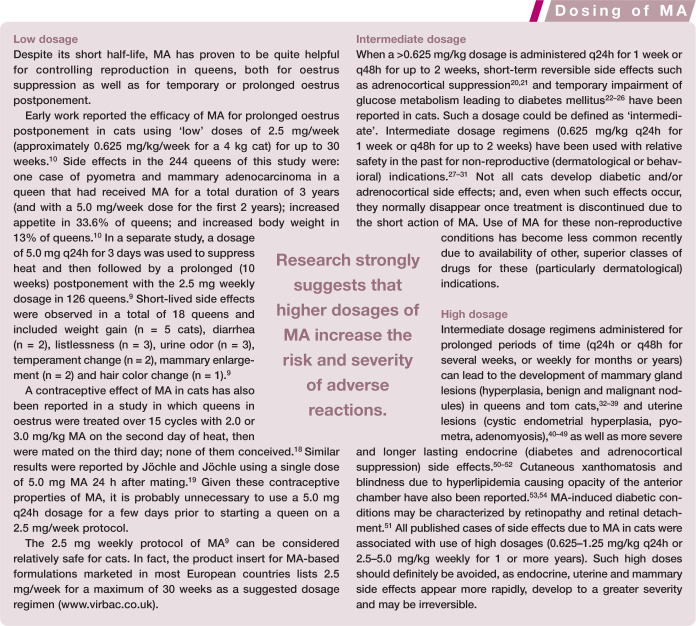
Dosing, safety and efficacy: Based on a combination of dose, frequency and duration of treatment, MA can be categorized into low (0.625 mg/kg/week for up to 30 weeks), medium (0.625 mg/kg q24h for 1 week or q48h for up to 2 weeks) and high (0.625 mg/kg q24h or q48h for several weeks, or weekly for months or years) dosages. Studies suggest that low dosages can be used relatively safely in cats, while higher dosages increase the risk and severity of adverse reactions. Early work showing that an oral MPA dosage of 0.01 mg/kg administered q24h for 12 months suppresses oestrus in queens effectively and safely has not been considered, and much higher MPA dosages (>6.25 mg/kg q24h) have been used in cats over the past 40 years.
Recommendations: Progestins should always be used with caution. Using the lowest possible dosages, MA and MPA may, however, continue to be used safely in pet queens as well as (in conjunction with TNR programs) for the control of feral cat colonies. More recent progestins appear to be effective and safe, albeit their efficacy and safety need to be further investigated.
© The Author(s) 2015.
Conflict of interest statement
The author has no conflict of interest to declare.
Figures




Comment in
- J Feline Med Surg. 2016 Mar;18(3):248-9
-
Use of megestrol in cats.J Feline Med Surg. 2016 Mar;18(3):248-9. doi: 10.1177/1098612X16631235. J Feline Med Surg. 2016. PMID: 26936496 Free PMC article. No abstract available.
References
-
- ASPCA. Pet statistics: How many pets are in the United States? How many animals are in shelters? https://www.aspca.org/about-us/faq/pet-statistics (2015, accessed 10 June, 2015).
-
- Natoli E, Maragliano L, Cariola G, et al. . Management of feral domestic cats in the urban environment of Rome (Italy). Prev Vet Med 2006; 77: 180–185. - PubMed
-
- Greenberg M, Lawler D, Zawistowski S, et al. . Low-dose megestrol acetate revisited: a viable adjunct to surgical sterilization in free roaming cats? Vet J 2013; 196: 304–308. - PubMed
Publication types
MeSH terms
Substances
LinkOut - more resources
Full Text Sources
Miscellaneous
