Cryptosporidium spp., Giardia intestinalis, and Enterocytozoon bieneusi in Captive Non-Human Primates in Qinling Mountains
- PMID: 26323837
- PMCID: PMC4566506
- DOI: 10.3347/kjp.2015.53.4.395
Cryptosporidium spp., Giardia intestinalis, and Enterocytozoon bieneusi in Captive Non-Human Primates in Qinling Mountains
Abstract
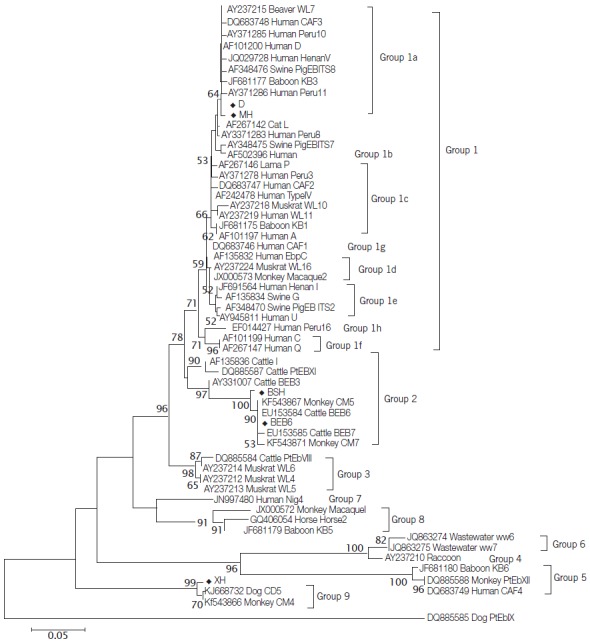
Non-human primates (NHPs) are confirmed as reservoirs of Cryptosporidium spp., Giardia intestinalis, and Enterocytozoon bieneusi. In this study, 197 fresh fecal samples from 8 NHP species in Qinling Mountains, northwestern China, were collected and examined using multilocus sequence typing (MLST) method. The results showed that 35 (17.8%) samples were positive for tested parasites, including Cryptosporidium spp. (3.0%), G. intestinalis (2.0%), and E. bieneusi (12.7%). Cryptosporidium spp. were detected in 6 fecal samples of Macaca mulatta, and were identified as C. parvum (n=1) and C. andersoni (n=5). Subtyping analysis showed Cryptosporidium spp. belonged to the C. andersoni MLST subtype (A4, A4, A4, and A1) and C. parvum 60 kDa glycoprotein (gp60) subtype IId A15G2R1. G. intestinalis assemblage E was detected in 3 M. mulatta and 1 Saimiri sciureus. Intra-variations were observed at the triose phosphate isomerase (tpi), beta giardin (bg), and glutamate dehydrogenase (gdh) loci, with 3, 1, and 2 new subtypes found in respective locus. E. bieneusi was found in Cercopithecus neglectus (25.0%), Papio hamadrayas (16.7%), M. mulatta (16.3%), S. sciureus (10%), and Rhinopithecus roxellana (9.5%), with 5 ribosomal internal transcribed spacer (ITS) genotypes: 2 known genotypes (D and BEB6) and 3 novel genotypes (MH, XH, and BSH). These findings indicated the presence of zoonotic potential of Cryptosporidium spp. and E. bieneusi in NHPs in Qinling Mountains. This is the first report of C. andersoni in NHPs. The present study provided basic information for control of cryptosporidiosis, giardiasis, and microsporidiosis in human and animals in this area.
Keywords: Cryptosporidium spp.; Enterocytozoon bieneusi; Giardia intestinalis; Qinling Mountains; captive non-human primate.
Conflict of interest statement
The authors declare that they have no competing interests.
Figures
References
-
- Xiao L, Fayer R. Molecular characterisation of species and genotypes of Cryptosporidium and Giardia and assessment of zoonotic transmission. Int J Parasitol. 2008;38:1239–1255. - PubMed
-
- Thellier M, Breton J. Enterocytozoon bieneusi in human and animals, focus on laboratory identification and molecular epidemiology. Parasite. 2008;15:349–358. - PubMed
-
- Fayer R. Taxonomy and species delimitation in Cryptosporidium. Exp Parasitol. 2010;124:90–97. - PubMed
-
- Ryan U, Caccio SM. Zoonotic potential of Giardia. Int J Parasitol. 2013;43:943–956. - PubMed
-
- Xiao L. Molecular epidemiology of cryptosporidiosis: an update. Exp Parasitol. 2010;124:80–89. - PubMed
Publication types
MeSH terms
LinkOut - more resources
Full Text Sources
Other Literature Sources
Medical
Molecular Biology Databases
Miscellaneous