


In Vivo T Cell Depletion with Myeloablative Regimens on Outcomes after Cord Blood Transplantation for Acute Lymphoblastic Leukemia in Children
- PMID: 26327630
- PMCID: PMC4639413
- DOI: 10.1016/j.bbmt.2015.08.022
In Vivo T Cell Depletion with Myeloablative Regimens on Outcomes after Cord Blood Transplantation for Acute Lymphoblastic Leukemia in Children
Abstract
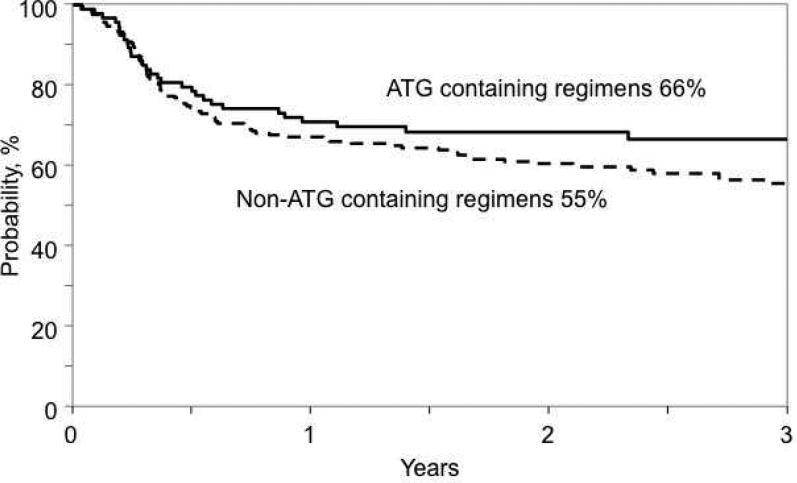
The inclusion of antithymocyte globulin (ATG) in cord blood transplantation is controversial. We evaluated outcomes according to ATG inclusion in 297 children and adolescents with acute lymphoblastic leukemia (ALL) who received myeloablative total body irradiation-based conditioning and either single-unit (74%) or double-unit (26%) grafts. Ninety-two patients (31%) received ATG and 205 (69%) did not. ATG recipients were more likely to be cytomegalovirus seronegative. The incidences of day 100 grades II to IV acute graft-versus-host disease (GVHD; 30% versus 54%, P = .0002) and chronic GVHD (22% versus 43%, P = .0008) were lower with ATG compared with non-ATG regimens. However, day 100 grades III to IV acute GVHD was comparable (11% versus 17%, P = .15). The 3-year incidences of transplant-related mortality (16% versus 17%, P = .98), relapse (17% versus 27%, P = .12), and leukemia-free survival (66% versus 55%, P = .23) in ATG and non-ATG recipients were similar. There were no differences in viral reactivation between treatment groups (60% versus 58%, P = .83). Therefore, the data suggest that incorporation of ATG with myeloablative conditioning regimens may be useful in reducing the risk of acute and chronic GVHD without any deleterious effect on transplant-related mortality, relapse, or leukemia-free survival in children and adolescents with ALL.
Keywords: Acute lymphoblastic leukemia; In vivo T cell depletion; Myeloablative conditioning.
Copyright © 2015 American Society for Blood and Marrow Transplantation. Published by Elsevier Inc. All rights reserved.
Figures


References
-
- Haidinger M, Geyeregger R, Poglitsch M, et al. Antithymocyte globulin impairs T-cell/antigen-presenting cell interaction: disruption of immunological synapse and conjugate formation. Transplantation. 2007;84(1):117–121. - PubMed
-
- Monti P, Allavena P, Di Carlo V, Piemonti L. Effects of anti-lymphocytes and anti-thymocytes globulin on human dendritic cells. Int Immunopharmacol. 2003;3(2):189–196. - PubMed
-
- Gillet-Hladky S, de Carvalho CM, Bernaud J, Bendahou C, Bloy C, Rigal D. Rabbit antithymocyte globulin inhibits monocyte-derived dendritic cells maturation in vitro and polarizes monocyte-derived dendritic cells towards tolerogenic dendritic cells expressing indoleamine 2,3-dioxygenase. Transplantation. 2006;82(7):965–974. - PubMed
-
- Fang L, Fehse B, Engel M, Zander A, Kroger N. Antithymocyte globulin induces ex vivo and in vivo depletion of myeloid and plasmacytoid dendritic cells. Transplantation. 2005;79(3):369–371. - PubMed
Publication types
MeSH terms
Substances
Grants and funding
LinkOut - more resources
Full Text Sources
Other Literature Sources
