


The Role of Adverse Event Reporting in the FDA Response to a Multistate Outbreak of Liver Disease Associated with a Dietary Supplement
- PMID: 26327730
- PMCID: PMC4529836
- DOI: 10.1177/003335491513000515
The Role of Adverse Event Reporting in the FDA Response to a Multistate Outbreak of Liver Disease Associated with a Dietary Supplement
Abstract
Objective: Liver disease is a potential complication from using dietary supplements. This study investigated an outbreak of non-viral liver disease associated with the use of OxyELITE Pro(TM), a dietary supplement used for weight loss and/or muscle building.
Methods: Illness details were ascertained from MedWatch reports submitted to the U.S. Food and Drug Administration (FDA) describing consumers who ingested OxyELITE Pro alone or in combination with other dietary supplements. FDA's Forensic Chemistry Center analyzed samples of OxyELITE Pro.
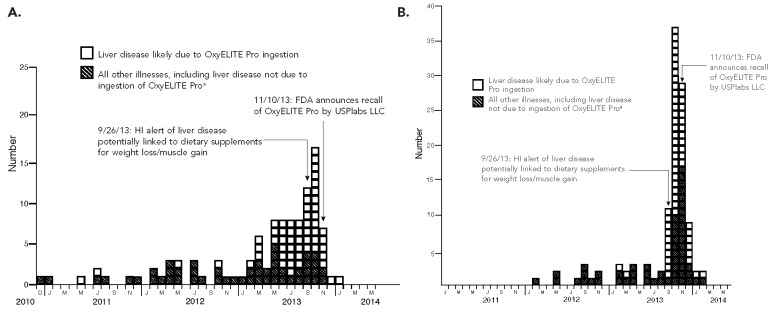
Results: From February 2012 to February 2014, FDA received 114 reports of adverse events of all kinds involving consumers who ingested OxyELITE Pro. The onset of illness for the first report was December 2010 and for the last report was January 2014. Thirty-three states, two foreign nations, and Puerto Rico submitted reports. Fifty-five of the reports (48%) described liver disease in the absence of viral infection, gallbladder disease, autoimmune disease, or other known causes of liver damage. A total of 33 (60%) of these patients were hospitalized, and three underwent liver transplantation. In early 2013, OxyELITE Pro products entered the market with a formulation distinct from products sold previously. The new formulation replaced 1,3-dimethylamylamine with aegeline. However, the manufacturer failed to submit to FDA a required "new dietary ingredient" notice for the use of aegeline in OxyELITE Pro products. Laboratory analysis identified no drugs, poisons, pharmaceuticals, toxic metals, usnic acid, N-Nitroso-fenfluramine, pyrrolizidine alkaloids, aristocholic acid, or phenethylamines in the products.
Conclusions: Vigilant surveillance is required for adverse events linked to the use of dietary supplements.
Figures
References
-
- Historical perspectives notifiable disease surveillance and notifiable disease statistics—United States, June 1946 and June 1996. MMWR Morb Mortal Wkly Rep. 1996;45(25):530–6. - PubMed
-
- Adams DA, Gallagher KM, Jajosky RA, Kriseman J, Sharp P, Anderson WJ, et al. Summary of notifiable diseases—United States, 2011 [published erratum appears in MMWR Morb Mortal Wkly Rep 2014;63(1):24] MMWR Morb Mortal Wkly Rep. 2013;60(53):1–117. - PubMed
-
- Park HS, Lloyd S, Decker RH, Wilson LD, Yu JB. Overview of the Surveillance, Epidemiology, and End Results database: evolution, data variables, and quality assurance. Curr Probl Cancer. 2012;36:183–90. - PubMed
-
- Woo EJ. Postmarketing safety of biologics and biological devices. Spine J. 2014;14:560–5. - PubMed
-
- Food and Drug Administration (US) Postmarketing requirements and commitments: introduction databases [cited 2014 Mar 27] Available from: URL: http://www.fda.gov/drugs/GuidanceComplianceRegulatoryInformation/post-ma....
MeSH terms
Substances
LinkOut - more resources
Full Text Sources
Other Literature Sources
Medical
