Review
. 2015 Aug 28;21(32):9512-25.
doi: 10.3748/wjg.v21.i32.9512.

Non-functional neuroendocrine tumors of the pancreas: Advances in diagnosis and management

Affiliations
Review

Non-functional neuroendocrine tumors of the pancreas: Advances in diagnosis and management

Jordan M Cloyd et al. World J Gastroenterol. .

Abstract

Nonfunctional neuroendocrine tumors of the pancreas (NF-PNETs) are a heterogeneous group of neoplasms. Although rare, the incidence of NF-PNETs is increasing significantly. The classification of PNETs has evolved over the past decades and is now based on a proliferation grading system. While most NF-PNETs are slow growing, tumors with more aggressive biology may become incurable once they progress to unresectable metastatic disease. Tumors of higher grade can be suspected preoperatively based on the presence of calcifications, hypoenhancement on arterial phase computed tomography, positron emission technology avidity and lack of octreotide scan uptake. Surgery is the only curative treatment and is recommended for most patients for whom complete resection is possible. Liver-directed therapies (thermal ablation, transarterial embolization) can be useful in controlling unresectable hepatic metastatic disease. In the presence of unresectable progressive disease, somatostatin analogues, everolimus and sunitinib can prolong progression-free survival. This article provides a comprehensive review of NF-PNETs with special emphasis on recent advances in diagnosis and management.

Keywords: Islet cell; Neuroendocrine carcinoma; Neuroendocrine tumor; Octreotide; Pancreas.


Figures
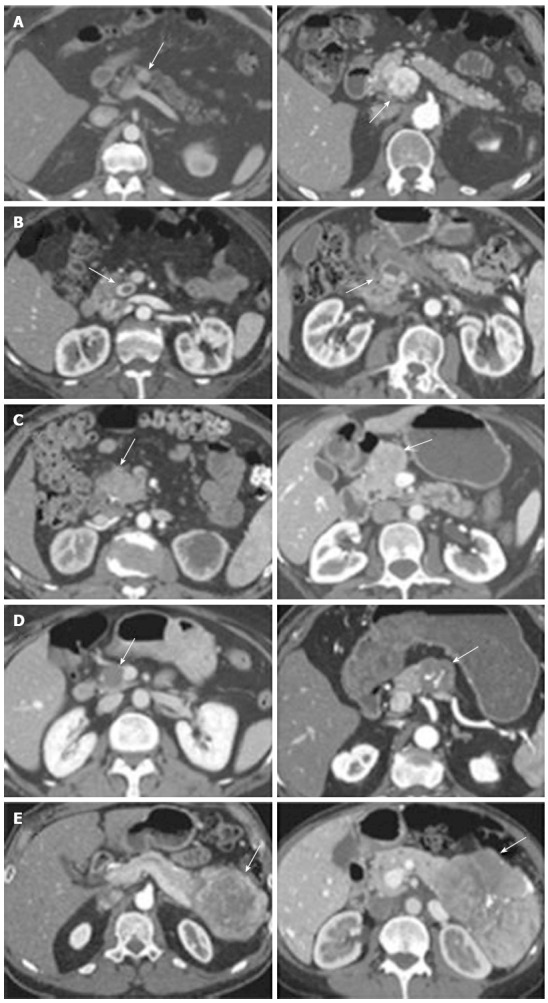
Figure 1
Figure 1
Representative images of the 5 types of pancreatic neuroendocrine tumor enhancement pattern on arterial phase computed tomography. Two images are shown for each type. A: Hyperenhancing, solid; B: Cystic with hyperenhancing rim; C: Isoenhancing or no mass visualized; D: Homogeneously hypoenhancing; E: Heterogeneous but mostly hypoenhancing with some peripheral enhancement. Groups D and E had worse survival after resection compared with groups A, B, and C (From Worhunsky et al[35]. Pancreatic neuroendocrine tumours: hypoenhancement on arterial phase computed tomography predicts biological aggressiveness. HPB 2014; 16: 304-311). Arrows indicate PNET.
Figure 2
Figure 2
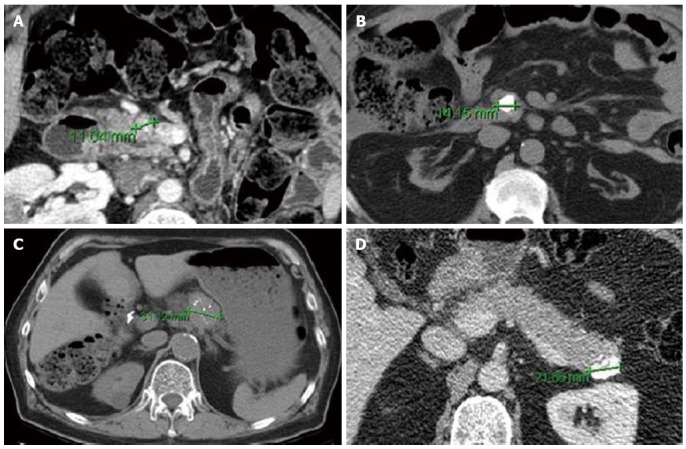
Axial computed tomography images of Pancreatic neuroendocrine tumor with punctate (A, C) and dense/coarse calcifications (B, D). Despite their small size, all lesions were associated with either lymph node metastasis (A-C) or intermediate (G2) grade (B-D) on pathologic evaluation (From Poultsides et al[36]. Pancreatic Neuroendocrine Tumors: Radiographic Calcifications Correlate with Grade and Metastasis. Ann Surg Onc 2012; 19: 2295-2303).
Figure 3
Figure 3
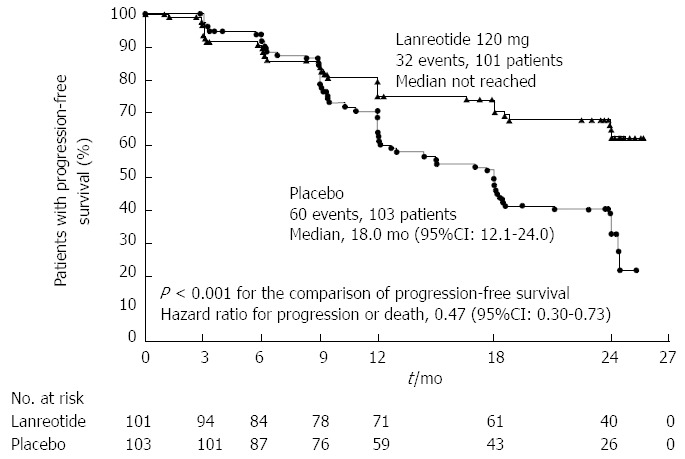
Results of the Clarinet trial which randomized patients with enteropancreatic neuroendocrine tumors to lanreotide vs placebo. From: Caplin et al[80]. Lanreotide in Metastatic Enteropancreatic Neuroendocrine Tumors. N Engl J Med 2014; 371: 224-233.
Figure 4
Figure 4
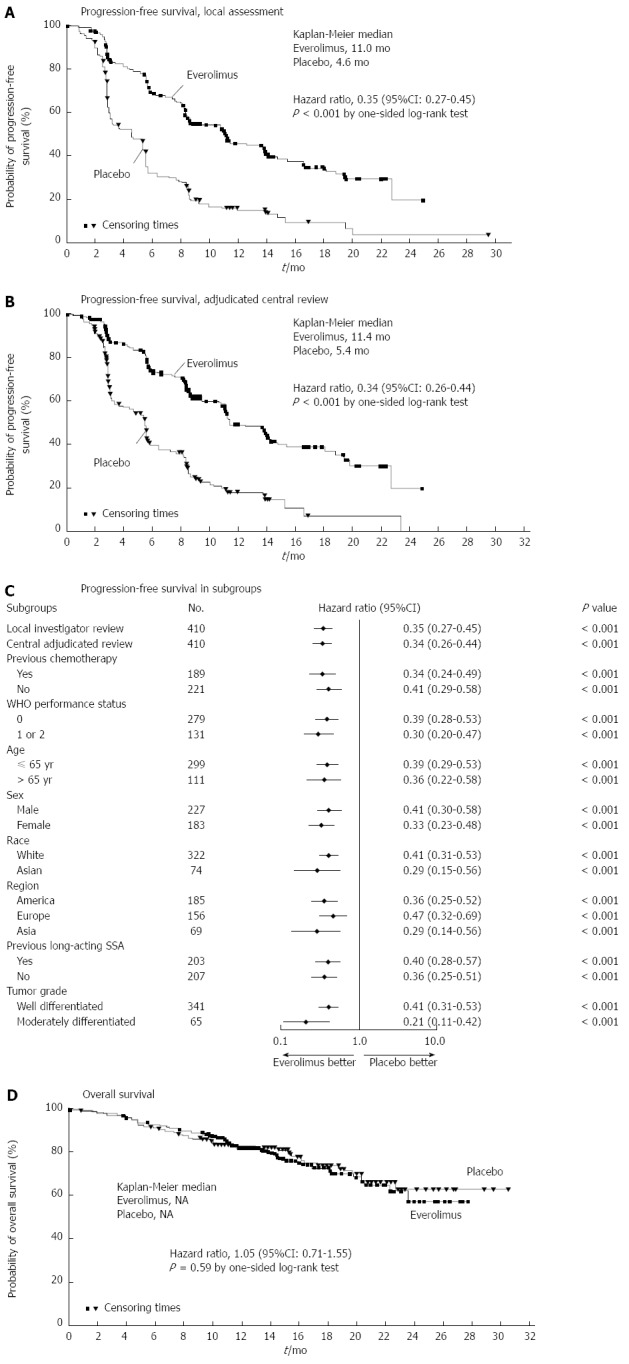
Results of the RADIANT-3 trial which randomized patients with nonfunctional neuroendocrine tumors of the pancreas to Everolimus vs placebo. From Yao et al[94]. Everolimus for Advanced Pancreatic Neuroendocrine Tumors. N Engl J Med 2011; 364: 514-523.
Figure 5
Figure 5
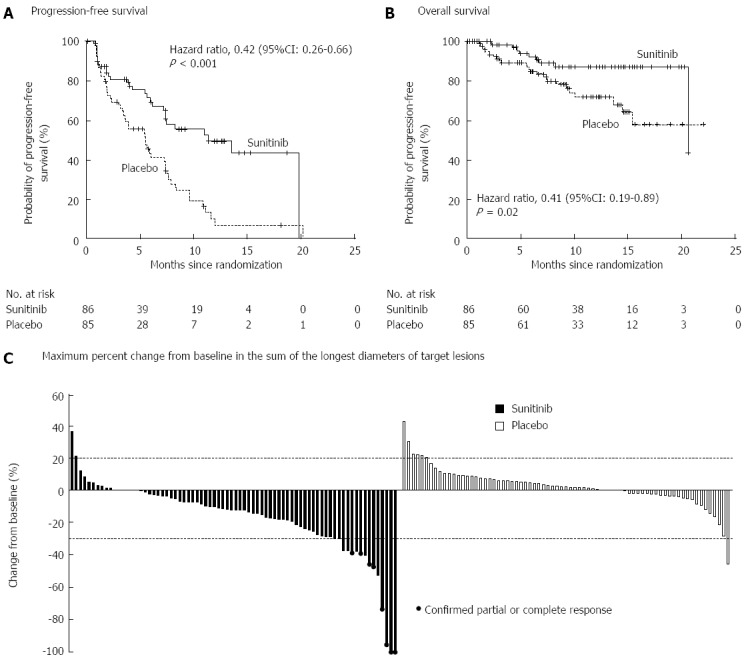
Results of a randomized controlled trial of Sunitinib vs placebo for well-differentiated pancreatic neuroendocrine tumors demonstrating (A) progression free survival and (B) overall survival. From: Raymond et al[98]. Sunitinib Malate for the Treatment of Pancreatic Neuroendocrine Tumors. N Engl J Med 2011; 364: 501-513.

References

    1. Lawrence B, Gustafsson BI, Chan A, Svejda B, Kidd M, Modlin IM. The epidemiology of gastroenteropancreatic neuroendocrine tumors. Endocrinol Metab Clin North Am. 2011;40:1–18, vii. - PubMed
    1. Halfdanarson TR, Rabe KG, Rubin J, Petersen GM. Pancreatic neuroendocrine tumors (PNETs): incidence, prognosis and recent trend toward improved survival. Ann Oncol. 2008;19:1727–1733. - PMC - PubMed
    1. Metz DC, Jensen RT. Gastrointestinal neuroendocrine tumors: pancreatic endocrine tumors. Gastroenterology. 2008;135:1469–1492. - PMC - PubMed
    1. Hallet J, Law CH, Cukier M, Saskin R, Liu N, Singh S. Exploring the rising incidence of neuroendocrine tumors: a population-based analysis of epidemiology, metastatic presentation, and outcomes. Cancer. 2015;121:589–597. - PubMed
    1. Kimura W, Kuroda A, Morioka Y. Clinical pathology of endocrine tumors of the pancreas. Analysis of autopsy cases. Dig Dis Sci. 1991;36:933–942. - PubMed

MeSH terms

Substances