


Assessment of Nutritional Status of Nepalese Hemodialysis Patients by Anthropometric Examinations and Modified Quantitative Subjective Global Assessment
- PMID: 26327781
- PMCID: PMC4536772
- DOI: 10.4137/NMi.S27640
Assessment of Nutritional Status of Nepalese Hemodialysis Patients by Anthropometric Examinations and Modified Quantitative Subjective Global Assessment
Abstract
Objective: To assess the nutritional status of patients on maintenance hemodialysis by using modified quantitative subjective global assessment (MQSGA) and anthropometric measurements.
Method: We Conducted a cross sectional descriptive analytical study to assess the nutritional status of fifty four patients with chronic kidney disease undergoing maintenance hemodialysis by using MQSGA and different anthropometric and laboratory measurements like body mass index (BMI), mid-arm circumference (MAC), mid-arm muscle circumference (MAMC), triceps skin fold (TSF) and biceps skin fold (BSF), serum albumin, C-reactive protein (CRP) and lipid profile in a government tertiary hospital at Kathmandu, Nepal.
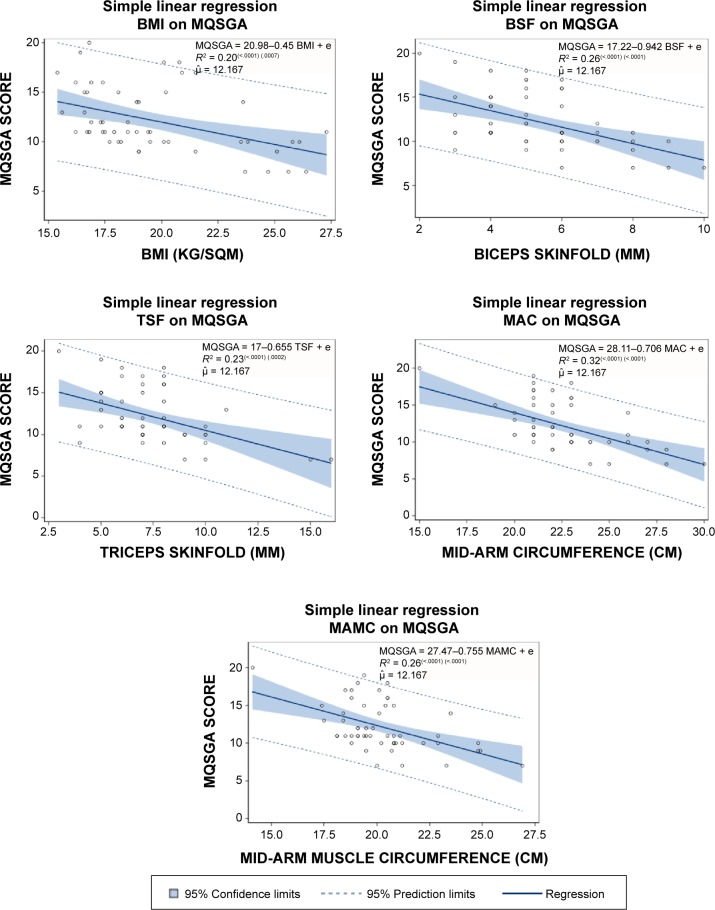
Results: Based on MQSGA criteria, 66.7% of the patients suffered from mild to moderate malnutrition and 33.3% were well nourished. None of the patients were severely malnourished. CRP was positive in 56.3% patients. Serum albumin, MAC and BMI were (mean + SD) 4.0 + 0.3 mg/dl, 22 + 2.6 cm and 19.6 ± 3.2 kg/m(2) respectively. MQSGA showed negative correlation with MAC (r = -0.563; P = <0.001), BMI (r = -0.448; P = <0.001), MAMC (r = -0.506; P = <.0001), TSF (r = -0.483; P = <.0002), and BSF (r = -0.508; P = <0.0001). Negative correlation of MQSGA was also found with total cholesterol, triglyceride, LDL cholesterol and HDL cholesterol without any statistical significance.
Conclusion: Mild to moderate malnutrition was found to be present in two thirds of the patients undergoing hemodialysis. Anthropometric measurements like BMI, MAC, MAMC, BSF and TSF were negatively correlated with MQSGA. Anthropometric and laboratory assessment tools could be used for nutritional assessment as they are relatively easier, cheaper and practical markers of nutritional status.
Keywords: CKD; MQSGA; anthropometric measuremen; hemodialysis; nutritional status.
Figures
References
-
- National Kidney Foundation (NKF)/kidney disease outcome quality initiative (K/DOQI) K/DOQI clinical practice guidelines for chronic kidney disease: evaluation, classification and stratification. Am J Kidney Dis. 2002;39(suppl 1):S1–S266. - PubMed
-
- Must A, Dallal GE, Dietz WH. Reference data for obesity: 85th and 95th percentile for body mass index (wt/ht2) and triceps skin fold thickness. Am J Clin Nutr. 1991;53:839–846. - PubMed
-
- Indian Society of Nephrology. Guidelines for the management of nutrition. Indian J Nephrol. 2005;15(Supl 1):S42–S46.
-
- Todigo G, Aparicio M, Attman P-O, et al. Expert working group report on nutrition in adult patients with renal insufficiency (part 1 of 2) Clin Nutr. 2000;19(3):197–207. - PubMed
-
- Kopple JD. Nutritional status as a predictor of morbidity and mortality in maintenance dialysis patients. ASAIO J. 1997;43(3):246–250. - PubMed
LinkOut - more resources
Full Text Sources
Research Materials
Miscellaneous
