


Plant-derived neuroprotective agents in Parkinson's disease
- PMID: 26328004
- PMCID: PMC4548312
Plant-derived neuroprotective agents in Parkinson's disease
Abstract
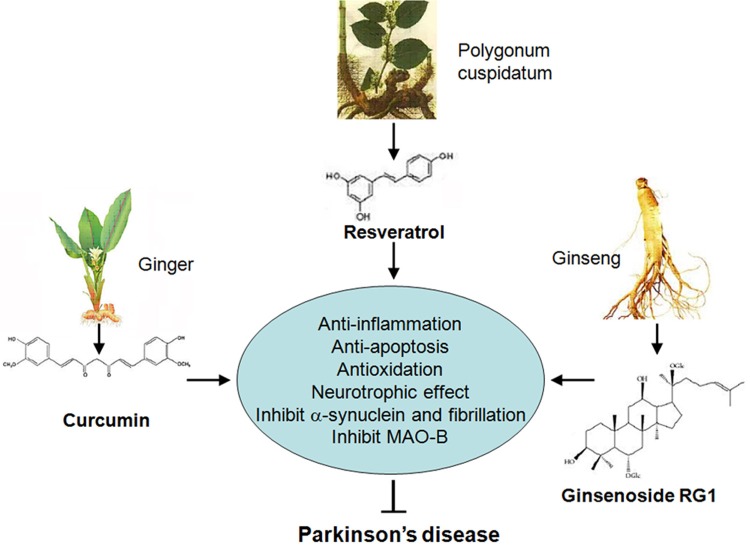
Parkinson's disease (PD) is one of the most common degenerative disorders of the central nervous system among the elderly. The disease is caused by the slow deterioration of the dopaminergic neurons in the substantia nigra. Treatment strategies to protect dopaminergic neurons from progressive damage have received much attention. However there is no effective treatment for PD. Traditional Chinese medicines have shown potential clinical efficacy in attenuating the progression of PD. Increasing evidence indicates that constituents of some Chinese herbs include resveratrol, curcumin, and ginsenoside can be neuroprotective. Since pathologic processes in PD including inflammation, oxidative stress, apoptosis, mitochondrial dysfunction, and genetic factors lead to neuronal degeneration, and these Chinese herbs can protect dopaminergic neurons from neuronal degeneration, in this article, we review the neuroprotective roles of these herbs and summarize their anti-inflammatory, antioxidant, and anti-apoptotic effects in PD. In addition, we discuss their possible mechanisms of action in in vivo and in vitro models of PD. Traditional Chinese medicinal herbs, with their low toxicity and side-effects, have become the potential therapeutic interventions for prevention and treatment of PD and other neurodegenerative diseases.
Keywords: Chinese herbs; Parkinson’s disease; curcumin; ginsenoside; neuroprotection; resveratrol.
Figures
References
-
- Dauer W, Przedborski S. Parkinson’s disease: mechanisms and models. Neuron. 2003;39:889–909. - PubMed
-
- Fu W, Zheng Z, Zhuang W, Chen D, Wang X, Sun X, Wang X. Neural metabolite changes in corpus striatum after rat multipotent mesenchymal stem cells transplanted in hemiparkinsonian rats by magnetic resonance spectroscopy. Int J Neurosci. 2013;123:883–891. - PubMed
-
- Buzhor E, Leshansky L, Blumenthal J, Barash H, Warshawsky D, Mazor Y, Shtrichman R. Cell-based therapy approaches: the hope for incurable diseases. Regen Med. 2014;9:649–672. - PubMed
-
- Virmani V, Pinto L, Binienda Z, Ali S. Food, nutrigenomics, and neurodegeneration--neuroprotection by what you eat! Mol Neurobiol. 2013;48:353–362. - PubMed
Publication types
LinkOut - more resources
Full Text Sources