


Who Will Walk Again? Effects of Rehabilitation on the Ambulatory Status in Elderly Patients Undergoing Hemiarthroplasty for Femoral Neck Fracture
- PMID: 26328231
- PMCID: PMC4536504
- DOI: 10.1177/2151458515583111
Who Will Walk Again? Effects of Rehabilitation on the Ambulatory Status in Elderly Patients Undergoing Hemiarthroplasty for Femoral Neck Fracture
Abstract
Introduction: Femoral neck fractures in elderly patients result in significant reduction in mobility. Deconditioning takes place quickly without early ambulation postsurgery. A recent Cochrane review found inconclusive evidence on the rehabilitation protocol required to effectively restore patients' prefracture mobility status. This study was conducted to determine the effects of different rehabilitation approaches on the functional and mobility outcomes of elderly patients after hip hemiarthroplasty for femoral neck fractures.
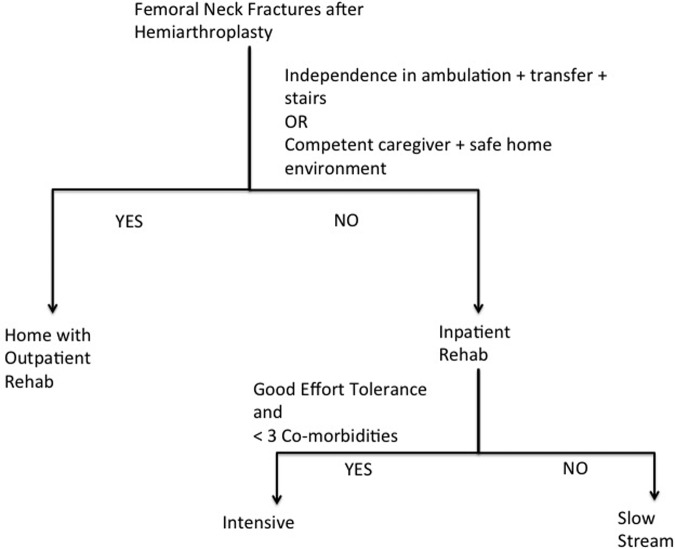
Materials and methods: We enrolled consecutive patients aged >65 years, admitted into a tertiary orthopedic unit from January to December 2010, who had undergone hip hemiarthroplasty. They were divided into 3 cohorts: (a) home with outpatient rehabilitation, (b) intensive short rehabilitation, and (c) extended slow-stream rehabilitation. Clinical variables were collected along with outcome variables of Modified Harris Hip Score, Parker Mobility Score (PMS), and the return to near premorbid ambulatory status at 1 year (PMS decrease of ≤2).
Results: A total of 133 patients were recruited and followed up for a year. The 3 cohorts were found to be comparable for prefall cardiovascular diseases, PMS, and Katz Index, although it was found that in the slow-stream cohort, there was a greater percentage of patients with previous cerebrovascular accidents. Patients in the intensive short rehabilitation cohort were found to have a higher proportion of patients returning to prefracture mobility, with the odds ratio of 2.3478 (95% confidence interval: 1.0667 to 5.1674; P = .042) after multivariate analysis.
Conclusions: Elderly patients >65 years who had undergone hemiarthroplasty would likely benefit most from an intensive inpatient rehabilitation program.
Keywords: ambulatory status; fragility hip fractures; hemiarthroplasty; osteoporosis; rehabilitation.
Conflict of interest statement
Figures
References
-
- Pasco JA, Sanders KM, Hoekstra FM, Henry MJ, Nicholson GC, Kotowicz MA. The human cost of fracture. Osteoporos Int. 2005;16(12):2046–2052. - PubMed
-
- Oldmeadow LB, Edwards ER, Kimmel LA, et al. No rest for the wounded: early ambulation after hip surgery accelerates recovery. ANZ J Surg. 2006;76(7):607–611. - PubMed
-
- Sherrington C, Lord SR, Herbert RD. A randomized controlled trial of weight-bearing versus non-weight-bearing exercise for improving physical ability after usual care for hip fracture. Arch Phys Med Rehabil. 2004;85(5):710–716. - PubMed
-
- Vidan M, Serra JA, Moreno C, Riquelme G, Ortiz J. Efficacy of a comprehensive geriatric intervention in older patients hospitalized for hip fracture: a randomized, controlled trial. J Am Geriatr Soc. 2005;53(9):1476–1482. - PubMed
LinkOut - more resources
Full Text Sources
Other Literature Sources
