


Organic cation transporter 2 for predicting cisplatin-based neoadjuvant chemotherapy response in gastric cancer
- PMID: 26328259
- PMCID: PMC4548340
Organic cation transporter 2 for predicting cisplatin-based neoadjuvant chemotherapy response in gastric cancer
Abstract
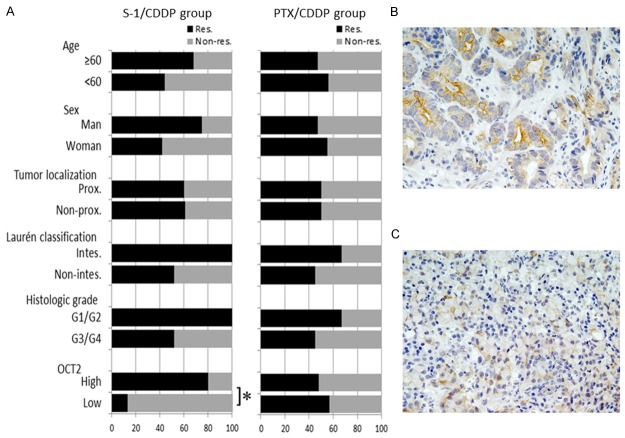
Some studies have shown the usability of neoadjuvant chemotherapy (NAC) in gastric cancer (GC). Nevertheless there are a few predictive markers of the effectiveness of NAC in GC. The aim of this study is to assess the predictive impact of organic cation transporter 2 (OCT2) expression on response to neoadjuvant chemotherapy (NAC) in gastric cancer. We retrospectively assessed 66 patients with advanced gastric cancer received NAC with S-1/cisplatin or paclitaxel/cisplatin. Expression levels of OCT2 were assessed by immunohistochemistry in pre-chemotherapy biopsies and correlated with clinicopathologic parameters including pathologic response. High expression level of OCT2 (OCT2(high)) was significantly associated with intestinal type according to Laurén classification (P = 0.03) and low histologic grade (P = 0.03). In univariate analysis of the entire cohort, no variables showed any significant association with a response, although intestinal type (P = 0.09), low histologic grade (P = 0.09), and OCT2(high) (P = 0.07) tended to be more frequent in responders compared with non-responders. When the two treatment groups were separately assessed in the univariate analysis, a significantly higher rate of OCT2(high) was observed in responders compared with non-responders in the S-1/cisplatin group (P = 0.001). In addition, multivariate analysis identified OCT2(high) as the sole independent predictor of response (P = 0.04). However, in the paclitaxel/cisplatin group, no variables were associated with response. Taken together, our results suggest that OCT2(high) may represent a potential predictor of response to NAC with S-1/cisplatin in gastric cancer.
Keywords: Organic cation transporter 2; S-1 plus cisplatin; gastric cancer; immunohistochemistry; neoadjuvant chemotherapy.
Figures
References
-
- Siegel R, Ma J, Zou Z, Jemal A. Cancer statistics, 2014. CA Cancer J Clin. 2014;64:9–29. - PubMed
-
- Yoshikawa T, Rino Y, Yukawa N, Oshima T, Tsuburaya A, Masuda M. Neoadjuvant chemotherapy for gastric cancer in Japan: a standing position by comparing with adjuvant chemotherapy. Surg Today. 2014;44:11–21. - PubMed
-
- Yoshikawa T, Tsuburaya A, Morita S, Kodera Y, Ito S, Cho H, Miyashita Y, Sakamoto J. A comparison of multimodality treatment: two or four courses of paclitaxel plus cisplatin or S-1 plus cisplatin followed by surgery for locally advanced gastric cancer, a randomized Phase II trial (COMPASS) Jpn J Clin Oncol. 2010;40:369–372. - PubMed
-
- Tsuburaya A, Nagata N, Cho H, Hirabayashi N, Kobayashi M, Kojima H, Munakata Y, Fukushima R, Kameda Y, Shimoda T, Oba K, Sakamoto J. Phase II trial of paclitaxel and cisplatin as neoadjuvant chemotherapy for locally advanced gastric cancer. Cancer Chemother Pharmacol. 2013;71:1309–1314. - PubMed
-
- Yoshikawa T, Tanabe K, Nishikawa K, Ito Y, Matsui T, Kimura Y, Hirabayashi N, Mikata S, Iwahashi M, Fukushima R, Takiguchi N, Miyashiro I, Morita S, Miyashita Y, Tsuburaya A, Sakamoto J. Induction of a pathological complete response by four courses of neoadjuvant chemotherapy for gastric cancer: early results of the randomized phase II COMPASS Trial. Ann Surg Oncol. 2014;21:213–219. - PubMed
LinkOut - more resources
Full Text Sources
Miscellaneous