


Effects of a quercetin-rich onion skin extract on 24 h ambulatory blood pressure and endothelial function in overweight-to-obese patients with (pre-)hypertension: a randomised double-blinded placebo-controlled cross-over trial
- PMID: 26328470
- PMCID: PMC4594049
- DOI: 10.1017/S0007114515002950
Effects of a quercetin-rich onion skin extract on 24 h ambulatory blood pressure and endothelial function in overweight-to-obese patients with (pre-)hypertension: a randomised double-blinded placebo-controlled cross-over trial
Abstract
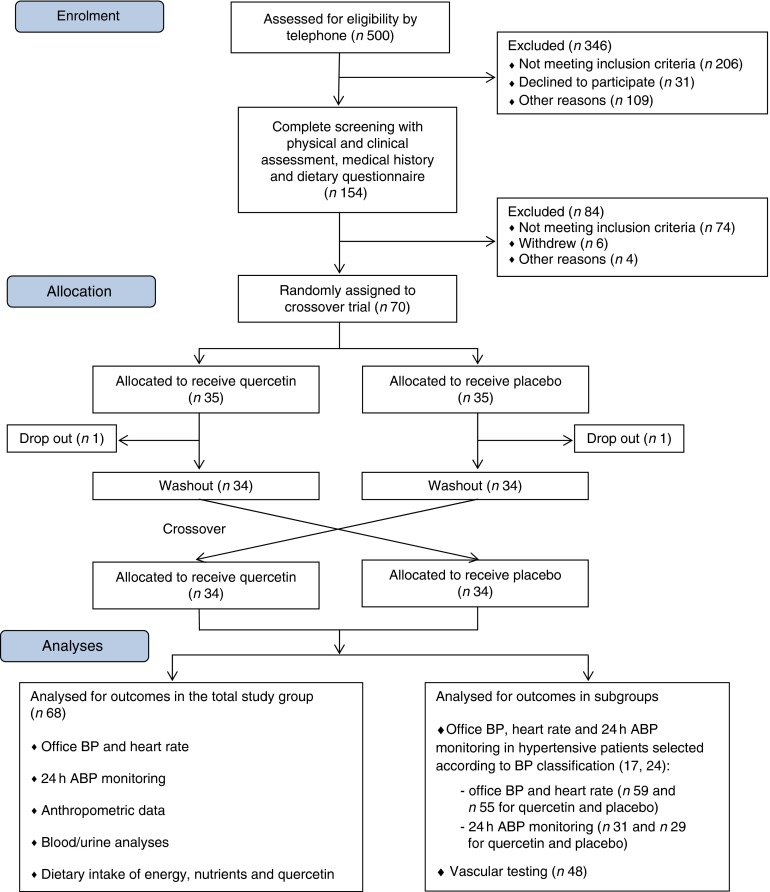
The polyphenol quercetin may prevent CVD due to its antihypertensive and vasorelaxant properties. We investigated the effects of quercetin after regular intake on blood pressure (BP) in overweight-to-obese patients with pre-hypertension and stage I hypertension. In addition, the potential mechanisms responsible for the hypothesised effect of quercetin on BP were explored. Subjects (n 70) were randomised to receive 162 mg/d quercetin from onion skin extract powder or placebo in a double-blinded, placebo-controlled cross-over trial with 6-week treatment periods separated by a 6-week washout period. Before and after the intervention, ambulatory blood pressure (ABP) and office BP were measured; urine and blood samples were collected; and endothelial function was measured by EndoPAT technology. In the total group, quercetin did not significantly affect 24 h ABP parameters and office BP. In the subgroup of hypertensives, quercetin decreased 24 h systolic BP by -3·6 mmHg (P=0·022) when compared with placebo (mean treatment difference, -3·9 mmHg; P=0·049). In addition, quercetin significantly decreased day-time and night-time systolic BP in hypertensives, but without a significant effect in inter-group comparison. In the total group and also in the subgroup of hypertensives, vasoactive biomarkers including endothelin-1, soluble endothelial-derived adhesion molecules, asymmetric dimethylarginine, angiotensin-converting enzyme activity, endothelial function, parameters of oxidation, inflammation, lipid and glucose metabolism were not affected by quercetin. In conclusion, supplementation with 162 mg/d quercetin from onion skin extract lowers ABP in patients with hypertension, suggesting a cardioprotective effect of quercetin. The mechanisms responsible for the BP-lowering effect remain unclear.
Keywords: ABP ambulatory blood pressure; ACE angiotensin-converting enzyme; ADMA asymmetric dimethylarginine; BP blood pressure; Blood pressure; Cardiovascular diseases; DBP diastolic blood pressure; Endothelial function; Hypertension; IsoP isoprostanes; MAP mean arterial pressure; PAT peripheral arterial tonometry; Quercetin; RHI reactive hyperaemia index; SBP systolic blood pressure; oxLDL oxidised LDL; sICAM-1 soluble intercellular adhesion molecule 1; sVCAM-1 soluble vascular cell adhesion molecule 1.
Figures
References
-
- Crozier A, Jaganath IB & Clifford MN (2009) Dietary phenolics: chemistry, bioavailability and effects on health. Nat Prod Rep 26, 1001–1043. - PubMed
-
- Erdman JW Jr, Balentine D, Arab L, et al. (2007) Flavonoids and Heart Health: Proceedings of the ILSI North America Flavonoids Workshop, May 31-June 1, 2005, Washington, DC. J Nutr 137, 718S–737S. - PubMed
-
- Scalbert A & Williamson G (2000) Dietary intake and bioavailability of polyphenols. J Nutr 130, 2073S–2085S. - PubMed
-
- Wang X, Ouyang YY, Liu J, et al. (2013) Flavonoid intake and risk of CVD: a systematic review and meta-analysis of prospective cohort studies. Br J Nutr 111, 1–11. - PubMed
-
- Hubbard GP, Wolffram S, Lovegrove JA, et al. (2004) Ingestion of quercetin inhibits platelet aggregation and essential components of the collagen-stimulated platelet activation pathway in humans. J Thromb Haemost 2, 2138–2145. - PubMed
Publication types
MeSH terms
Substances
LinkOut - more resources
Full Text Sources
Other Literature Sources
Medical
Miscellaneous
