


Suicide mortality trends in Galicia, Spain and their relationship with economic indicators
- PMID: 26328749
- PMCID: PMC7137585
- DOI: 10.1017/S2045796015000773
Suicide mortality trends in Galicia, Spain and their relationship with economic indicators
Abstract
Background: Recent research has shown an association between unemployment and suicide, but the mediating factors in this relationship are still unknown. In this study, we investigated the effect of unemployment and economic recession on suicide rates in the Spanish region of Galicia between 1975 and 2012 Method. We analysed age-standardised suicide rates in men and women and in four age groups: less than 25 years, 25-45 years, 45-65 years and more than 65 years and performed a joinpoint analysis to determine trend changes throughout 1975-2012 period. Also we analysed the association between suicide, recession and unemployment by means of a temporal trend model with a Generalised Additive Model.
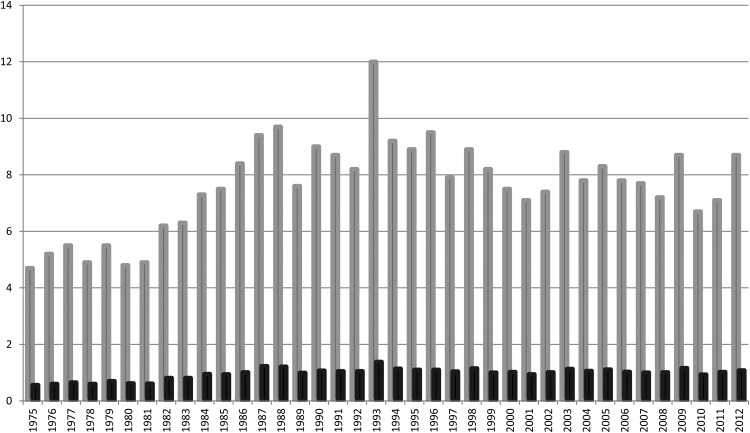
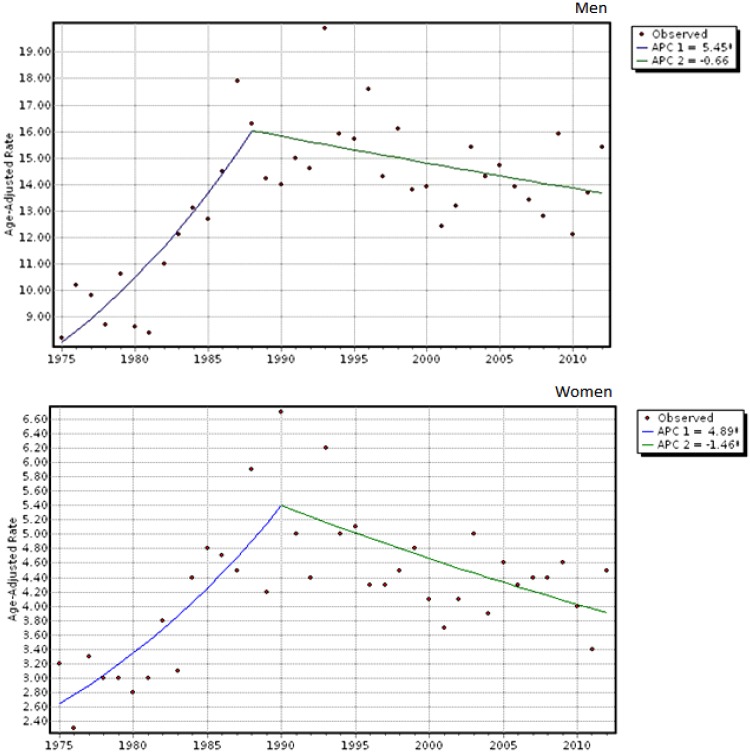
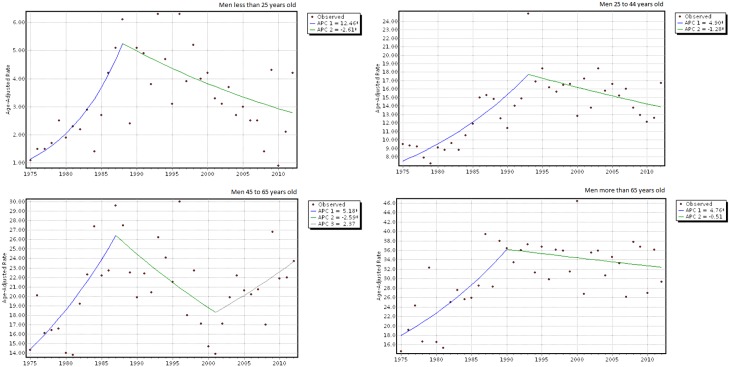
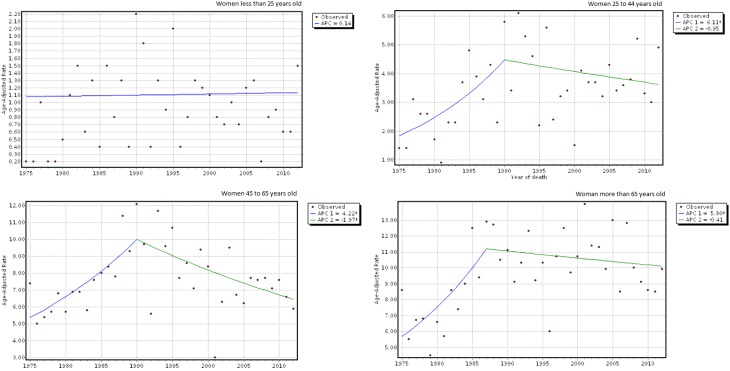
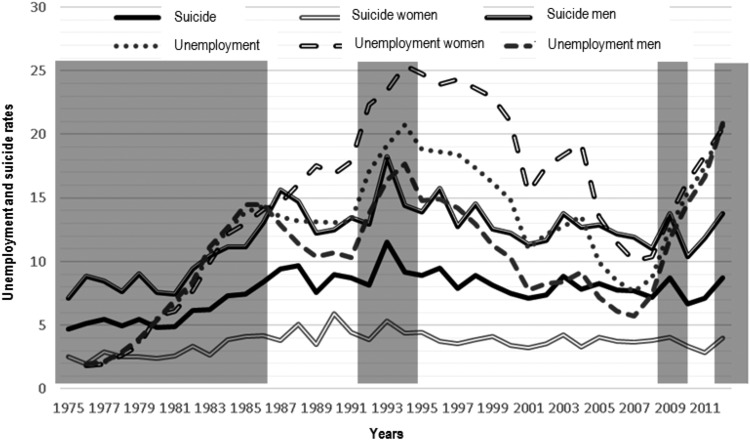
Results: Suicide rates increased from 145 suicides in 1975 to a high in 1993, with 377 deaths by suicide, representing 1.38% of all causes of death, and thereafter they tend to decrease to 335 suicides in 2012. Joinpoint analyses revealed that suicide rates changed differently across sex and age groups. For men, the annual percentage of change (APC) between 1975 and 1988 (CI 95% 1986-1994) was 5.45 (CI 95% = 3.5, -7.2) but from 1988 the APC became negative [-0.66 (CI 95% = -1.3, -0.1)]. For women, APC between 1974 and 1990 (CI 95% 1986-1992) was 4.86 (CI 95% = 3.2, -6.4) and -1.46 subsequently (CI 95% = -2.2, -0.5). Women aged 24 years or less showed stable suicide rates while men from 45-65 years showed two incidence peaks. When we studied the independent correlation between unemployment, recession and suicide, we found a significant association between unemployment and suicide, but not between recession and suicide for both sexes together and for men while for women there was no significant correlation between suicide and unemployment or recession. Finally, when we studied the effect of the interaction between unemployment and recession on suicide we found economic recession and unemployment interacted with regards to suicide rates (F = 5.902; df = 4.167; p = 0.00098) and after adjusting by sex, the effect was confirmed among men (F = 4.827; df = 2.823; p = 0.0087), but not among women (F = 0.001; df = 1.000; p = 0.979).
Conclusions: Although suicide rates in Galicia are gradually decreasing in the last decades, there are important sex and age differences. Unemployment was related with suicide during economic recession periods according to our results.
Keywords: Economic recession; joinpoint analyses; suicide; unemployment.
Figures
References
-
- 19 Age Groups – Standard Populations – SEER Datasets. Retrieved 8 July 2015 from http://seer.cancer.gov/stdpopulations/stdpop.19ages.html
-
- Alameda-Palacios J, Ruiz-Ramos M, García-Robredo B (2014). Suicidio, prescripción de antidepresivos y desempleo en Andalucía (Suicide, antidepressant prescription and unemployment in Andalusia (Spain)). Gaceta Sanitaria 28, 309–312. - PubMed
-
- Álvaro-Meca A, Kneib T, Gil-Prieto R, Gil de Miguel A (2013). Epidemiology of suicide in Spain, 1981–2008: a spatiotemporal analysis. Public Health 127, 380–385. - PubMed
-
- Ayuso-Mateos JL, Barros PP, Gusmão R (2013). Financial crisis, austerity, and health in Europe. The Lancet 382, 391–392. - PubMed
LinkOut - more resources
Full Text Sources
Miscellaneous
