


The Impact of Sleep Disturbance on the Association Between Stressful Life Events and Depressive Symptoms
- PMID: 26329114
- PMCID: PMC4861642
- DOI: 10.1093/geronb/gbv072
The Impact of Sleep Disturbance on the Association Between Stressful Life Events and Depressive Symptoms
Abstract
Objectives: Sleep problems are common across the adult life span and may exacerbate depressive symptoms and the effect of common risk factors for depressive symptoms such as life stress. We examine sleep disturbance as a moderator of the association between stressful life events and depressive symptoms across five waves (25 years) of the nationally representative, longitudinal American Changing Lives Study.
Method: The sample includes 3,597 adults aged 25 years or older who were surveyed up to five times over 25 years. Multilevel models were run to examine between- and within-person variability in sleep disturbance and life event stress as predictors of depressive symptoms, and an interaction to test sleep disturbance as a moderator is included in a second step.
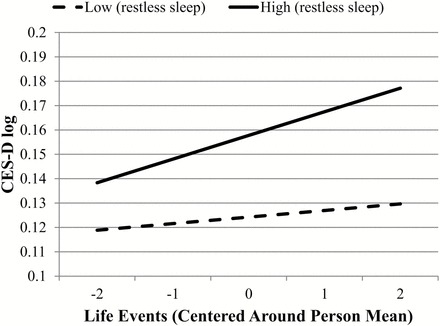
Results: Life events and sleep disturbance were associated with elevated depressive symptoms at the between- and within-person levels. A significant sleep disturbance by interaction of life events was found, indicating that when individuals experienced an above average number of life events and slept more restlessly than usual, they had a higher risk for depressive symptoms than individuals who experienced above average stress but slept well.
Discussion: Sleeping restfully may allow individuals the rejuvenation needed to manage stress adaptively and reduce depressive symptom burden.
Keywords: Depressive symptoms; Sleep disturbance; Stressful life events.
© The Author 2015. Published by Oxford University Press on behalf of The Gerontological Society of America. All rights reserved. For permissions, please e-mail: journals.permissions@oup.com.
Figures
References
-
- Abramson L. Y. Seligman M. E., & Teasdale J. D (1978). Learned helplessness in humans: Critique and reformulation. Journal of Abnormal Psychology, 87, 49–74. doi:10.1037/0021-843X.87.1.49 - PubMed
-
- Aranda M. P., & Lincoln K. D (2011). Financial strain, negative interaction, coping styles, and mental health among low-income latinos. Race and Social Problems, 3, 280–297. doi:10.1007/s12552-011-9060-4
-
- Baglioni C. Battagliese G. Feige B. Spiegelhalder K. Nissen C. Voderholzer U. … Riemann D (2011). Insomnia as a predictor of depression: A meta-analytic evaluation of longitudinal epidemiological studies. Journal of Affective Disorders, 135, 10–19. doi:10.1016/j.jad.2011.01.011 - PubMed
-
- Baglioni C. Lombardo C. Bux E. Hansen S. Salveta C. Biello S. … Espie C. A (2010). Psychophysiological reactivity to sleep-related emotional stimuli in primary insomnia. Behaviour Research and Therapy, 48, 467–475. doi:10.1016/j.brat.2010.01.008 - PubMed
-
- Baglioni C., Spiegelhalder K., Lombardo C., Riemann D. (2010). Sleep and emotions: A focus on insomnia. Sleep Medicine Reviews, 14, 227–238. doi:10.1016/j.smrv.2009.10.007 - PubMed
Publication types
MeSH terms
Grants and funding
LinkOut - more resources
Full Text Sources
Other Literature Sources
Medical
