


Evaluation of the hypothalamic-pituitary-adrenal axis and its relationship with central respiratory dysfunction in children with Prader-Willi syndrome
- PMID: 26329144
- PMCID: PMC4557896
- DOI: 10.1186/s13023-015-0312-z
Evaluation of the hypothalamic-pituitary-adrenal axis and its relationship with central respiratory dysfunction in children with Prader-Willi syndrome
Abstract
Background: Children with Prader-Willi Syndrome (PWS) have been considered at risk for central adrenal insufficiency (CAI). Hypothalamic dysregulation has been proposed as a common mechanism underlying both stress-induced CAI and central respiratory dysfunction during sleep.
Objective: To evaluate CAI and sleep-related breathing disorders in PWS children.
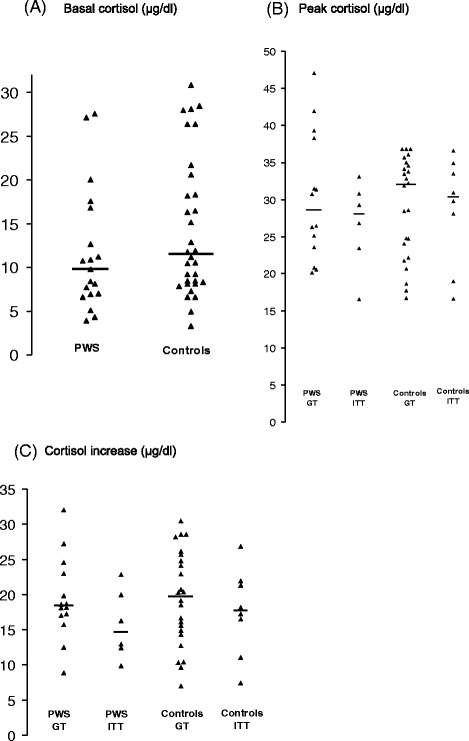
Patients and methods: Retrospective study of cortisol response following either insulin tolerance test (ITT) or glucagon test (GT) in 20 PWS children, and comparison with 33 non- Growth Hormone deficient (GHD) controls. Correlation between sleep related breathing disorders and cortisol response in 11 PWS children who received both investigations.
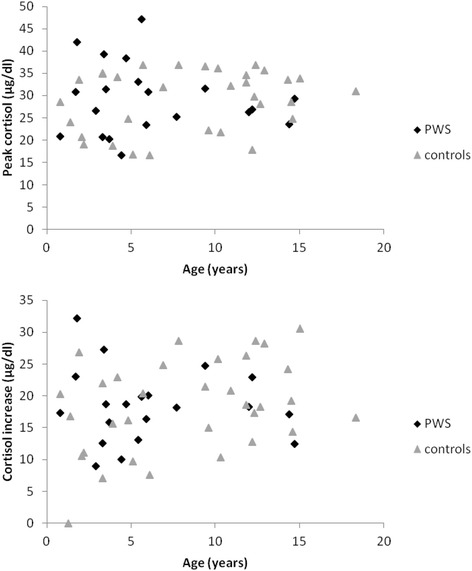
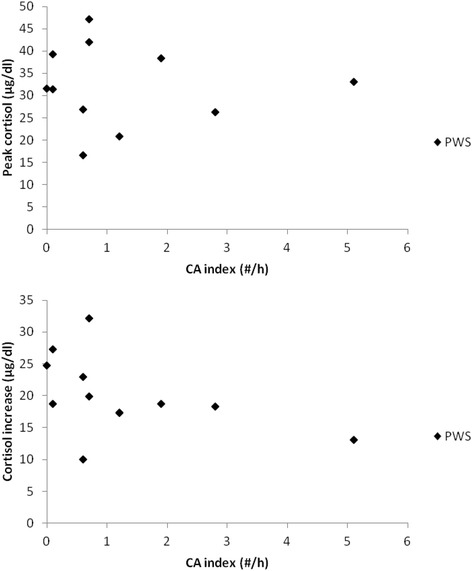
Results: In PWS children, the cortisol peak value showed a significant, inverse correlation with age (Kendall's τ = -0.411; p = 0.012). A similar though non-significant correlation was present between cortisol increase and age (τ = -0.232; p = 0.16). Similar correlations were found in controls. In only 1 of 20 PWS children (5 %), ITT was suggestive of CAI. Four patients had an elevated central apnea index but they all exhibited a normal cortisol response. No relationship was found between peak cortisol or cortisol increase and central apnea index (respectively p = 0.94 and p = 0.14) or the other studied polysomnography (PSG) parameters.
Conclusions: CAI assessed by ITT/GT is rare in PWS children. Our data do not support a link between CAI and central respiratory dysregulation.
Figures
References
-
- Verrillo E, Bruni O, Franco P, Ferri R,Thiriez G, Pavone M, et al. Analysis of NREM sleep in children with Prader-Willi syndrome and the effect of growth hormone treatment. Sleep Med. 2009;10:646–50. - PubMed
MeSH terms
Substances
LinkOut - more resources
Full Text Sources
Other Literature Sources
Medical
Miscellaneous
