. 2015 Sep 2:12:26.
doi: 10.1186/s12989-015-0101-9.

Pharmaceutical/food grade titanium dioxide particles are absorbed into the bloodstream of human volunteers

Affiliations

Pharmaceutical/food grade titanium dioxide particles are absorbed into the bloodstream of human volunteers

Laetitia C Pele et al. Part Fibre Toxicol. .

Abstract

Background: Exposure to persistent engineered nano and micro particles via the oral route is well established. Animal studies have demonstrated that, once ingested, a small proportion of such particles translocate from the gastrointestinal tract to other tissues. Exposure to titanium dioxide is widespread via the oral route, but only one study has provided indirect evidence (total titanium analyses) of absorption into the blood stream in humans. We sought to replicate these observations and to provide additional evidence for particulate uptake.

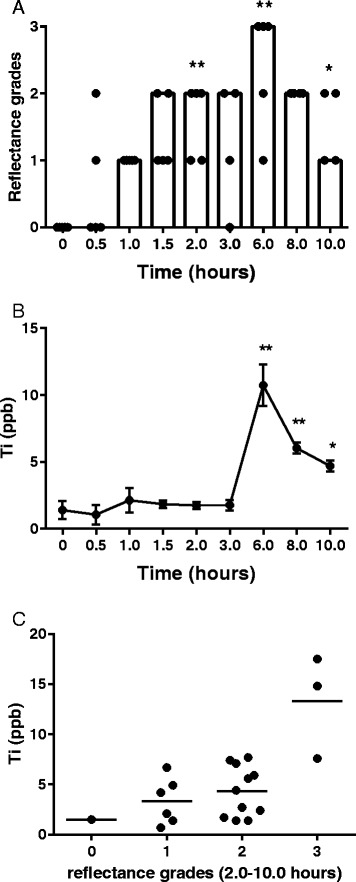
Findings: Human volunteers with normal intestinal permeability were orally administered 100 mg pharmaceutical/food grade titanium dioxide. Blood samples were collected from 0.5 to 10 h post ingestion and analysed for the presence of reflectant bodies (particles) by dark field microscopy, and for total titanium by inductively coupled plasma mass spectrometry (ICP-MS). Blood film analyses implied early absorption of particles (2 h) with a peak maximum at 6 h following ingestion. The presence of these reflectant particles in blood roughly mirrored the levels of total titanium by ICP-MS, providing good evidence for the latter being a measure of whole particle (titanium dioxide) absorption.

Conclusions: This study shows that a fraction of pharmaceutical/food grade titanium dioxide is absorbed systemically by humans following ingestion. It confirms that at least two routes of particle uptake may exist in the human gut- one proximal and one distal. Further work should quantify human exposure and uptake of such persistent particles.


Figures

Fig. 1
Fig. 1
Intestinal permeability and absorption. Small molecule permeability (black circles; lactulose:rhamnose excretion) and absorption (black squares; rhamnose:3-O-methyl glucose excretion) ratios. The reference ranges for permeability (dotted line) and absorption (dashed line) are ratios of <0.05, and 0.132 – 0.258, respectively
Fig. 2
Fig. 2
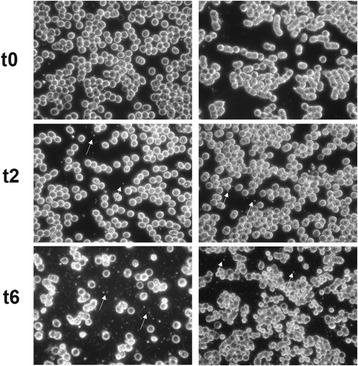
Reflectance micrographs of blood smears. Representative examples of visualisation of blood smears at x 400 magnification by dark field microscopy at baseline (t0), 2 h (t2) and 6 h (t6) following ingestion of 100 mg TiO2 capsules, in two subjects. Examples of particle-positive signals are indicated by the white arrows. A few particles were present at t0, but were always below 5 particles per field of analysis. Data for all five subjects are displayed and summarised in Fig. 3
Fig. 3
Fig. 3
Absorption of TiO2 particles into the blood stream. a- Grading of the frequency of discrete particulate reflectance in blood smears by dark field microscopy following ingestion of 100 mg TiO2 capsules (n = 5 subjects). Data are plotted as mode (column) and individual grades (closed circles). * p < 0.05 and **p < 0.01 vs time point 0, two-tailed paired t test. b- Total Ti levels (ppb) measured by ICP-MS in the same blood samples as above with two further subjects (total seven). Data are represented as mean +/− SEM. *p < 0.05 and **p < 0.01 vs time point 0, two-tailed paired t test. c- Correlation between reflectance grades and total Ti levels in blood for the five complete subjects only. Pearson correlation p = 0.0058 and r = 0.5803

References

    1. Powell JJ, Faria N, Thomas-McKay E, Pele LC. Origin and fate of dietary nanoparticles and microparticles in the gastrointestinal tract. J Autoimmun. 2010;34(3):J226–33. doi: 10.1016/j.jaut.2009.11.006. - DOI - PubMed
    1. Lin Z, Monteiro-Riviere NA, Riviere JE. Pharmacokinetics of metallic nanoparticles. Wiley Interdiscip Rev Nanomed Nanobiotechnol. 2014 - PubMed
    1. Powell JJ, Ainley CC, Harvey RS, Mason IM, Kendall MD, Sankey EA, et al. Characterisation of inorganic microparticles in pigment cells of human gut associated lymphoid tissue. Gut. 1996;38(3):390–5. doi: 10.1136/gut.38.3.390. - DOI - PMC - PubMed
    1. Shepherd NA, Crocker PR, Smith AP, Levison DA. Exogenous pigment in Peyer’s patches. Hum Pathol. 1987;18(1):50–4. doi: 10.1016/S0046-8177(87)80193-4. - DOI - PubMed
    1. Urbanski SJ, Arsenault AL, Green FH, Haber G. Pigment resembling atmospheric dust in Peyer’s patches. Mod Pathol. 1989;2(3):222–6. - PubMed

Publication types