


Preventing Pressure Ulcers: A Multisite Randomized Controlled Trial in Nursing Homes
- PMID: 26330893
- PMCID: PMC4552218
Preventing Pressure Ulcers: A Multisite Randomized Controlled Trial in Nursing Homes
Abstract
Background: Pressure at the interface between bony prominences and support surfaces, sufficient to occlude or reduce blood flow, is thought to cause pressure ulcers (PrUs). Pressure ulcers are prevented by providing support surfaces that redistribute pressure and by turning residents to reduce length of exposure.
Objective: We aim to determine optimal frequency of repositioning in long-term care (LTC) facilities of residents at risk for PrUs who are cared for on high-density foam mattresses.
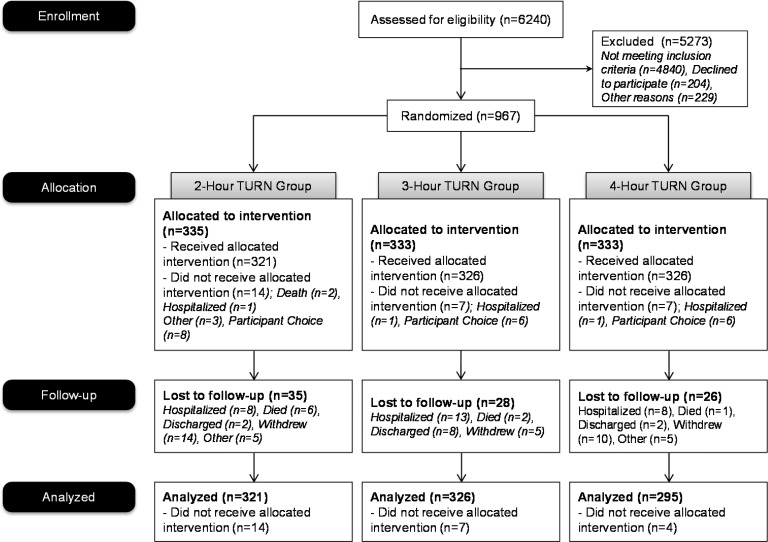
Methods: We recruited residents from 20 United States and 7 Canadian LTC facilities. Participants were randomly allocated to 1 of 3 turning schedules (2-, 3-, or 4-hour intervals). The study continued for 3 weeks with weekly risk and skin assessment completed by assessors blinded to group allocation. The primary outcome measure was PrU on the coccyx or sacrum, greater trochanter, or heels.
Results: Participants were mostly female (731/942, 77.6%) and white (758/942, 80.5%), and had a mean age of 85.1 (standard deviation [SD] ± 7.66) years. The most common comorbidities were cardiovascular disease (713/942, 75.7%) and dementia (672/942, 71.3%). Nineteen of 942 (2.02%) participants developed one superficial Stage 1 (n = 1) or Stage 2 (n = 19) ulcer; no full-thickness ulcers developed. Overall, there was no significant difference in PrU incidence (P = 0.68) between groups (2-hour, 8/321 [2.49%] ulcers/group; 3-hour, 2/326 [0.61%]; 4-hour, 9/295 [3.05%]. Pressure ulcers among high-risk (6/325, 1.85%) versus moderate-risk (13/617, 2.11%) participants were not significantly different (P = 0.79), nor was there a difference between moderate-risk (P = 0.68) or high-risk allocation groups (P = 0.90).
Conclusions: Results support turning moderate- and high-risk residents at intervals of 2, 3, or 4 hours when they are cared for on high-density foam replacement mattresses. Turning at 3-hour and at 4-hour intervals is no worse than the current practice of turning every 2 hours. Less frequent turning might increase sleep, improve quality of life, reduce staff injury, and save time for such other activities as feeding, walking, and toileting.
References
-
- Kosiak M. Etiology of decubitus ulcers. Arch Phys Med Rehabil. 1961. Jan; 42: 19–29. - PubMed
-
- Lindan O. Etiology of decubitus ulcers: an experimental study. Arch Phys Med Rehabil. 1961. Nov; 42: 774–83. - PubMed
-
- Bergstrom N, Horn SD. Racial disparities in rates of pressure ulcers in nursing homes and site of care. JAMA. 2011. Jul 13; 306(2): 211–2. - PubMed
-
- Bates-Jensen BM, Cadogan M, Osterweil D, Levy-Storms L, Jorge J, Al-Samarrai N, et al. The minimum data set pressure ulcer indicator: does it reflect differences in care processes related to pressure ulcer prevention and treatment in nursing homes? J Am Geriatr Soc. 2003. Sep; 51(9): 1203–12. - PubMed
Publication types
MeSH terms
LinkOut - more resources
Full Text Sources
Medical