Review
. 2015:69:463-85.
doi: 10.1146/annurev-micro-091014-104100. Epub 2015 Aug 28.

Lytic Cycle of Toxoplasma gondii: 15 Years Later

Affiliations
Review

Lytic Cycle of Toxoplasma gondii: 15 Years Later

Ira J Blader et al. Annu Rev Microbiol. 2015.

Abstract

Toxoplasmosis is the clinical and pathological consequence of acute infection with the obligate intracellular apicomplexan parasite Toxoplasma gondii. Symptoms result from tissue destruction that accompanies lytic parasite growth. This review updates current understanding of the host cell invasion, parasite replication, and eventual egress that constitute the lytic cycle, as well as the ways T. gondii manipulates host cells to ensure its survival. Since the publication of a previous iteration of this review 15 years ago, important advances have been made in our molecular understanding of parasite growth and mechanisms of host cell egress, and knowledge of the parasite's manipulation of the host has rapidly progressed. Here we cover molecular advances and current conceptual frameworks that include each of these topics, with an eye to what may be known 15 years from now.

Keywords: Apicomplexa; IRG; egress; endodyogeny; inflammasome; invasion.


Figures
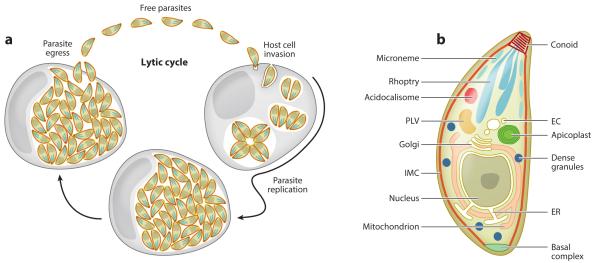
Figure 1
Figure 1
The Toxoplasma lytic cycle and basic tachyzoite organization. (a) The lytic cycle of invasion, replication and egress. (b) Organelles in the secretory pathway are shown in white; the actual secretory organelles in three hues of blue. PLV, plant like vacuole; EC endosome compartment; IMC, inner membrane complex; ER, endoplasmic reticulum.
Figure 2
Figure 2
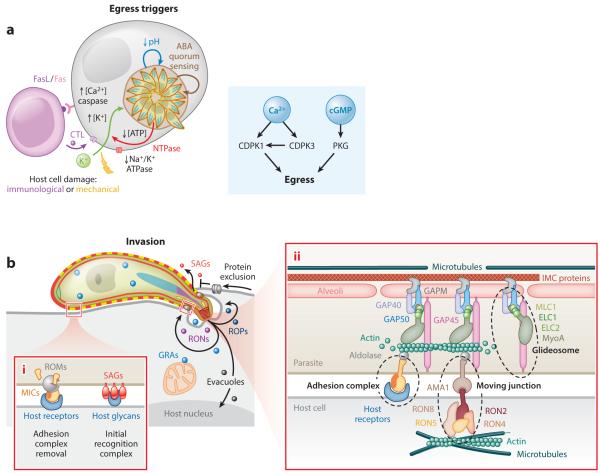
Activation of egress, gliding motility and host cell invasion. (a) Schematic overview of described egress stimuli. The cytotoxic T-cell response (CTL) releases perforin inserting in the plasma membrane. Fas receptor activation induces host cell necrosis rather than apoptosis. Triangular insert: summary of Ca2+ and cGMP secondary messenger signaling following triggers to egress. (b) Invasion gliding motility and glideosome composition (modified from (53)); panel 1. Initial attachment and adhesion release. Panel 2. Molecular composition and mechanism of adhesion, gliding motility, the glideosome, and the moving junction. Not depicted is the family of actin binding proteins.
Figure 3
Figure 3
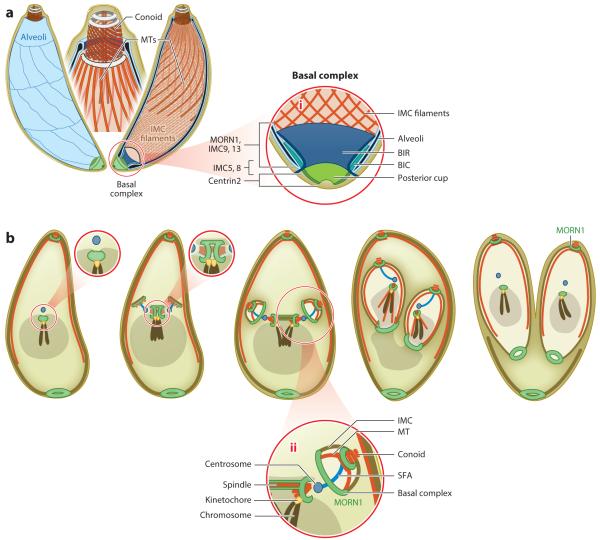
The cortical cytoskeleton and cell division. (a) A patchwork of alveoli (flattened vesicles) underlies the plasma membrane (left) which in turn are supported by a meshwork of intermediate filament-like IMC proteins (right). At the apical end (enlarged in center) the conoid composed of MT is an extrudable basket, whereas 22 cortical, subpellicular microtubules emanate from the apical end to about 2/3 the length of the parasite. At the basal end the cytoskeleton is capped by the basal complex and posterior cup, as magnified in panel 1. BIC, basal inner complex; BIR, basal inner ring. (b) Concurrent mitosis and cell division are coordinated by the centrosome. Mitosis is closed without chromosome condensation whereas the spindle resides eccentrically at the apical side of the nucleus. Throughout the cell cycle the 14 chromosomes are clustered at the centromeres and anchored at the spindle pole (centrocone) by the kinetochore. Daughter bud assembly starts before completion of mitosis and is driven by assembly of the cortical cytoskeleton in an apical to basal direction. The nucleus is anchored in the daughter scaffolds through the centrosome and SFA fiber. Constriction of the basal complex drives tapering of the daughter bud towards the basal end and is required to separate the daughter parasites. Magnification of black dotted regions next to relevant panel. Panel 2 magnifies the interaction between nucleus, centrosome and daughter cytoskeleton. SFA, striated fiber assemblin. Schematic modified from (62).

References

References cited

    1. Agop-Nersesian C, Egarter S, Langsley G, Foth BJ, Ferguson DJ, Meissner M. Biogenesis of the inner membrane complex is dependent on vesicular transport by the alveolate specific GTPase Rab11B. PLoS Pathog. 2010;6:e1001029. - PMC - PubMed
    1. Agop-Nersesian C, Naissant B, Ben Rached F, Rauch M, Kretzschmar A, et al. Rab11A-controlled assembly of the inner membrane complex is required for completion of apicomplexan cytokinesis. PLoS Pathog. 2009;5:e1000270. - PMC - PubMed
    1. Alexander DL, Mital J, Ward GE, Bradley P, Boothroyd JC. Identification of the Moving Junction Complex of Toxoplasma gondii: A Collaboration between Distinct Secretory Organelles. PLoS Pathog. 2005;1:e17. - PMC - PubMed
    1. Anderson-White BR, Beck JR, Chen CT, Meissner M, Bradley PJ, Gubbels MJ. Cytoskeleton assembly in Toxoplasma gondii cell division. Int. Rev. Cell Mol. Biol. 2012;298:1–31. - PMC - PubMed
    1. Anderson-White BR, Ivey FD, Cheng K, Szatanek T, Lorestani A, et al. A family of intermediate filament-like proteins is sequentially assembled into the cytoskeleton of Toxoplasma gondii. Cell Microbiol. 2011;13:18–31. - PMC - PubMed

Annotated key references

    1. Moudy R, Manning TJ, Beckers CJ. The loss of cytoplasmic potassium upon host cell breakdown triggers egress of Toxoplasma gondii. J Biol Chem. 2001;276:41492–501. First comphrehensive analysis of the egress mechanism by innovative assays. - PubMed
    1. Lourido S, Shuman J, Zhang C, Shokat KM, Hui R, Sibley LD. Calcium-dependent protein kinase 1 is an essential regulator of exocytosis in Toxoplasma. Nature. 2010;465:359–62. First proof of a Ca2+-dependent protein kinase, a protein family absent from mammals, with an essential role in invasion. - PMC - PubMed
    1. Meissner M, Schluter D, Soldati D. Role of Toxoplasma gondii myosin A in powering parasite gliding and host cell invasion. Science. 2002;298:837–40. Shows that Myosin A, a class XIVa myosin, is the main motor driving motility and invasion. - PubMed
    1. Suvorova ES, Francia M, Striepen B, White MW. A novel bipartite centrosome coordinates the apicomplexan cell cycle. PLoS Biol. 2015 in press. In this paper the mechanical basis for how mitosis and daughter budding are coordinated by the centrome. - PMC - PubMed
    1. Alexander DL, Mital J, Ward GE, Bradley P, Boothroyd JC. Identification of the Moving Junction Complex of Toxoplasma gondii: A Collaboration between Distinct Secretory Organelles. PLoS Pathog. 2005;1:e17. Identification of the composition of the moving junction. - PMC - PubMed

Publication types

Substances