


Impact of Pneumococcal Conjugate Vaccine Administration in Pediatric Older Age Groups in Low and Middle Income Countries: A Systematic Review
- PMID: 26332848
- PMCID: PMC4557974
- DOI: 10.1371/journal.pone.0135270
Impact of Pneumococcal Conjugate Vaccine Administration in Pediatric Older Age Groups in Low and Middle Income Countries: A Systematic Review
Abstract
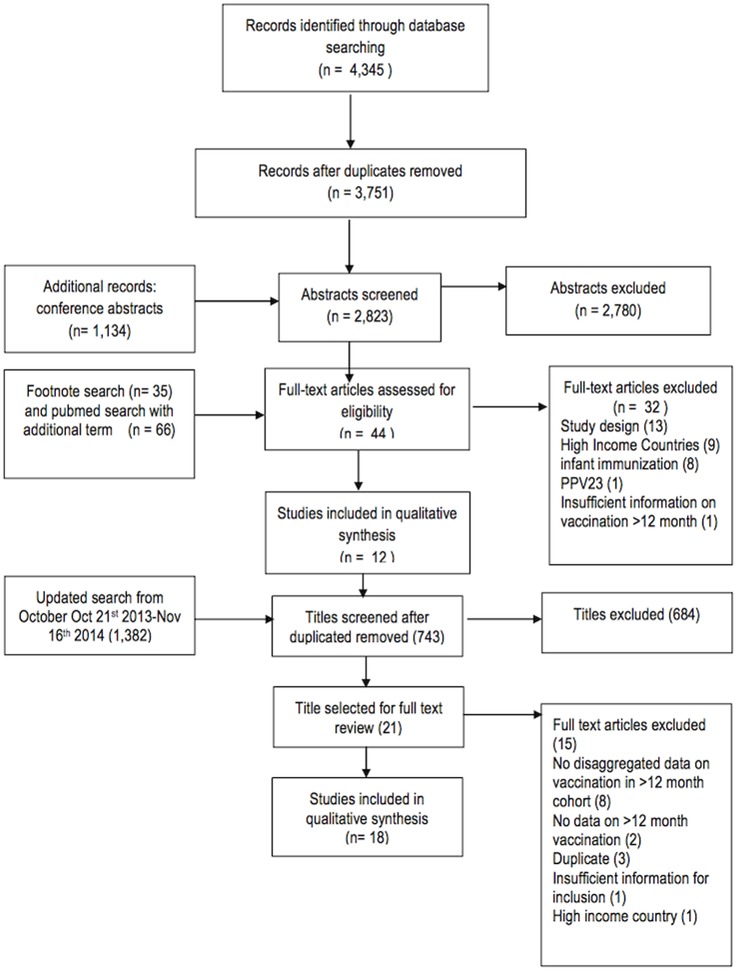
Introduction: Pneumococcal conjugate vaccine (PCV) is included in the World Health Organization's routine immunization schedule and is recommended by WHO for vaccination in high-risk children up to 60 months. However, many countries do not recommend vaccination in older age groups, nor have donors committed to supporting extended age group vaccination. To better inform decision-making, this systematic review examines the direct impact of extended age group vaccination in children over 12 months in low and middle income countries.
Methods: An a priori protocol was used. Using pre-specified terms, a search was conducted using PubMed, LILACS, Cochrane Infectious Diseases Group Specialized Register, Cochrane Central Register of Controlled Trials, CAB Abstracts, clinicaltrials.gov and the International Symposium on Pneumococci and Pneumococcal Diseases abstracts. The primary outcome was disease incidence, with antibody titers and nasopharyngeal carriage included as secondary outcomes.
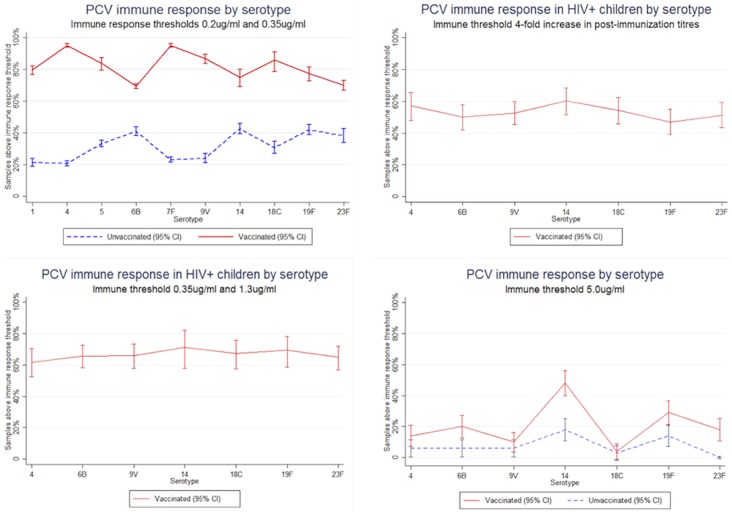
Results: Eighteen studies reported on disease incidence, immune response, and nasopharyngeal carriage. PCV administered after 12 months of age led to significant declines in invasive pneumococcal disease. Immune response to vaccine type serotypes was significantly higher for those vaccinated at older ages than the unimmunized at the established 0.2 ug/ml and 0.35 ug/ml thresholds. Vaccination administered after one year of age significantly reduced VT carriage with odds ratios ranging from 0.213 to 0.69 over four years. A GRADE analysis indicated that the studies were of high quality.
Discussion: PCV administration in children over 12 months leads to significant protection. The direct impact of PCV administration, coupled with the large cohort of children missed in first year vaccination, indicates that countries should initiate or expand PCV immunization for extended age group vaccinations. Donors should support implementation of PCV as part of delayed or interrupted immunization for older children. For countries to effectively implement extended age vaccinations, access to affordably-priced PCV is critical.
Conflict of interest statement
Figures
References
-
- WHO. Pneumococcal vaccines WHO position paper. Weekly Epidemiological Record. 2012;14: 129–144.
-
- WHO/UNICEF. WHO/UNICEF coverage estimates 2013 version. July 2014. Available: http://apps.who.int/immunization_monitoring/globalsummary/timeseries/tsw...
-
- Gavi, the Vaccine Alliance. Vaccine goal indicators. Available: http://www.gavi.org/results/goal-level-indicators/vaccine-goal-indicators/.
Publication types
MeSH terms
Substances
LinkOut - more resources
Full Text Sources
Other Literature Sources
Medical
