. 2015 Sep 2;10(9):e0136726.
doi: 10.1371/journal.pone.0136726. eCollection 2015.

Fluorescence In Situ Hybridization (FISH) Assays for Diagnosing Malaria in Endemic Areas

Affiliations

Fluorescence In Situ Hybridization (FISH) Assays for Diagnosing Malaria in Endemic Areas

Jyotsna Shah et al. PLoS One. .

Abstract

Malaria is a responsible for approximately 600 thousand deaths worldwide every year. Appropriate and timely treatment of malaria can prevent deaths but is dependent on accurate and rapid diagnosis of the infection. Currently, microscopic examination of the Giemsa stained blood smears is the method of choice for diagnosing malaria. Although it has limited sensitivity and specificity in field conditions, it still remains the gold standard for the diagnosis of malaria. Here, we report the development of a fluorescence in situ hybridization (FISH) based method for detecting malaria infection in blood smears and describe the use of an LED light source that makes the method suitable for use in resource-limited malaria endemic countries. The Plasmodium Genus (P-Genus) FISH assay has a Plasmodium genus specific probe that detects all five species of Plasmodium known to cause the disease in humans. The P. falciparum (PF) FISH assay and P. vivax (PV) FISH assay detect and differentiate between P. falciparum and P. vivax respectively from other Plasmodium species. The FISH assays are more sensitive than Giemsa. The sensitivities of P-Genus, PF and PV FISH assays were found to be 98.2%, 94.5% and 98.3%, respectively compared to 89.9%, 83.3% and 87.9% for the detection of Plasmodium, P. falciparum and P. vivax by Giemsa staining respectively.


Conflict of interest statement

Competing Interests: JS, OM, HW, DW and NH are authors on patents listed below. JS and NH have stocks in ID-FISH andIGeneX. HW and DW were employees and OM is an employee of IGeneX and ID-FISH. They do not have any stock in these companies. AR and SK are employees of and have financial interest in Nova Meditech Pvt. Ltd. This study was supported by NIH SBIR Phase I and Phase II Grants # A1056785. 1. NUCLEIC ACID PROBES AND METHODS FOR DETECTING PLASMODIUM PARASITES Nick S. Harris, Monterey, California (United States); Suzanne Scherini-Ward, Santa Clara, California (United States); Olivia Mark, San Jose, California (United States); Jyotsna S. Shah, Santa Clara, California (United States); Helena Weltman Los Altos, California (United States); Danuta Wronska Raleigh, North Carolina (United States). Patent Number: US 007,927,801; Issue Date: 4/19/2011. 2. NUCLEIC ACID PROBES AND METHODS FOR DETECTING PLASMODIUM PARASITES (54) (75) Inventors: Jyotsna S. Shah, Santa Clara, California (United States); Danuta Wronska, Raleigh, North Carolina (United States); Helena Weltman, Los Altos, California (United States); Nick S. Harris, Monterey, California (United States); Suzanne Scherini-Ward, Santa Clara, California (United States); Oliva Mark, San Jose, California. Patent Number: US 008,323,901; Issue Date: 12/4/2012. 3. NUCLEIC ACID PROBES AND METHODS FOR DETECTING PLASMODIUM PARASITES (54) (75) Inventors: Jyotsna S. Shah, Santa Clara, California (United States); Danuta Wronska, Raleigh, North Carolina (United States); Helena Weltman, Los Altos, California (United States); Nick S. Harris, Monterey, California (United States); Suzanne Scherini-Ward, Santa Clara, California (United States); Oliva Mark, San Jose, California. Patent Number: US 008592568B2; Issue Date: 11/26/2013. The authors confirm that this does not alter their adherence to all PLOS ONE policies on sharing data and materials, as detailed online in our guide for authors http://www.PLOSone.org/static/editorial.action#competing.

Figures

Fig 1
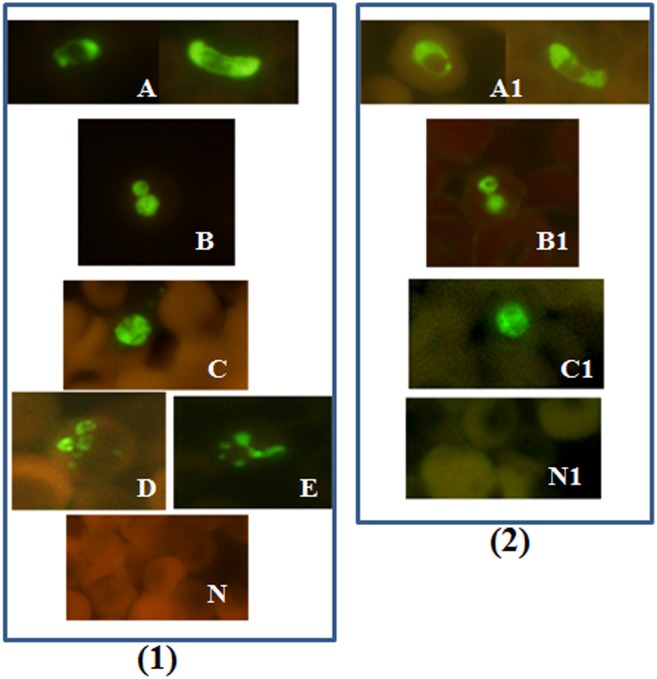
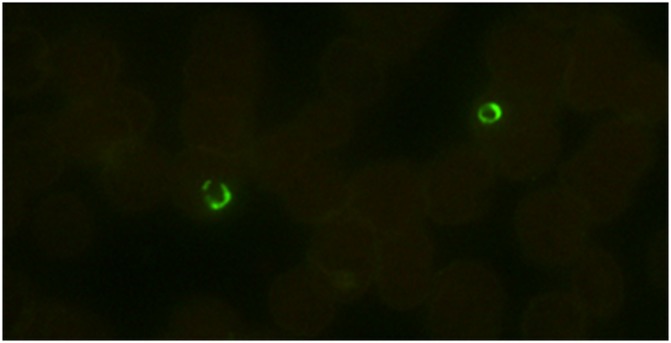
Fig 1. Blood smears tested with Plasmodium genus FISH assay.
Blood smears from different Plasmodium species P. falciparum, P. vivax, P. knowlesi, P. ovale and P. malariae were analyzed using Plasmodium genus FISH assay. (1) All the processed smears were read with a 100X objective in a fluorescence microscope. (2) P. falciparum. P. vivax, P. knowlesi and negative control smears were read with a 100X objective on a regular microscope with a LED unit. Green fluorescence indicates the presence of Plasmodium ribosomal RNA (rRNA). (A) P. falciparum including crescent shaped gametocytes (B) P. vivax; (C) P. knowlesi; (D) P. ovale; (E) P. malariae; and (N) Negative Control; (A1) P. falciparum;. (B1) P. vivax; (C1) P. knowlesi; and (N1) Negative Control.
Fig 2
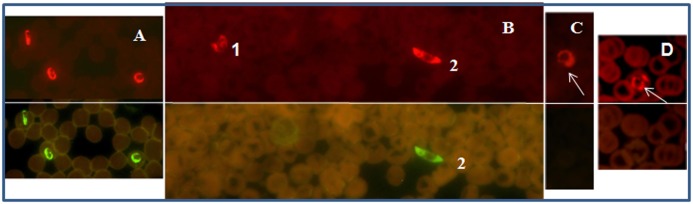
Fig 2. Blood smears tested with P. falciparum FISH assay.
Malaria positive patient blood samples from two collection sites, Peru (A), and Kenya (B) were analyzed using PF-FISH assay. (A) Patient blood positive for P. falciparum. (B) Patient blood positive for P. malariae [1] and P. falciparum gametocyte [2]. (C) Patient blood positive for P. ovale. (D) Patient blood positive for P. vivax. Green fluorescence is due to the P. falciparum specific probe and red fluorescence due to the Plasmodium genus probe.
Fig 3
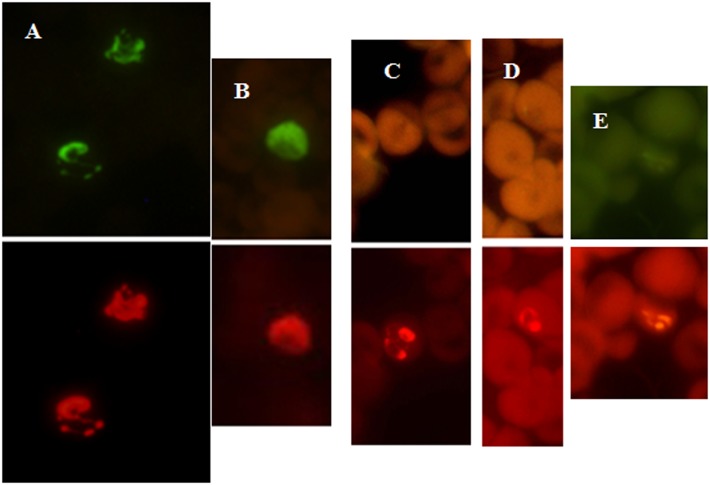
Fig 3. Blood smears tested with P. vivax FISH assay.
Malaria positive patient blood samples from two collection sites, Peru (A), India (B) and Kenya (C-E) were analyzed using PV-FISH assay. (A) Patient blood positive for P. vivax. (B) Patient blood positive for P. vivax. (C) Patient blood positive for P. ovale. (D) Patient blood positive for P. malariae. (E) Patient blood positive for P. falciparum. Green fluorescence is due to reactivity with the P. vivax specific probe and red fluorescence is due to reactivity with the Plasmodium genus probe.
Fig 4
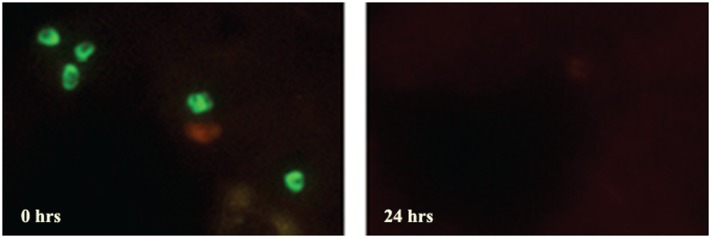
Fig 4. FISH assay only detects live Plasmodium parasites.
Blood smears prepared from P. falciparum positive patient before (0 Hrs) and after 24 hours (24Hrs) drug treatment were analyzed by Plasmodium Genus FISH assay. The disappearance of the Plasmodium Genus fluorescence signal at 24 hours suggests that FISH assay only detects live Plasmodium parasites.
Fig 5
Fig 5. P. falciparum positive patient’s finger-prick capillary blood smear tested with Plasmodium genus FISH assay.
Smear prepared from finger-prick capillary blood without anticoagulant. Green fluorescence indicates the presence of Plasmodium ribosomal RNA (rRNA) due to reaction with Plasmodium genus FISH.

References

    1. Ramasamy R. Zoonotic malaria—global overview and research and policy needs. Front Public Health. 2014;18 (2): 123–2: 123. - PMC - PubMed
    1. WHO Geneva, Switzerland: WHO Press; 2. World Malaria Report 2014: 1–242,
    1. WHO Geneva, Switzerland: WHO Press; 2. World Malaria Report 2013: 1–255.
    1. CDC (2012) Malaria surveillance—United States, 2010. 1–17 p. - PubMed
    1. Tangpukdee N, Duangdee C, Wilairatana P, Krudsood S. Malaria diagnosis: a brief review. Korean J Parasitol. 2009; 47: 93–102. 10.3347/kjp.2009.47.2.93 - DOI - PMC - PubMed

Publication types

LinkOut - more resources