. 2015 Nov;73(8):ftv062.
doi: 10.1093/femspd/ftv062. Epub 2015 Sep 1.

Angiogenic, lymphangiogenic and adipogenic effects of HIV-1 matrix protein p17

Affiliations

Angiogenic, lymphangiogenic and adipogenic effects of HIV-1 matrix protein p17

Daniele Basta et al. Pathog Dis. 2015 Nov.

Abstract

Lymphangiogenesis and concurrent angiogenesis are essential in supporting proliferation and survival of AIDS-related lymphomas, which are often metastatic. In vitro studies suggest a candidate angiogienic and lymphangiogenic factor encoded by HIV: the matrix protein p17. p17 accumulates in lymph nodes of patients even when they are undergoing highly active antiretroviral therapy. p17 has been found to affect immune cells, and recent data showed that a variant p17, called S75X, induces cell growth by triggering MAPK/ERK and PI3K/AKT pathways. We tested the in vivo angiogenic activity of p17 by injecting it in Matrigel plugs in nude mice. Plugs were retrieved 7 days after injection, and assessed macroscopically, and by light and confocal microscopy. Our data revealed that both reference and S75X variant p17 promote angiogenesis and lymphangiogenesis in vivo. Our results suggest that the induction of angiogenesis and lymphangiogenesis by HIV-1 p17 may generate a favorable microenvironment that could trigger tumor growth and maintenance. Moreover, the presence of adipocytes infiltration observed at the histological level suggests a possible interplay between angiogenesis, lymphangiogenesis and adipogenesis. These findings offer new opportunities for the development of treatment strategies to combat HIV-related cancers.

Keywords: HIV-1; adipogenesis; angiogienesis; lymphangiogenesis; lymphomagenesis; matrix protein.


Figures

Graphical Abstract Figure.
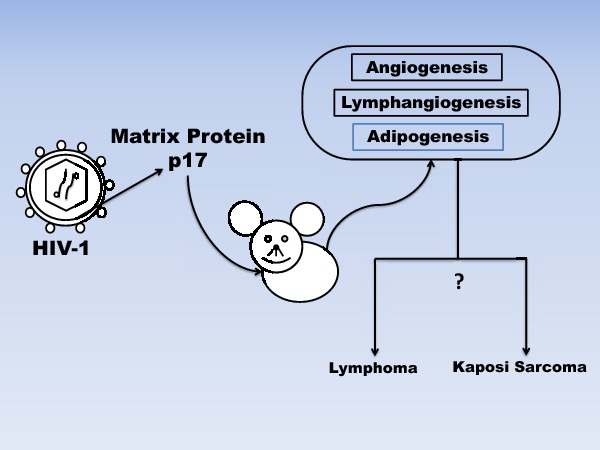
HIV-1 matrix protein is involved in several functions in the viral life cycle and can promote angiogenesis, lymphoangiogenesis and adipogenesis, generating a favorable microenvironment which could support tumor growth and maintenance; this study examines the role of MA/p17 in promoting these pathways and reports novel effects on adipogenesis.
Figure 1.
Figure 1.
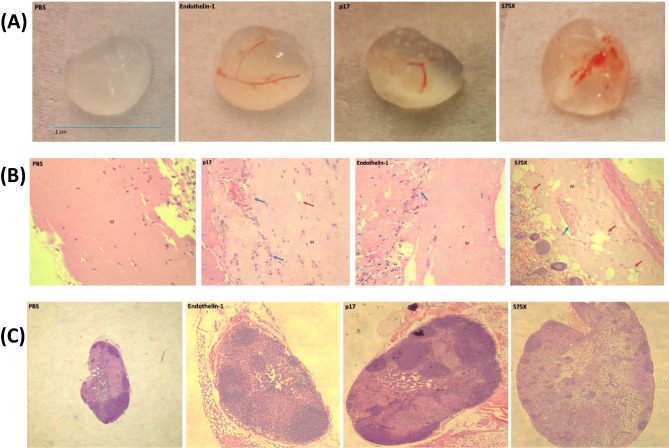
HIV-1 p17 MA induces angiogienesis in nude mice. (A) Matrigel plugs were injected subcutaneously in the flanks of nude mice and extracted 7 days after injection. The positive control endothelin-1 was mixed in the Matrigel at concentration of 500 ng ml−1, while reference (p17) and the S75X variant p17 (s75x) were used at a concentration of 200 ng ml−1. (B) Microphotographs from 5-μm sections obtained from Matrigel plugs stained with hematoxylin and eosin. Marginal endothelial cells invasion is seen in the negative control plug (PBS), while angiogenesis can be readily observed in plugs supplemented with Et-1 (500 ng ml−1), p17 reference (top-right panel, 200 ng ml−1) and p17S75X (lower-right panel, 200 ng ml−1). Blue arrows point at vessels filled with red blood cells, red arrows point at adipocyte cells. (C) 5-μm sections of axillary lymph nodes evaluated at the light microscope. Lymph nodes of the mice that received reference p17 and p17 S75X plugs (200 ng ml−1) appear enlarged and activated in comparison with these that received PBS Matrigel as a control.
Figure 2.
Figure 2.
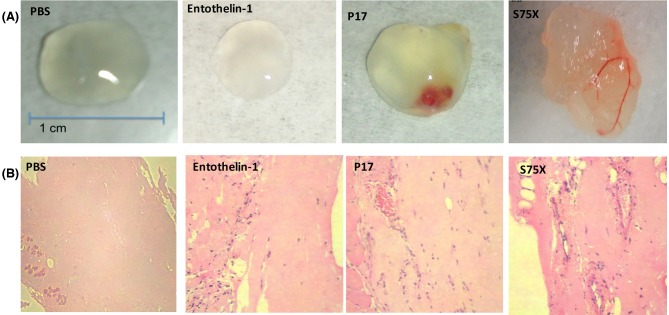
HIV-1 p17 MA induces angiogienesis in HIV transgenic (Tg) nude mice. (A) Matrigel plugs were injected subcutaneously in the flanks of HIV Tg/nude mice flanks and extracted 7 days after injection. Angiogenesis can be observed when 100 ng ml−1 of reference p17 (p17, top-right panel) or variant S75X Matrigel plugs (S75Z, bottom-right panel). (B) 5-μm sections obtained from Matrigel plugs and stained with H&E. Angiogenesis can be readily observed in plugs supplemented with ET-1 (500 ng ml−1), p17 reference (200 ng ml−1) and p17S75X (200 ng ml−1).
Figure 3.
Figure 3.
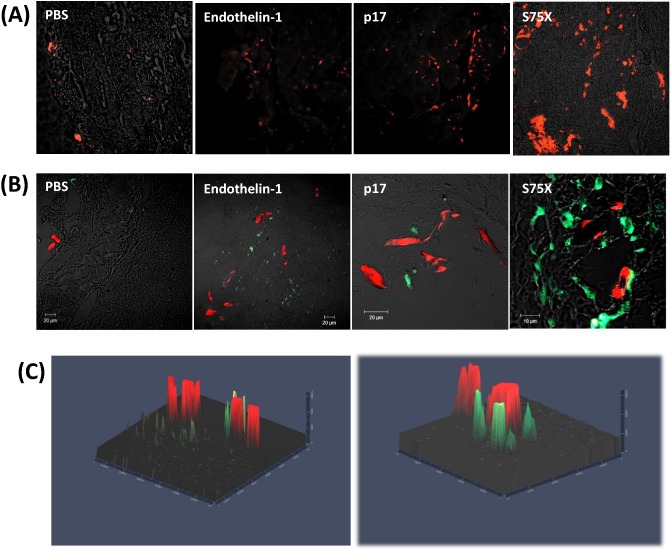
HIV-1 p17/MA induces angiogenesis and lymphangiogenesis in vivo. (A) 5-μm sections were stained with anti-mouse LYVE1-Biotin and anti-mouse Streptavidin FITC (eBioscience). (B) Immunofluorescence double staining of Matrigel slides with anti-CD31 and anti-LYVE1 antibodies to detect blood (red) and lymphatic (green) cells and microvessels. (C) 3D presentation of Z stacks (1 μm each) acquired by imaging blood and lymphatic vessels of p17 and p17S75X matrigel slides.
Figure 4.
Figure 4.
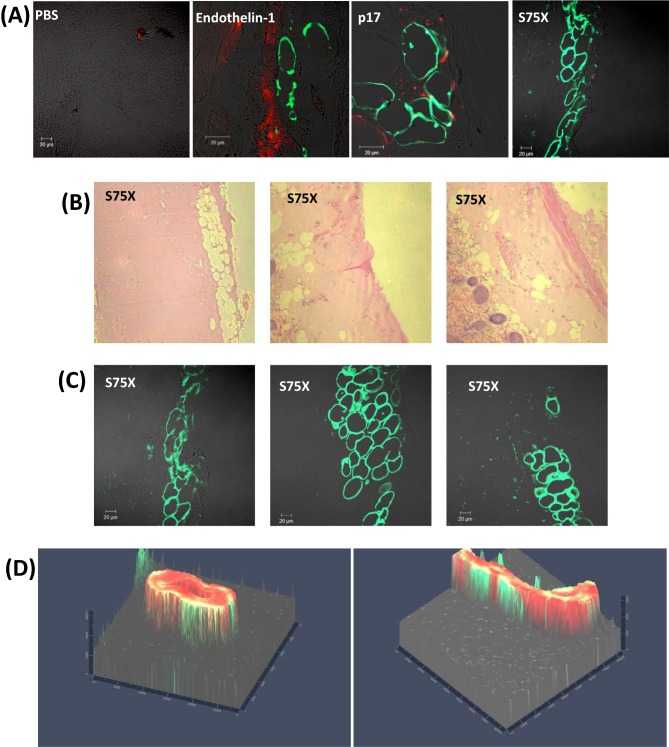
(A) Immunofluorescence assay staining slides from Matrigel plugs with anti-CD31 and anti-Perilipin-A for evidencing blood cells and vessels (red—CD31) and adipocyte cells (green—Perilipin A). (B) Immunohystochimical analysis of 5-μm sections of p17S75X matrigel stained with hematoxylin and eosin. (C) Immunofluorescence slides from p17 S75X Matrigel plugs with anti-Perilipin A antibody. (D) 3D presentation of Z stacks (1 μm each) showing blood vessel (red) surrounded by adipocytes (green) in p17 S75X Matrigel slides.

References

    1. Albini A, Barillari G, Benelli R, et al. Angiogenic properties of human immunodeficiency virus type 1 Tat protein. P Natl Acad Sci USA. 1995;92:4838–42. - PMC - PubMed
    1. Backhed F, Crawford PA, O'Donnell D, et al. Postnatal lymphatic partitioning from the blood vasculature in the small intestine requires fasting-induced adipose factor. P Natl Acad Sci USA. 2007;104:606–11. - PMC - PubMed
    1. Barillari G, Gendelman R, Gallo RC, et al. The Tat protein of human immunodeficiency virus type 1, a growth factor for AIDS Kaposi sarcoma and cytokine-activated vascular cells, induces adhesion of the same cell types by using integrin receptors recognizing the RGD amino acid sequence. P Natl Acad Sci USA. 1993;90:7941–5. - PMC - PubMed
    1. Boshoff C. Kaposi sarcoma, KSHV and lymphangiogenesis. Exp Dermatol. 2007;16:867–8.
    1. Caccuri F, Giagulli C, Bugatti A, et al. HIV-1 matrix protein p17 promotes angiogenesis via chemokine receptors CXCR1 and CXCR2. P Natl Acad Sci USA. 2012;109:14580–5. - PMC - PubMed

Publication types

MeSH terms

Substances