. 2015 Sep 1;5(11):2299-306.
doi: 10.1534/g3.115.021782.

Persistent Activation of the Innate Immune Response in Adult Drosophila Following Radiation Exposure During Larval Development

Affiliations

Persistent Activation of the Innate Immune Response in Adult Drosophila Following Radiation Exposure During Larval Development

Lisa J Sudmeier et al. G3 (Bethesda). .

Abstract

Cranial radiation therapy (CRT) is an effective treatment for pediatric central nervous system malignancies, but survivors often suffer from neurological and neurocognitive side effects that occur many years after radiation exposure. Although the biological mechanisms underlying these deleterious side effects are incompletely understood, radiation exposure triggers an acute inflammatory response that may evolve into chronic inflammation, offering one avenue of investigation. Recently, we developed a Drosophila model of the neurotoxic side effects of radiation exposure. Here we use this model to investigate the role of the innate immune system in response to radiation exposure. We show that the innate immune response and NF-ĸB target gene expression is activated in the adult Drosophila brain following radiation exposure during larval development, and that this response is sustained in adult flies weeks after radiation exposure. We also present preliminary data suggesting that innate immunity is radioprotective during Drosophila development. Together our data suggest that activation of the innate immune response may be beneficial initially for survival following radiation exposure but result in long-term deleterious consequences, with chronic inflammation leading to impaired neuronal function and viability at later stages. This work lays the foundation for future studies of how the innate immune response is triggered by radiation exposure and its role in mediating the biological responses to radiation. These studies may facilitate the development of strategies to reduce the deleterious side effects of CRT.

Keywords: genetics of immunity; innate immunity; neuroinflammation; radioprotection; radiosensitivity.


Figures

Figure 1
Figure 1
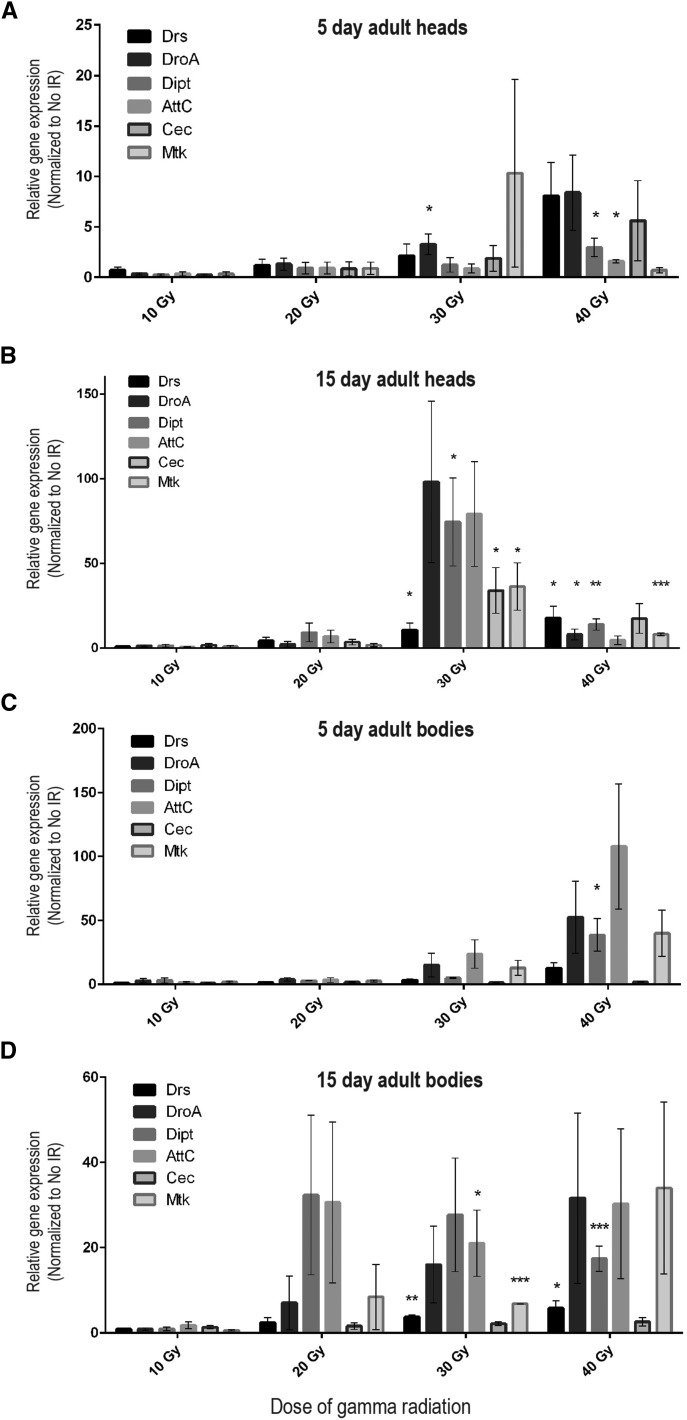
AMP expression in adult heads and bodies is increased following irradiation of larvae. For each dose of radiation during the late third instar, expression of mRNAs encoding six different AMPs in heads (A, B) and bodies (C, D) of 5-d-old and 15-d-old adults was measured by qRT-PCR analysis. Wild-type male Canton-S flies were used for these experiments. Bars represent mean expression of each AMP mRNA (3–5 trials each) normalized to mean expression of the corresponding RNA in nonirradiated, age-matched controls (fold-induction). Error bars are SEM. Rp49 was used as the reference gene. See Table S1 for primers used. *P < 0.05, **P < 0.05, and ***P < 0.01 based on Student’s t-test comparing relative expression in 40 Gy or 30 Gy samples to 10 Gy samples.
Figure 2
Figure 2
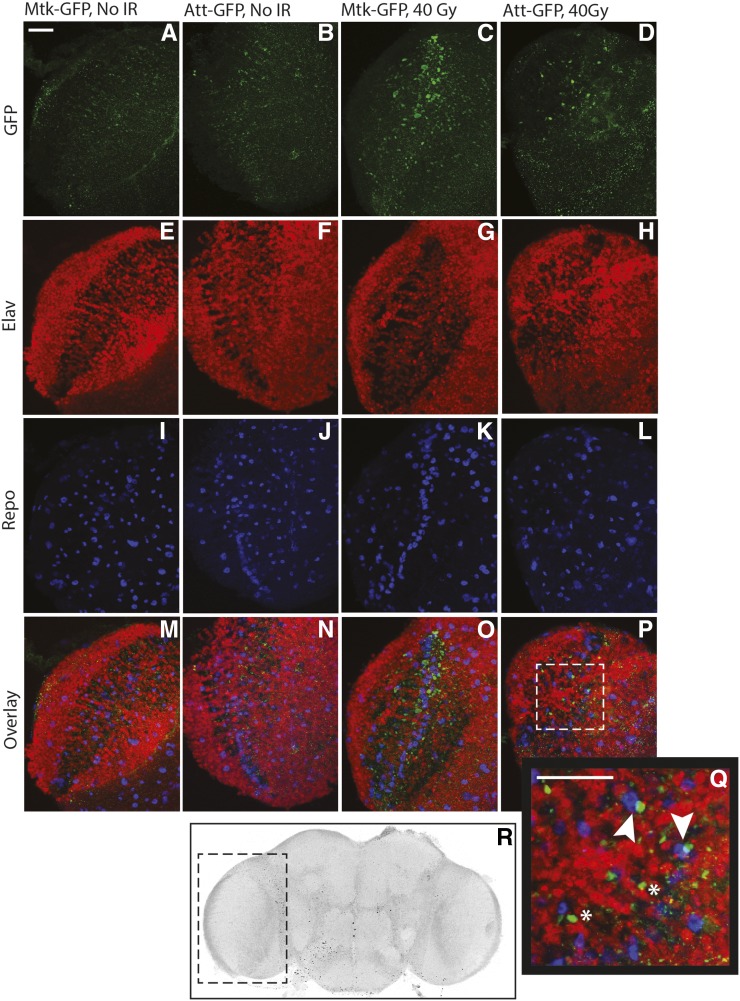
AMP-GFP reporter expression is increased in adult brains following irradiation of larvae. Following exposure of late third instar larvae to a 40-Gy dose of radiation, surviving adults were aged for 5 d after eclosion and brains were dissected for confocal microscopy. (A–Q) Confocal stacks are shown of Metchnikowin-GFP and Attacin-GFP brains immunostained for GFP (green, A–D), the neuronal (nuclear) marker Elav (red, E–H), and the glial (nuclear) marker Repo (blue, I–L). All markers are shown in the overlay (M–P). Images are of the optic lobe, as shown by the dashed box in (R). The indicated region of (P) (Attacin-GFP) is shown at higher magnification in the inset (Q). Brains from adults that were irradiated during larval development show increased GFP expression (C, D) compared to brains from adults that were not irradiated as larvae (A, B). Some of the GFP+ puncta are in close proximity to nuclei that are Repo+ (arrowheads in Q) or Elav+ (* in Q). Scale bars are 20 μm; 7–10 brains of each genotype for each condition were analyzed.
Figure 3
Figure 3
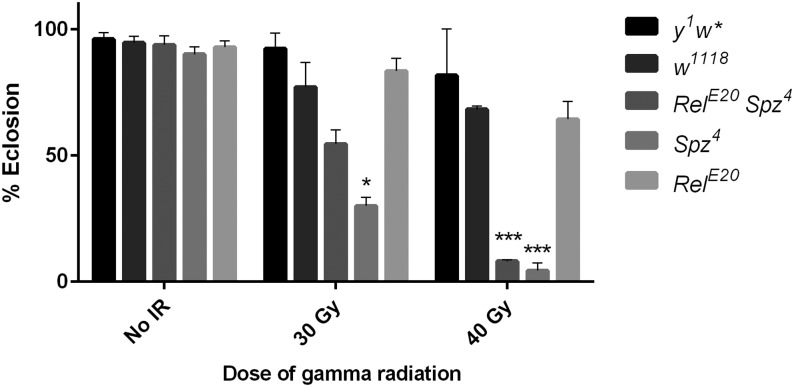
Activation of the innate immune response may be radioprotective during larval development. For each dose of radiation, the percentage of irradiated third instar larvae that complete development and eclose as adults is shown for the indicated genotypes. Loss of both Toll and Imd signaling (RelE20 spz4) or Toll signaling alone (spz4) results in increased sensitivity to radiation compared with controls. Each bar represents mean ± SEM for two to five trials with 20–40 larvae per trial. ***P < 0.001 based on Student’s t-test comparing RelE20 spz4 40 Gy or spz4 40 Gy to w1118 40 Gy. *P < 0.05 based on Student’s t-test comparing spz4 30 Gy to w1118 30 Gy.

References

    1. Armstrong G. T., Liu Q., Yasui Y., Huang S., Ness K. K., et al. , 2009. Long-term outcomes among adult survivors of childhood central nervous system malignancies in the Childhood Cancer Survivor Study. J. Natl. Cancer Inst. 101: 946–958. - PMC - PubMed
    1. Belvin M. P., Anderson K. V., 1996. A conserved signaling pathway: the Drosophila toll-dorsal pathway. Annu. Rev. Cell Dev. Biol. 12: 393–416. - PubMed
    1. Bulet P., Stöcklin R., Menin L., 2004. Anti-microbial peptides: from invertebrates to vertebrates. Immunol. Rev. 198: 169–184. - PubMed
    1. Burdelya L. G., Krivokrysenko V. I., Tallant T. C., Strom E., Gleiberman A. S., et al. , 2008. An agonist of toll-like receptor 5 has radioprotective activity in mouse and primate models. Science 320: 226–230. - PMC - PubMed
    1. Cao Y., Chtarbanova S., Petersen A. J., Ganetzky B., 2013. Dnr1 mutations cause neurodegeneration in Drosophila by activating the innate immune response in the brain. Proc. Natl. Acad. Sci. USA 110: E1752–E1760. - PMC - PubMed

Publication types

MeSH terms

LinkOut - more resources