


Anti-D administration in pregnancy for preventing Rhesus alloimmunisation
- PMID: 26334436
- PMCID: PMC7061251
- DOI: 10.1002/14651858.CD000020.pub3
Anti-D administration in pregnancy for preventing Rhesus alloimmunisation
Abstract
Background: During pregnancy, a Rhesus negative (Rh-negative) woman may develop antibodies when her fetus is Rhesus positive (Rh-positive). These antibodies may harm Rh-positive babies.
Objectives: To assess the effects of antenatal anti-D immunoglobulin on the incidence of Rhesus D alloimmunisation when given to Rh-negative women without anti-D antibodies.
Search methods: We searched the Cochrane Pregnancy and Childbirth Group's Trials Register (31 May 2015) and reference lists of retrieved studies.
Selection criteria: Randomised trials in Rh-negative women without anti-D antibodies given anti-D after 28 weeks of pregnancy, compared with no treatment, placebo or a different regimen of anti-D.
Data collection and analysis: Two review authors independently assessed trials for inclusion and risk of bias, extracted data and checked them for accuracy.
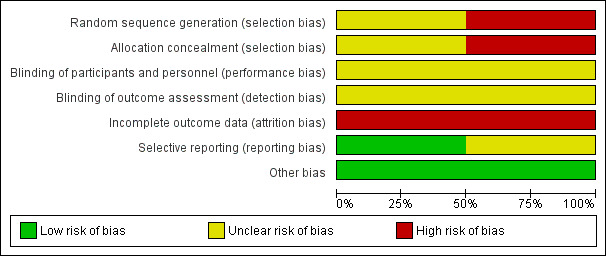
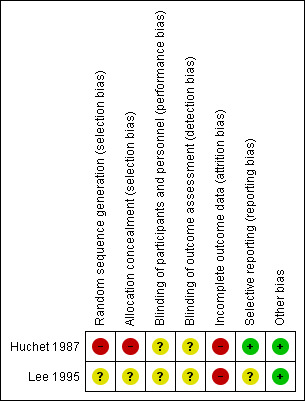
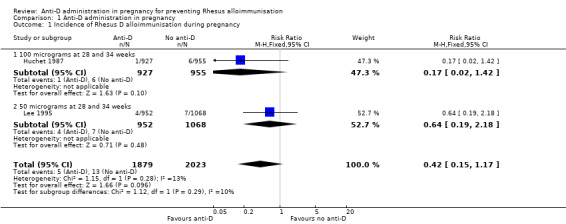
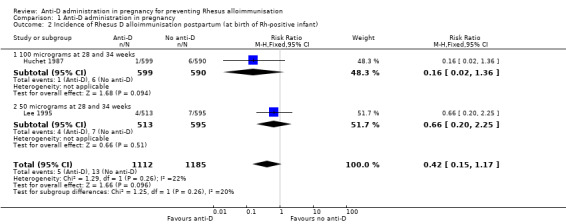
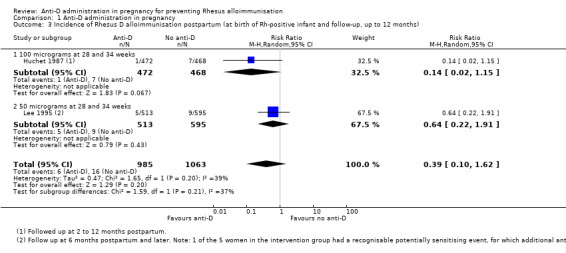
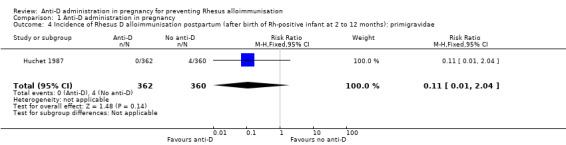
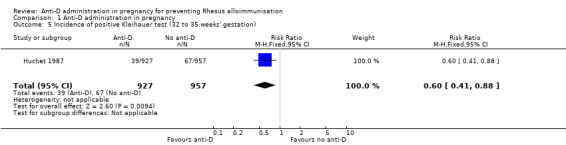
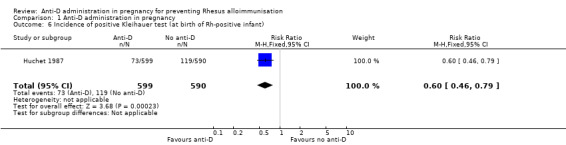
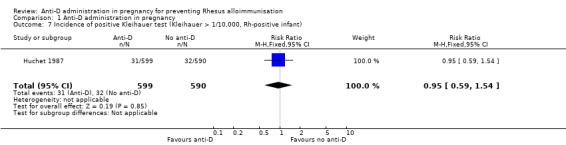
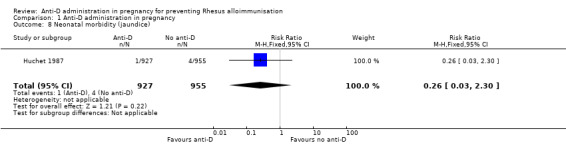
Main results: We included two trials involving over 4500 women, comparing anti-D prophylaxis with no anti-D during pregnancy in this review. Overall, the trials were judged to be at moderate to high risk of bias. The quality of the evidence for pre-specified outcomes was also assessed using the GRADE (Grades of Recommendation, Assessment, Development and Evaluation) approach.In regards to primary review outcomes, there did not appear to be a clear difference in the risks of immunisation when women who received anti-D at 28 and 34 weeks' gestation were compared with women who were not given antenatal anti-D: risk ratio (RR) for incidence of Rhesus D alloimmunisation during pregnancy was 0.42 (95% confidence interval (CI) 0.15 to 1.17, two trials, 3902 women; GRADE: low quality evidence); at birth of a Rh-positive infant the RR was 0.42 (95% CI 0.15 to 1.17, two trials, 2297 women); and within 12 months after birth of a Rh-positive infant the average RR was 0.39 (95% CI 0.10 to 1.62, two trials, 2048 women; Tau²: 0.47; I²: 39%; GRADE: low quality evidence). Neither of the trials reported on incidence of Rhesus D alloimmunisation in subsequent pregnancies.Considering secondary outcomes, in one trial, women receiving anti-D during pregnancy were shown to be less likely to register a positive Kleihauer test (which detects fetal cells in maternal blood) in pregnancy (at 32 to 25 weeks) (RR 0.60, 95% CI 0.41 to 0.88; 1884 women; GRADE: low quality evidence) and at the birth of a Rh-positive infant (RR 0.60, 95% CI 0.46 to 0.79; 1189 women; GRADE: low quality evidence). No clear differences were seen for neonatal jaundice (RR 0.26, 95% CI 0.03 to 2.30; 1882 infants; GRADE: very low quality evidence). Neither of the trials reported on adverse effects associated with anti-D treatment.
Authors' conclusions: Existing studies do not provide conclusive evidence that the use of anti-D during pregnancy benefits either mother or baby in terms of incidence of Rhesus D alloimmunisation during the pregnancy or postpartum, or the incidence of neonatal morbidity (jaundice) (low to very low quality evidence). However women receiving anti-D may be less likely to register a positive Kleihauer test in pregnancy and at the birth of a Rh-positive infant (low quality evidence). Fewer women who receive anti-D during pregnancy may have Rhesus D antibodies in a subsequent pregnancy, with benefits for the baby, however this needs to be tested in studies of robust design.
Conflict of interest statement
None known.
Figures
Update of
-
Anti-D administration in pregnancy for preventing Rhesus alloimmunisation.Cochrane Database Syst Rev. 2013 Feb 28;(2):CD000020. doi: 10.1002/14651858.CD000020.pub2. Cochrane Database Syst Rev. 2013. Update in: Cochrane Database Syst Rev. 2015 Sep 03;(9):CD000020. doi: 10.1002/14651858.CD000020.pub3. PMID: 23450526 Updated.
References
References to studies included in this review
Huchet 1987 {published data only}
-
- Huchet J, Dallemagne S, Huchet C, Brossard Y, Larsen M, Parnet‐Mathieu F. The antepartum use of anti‐D immunoglobulin in rhesus negative women. Parallel evaluation of fetal blood cells passing through the placenta. The results of a multi‐centre study carried out in the region of Paris. European Journal of Obstetrics, Gynecology, and Reproductive Biology 1987;16:101‐11. - PubMed
Lee 1995 {published data only}
-
- Lee D, Rawlinson VI. Multicentre trial of antepartum low‐dose anti‐D immunoglobulin. Transfusion Medicine 1995;5:15‐9. - PubMed
References to studies excluded from this review
Ismail 2002 {published and unpublished data}
-
- Ismail K, Kilby M, Alfirevic Z, Khan K, Whittle M. Prospective randomised trial of alloimmunisation management (PRAM). Journal of Obstetrics and Gynaecology 2002;22(2 Suppl):S33.
References to ongoing studies
ACTRN12613000661774 {published data only}
-
- ACTRN12613000661774. Detectability of anti‐D and compliance in two regimens. https://www.anzctr.org.au/Trial/Registration/TrialReview.aspx?ACTRN=1261... (accessed 6 May 2015).
CTRI/2008/091/000157 {published data only}
-
- CTRI/2008/091/000157. A clinical trial to study the effect of injection anti D administered during pregnancy for Rh negative mothers. http://www.ctri.nic.in/Clinicaltrials/pmaindet2.php?trialid=172 (accessed 6 May 2015).
Additional references
Bishler 2003
-
- Bishler J, Schondorfer G, Pabst G, Andresen I. Pharmacokinetics of anti‐D IgG in pregnant Rh‐D negative women. British Journal of Obstetrics and Gynaecology 2003;110:39‐45. - PubMed
Boruchov 2005
Bowman 1965
-
- Bowman JM, Pollock JM. Amniotic fluid spectrophotometry and early delivery in the management of erythroblastosis fetalis. Pediatrics 1965;35:815. - PubMed
Bowman 1996
-
- Bowman JM. Hemolytic disease of the newborn. Vox Sanguinis 1996;70:62‐7.
Chilcott 2002
-
- Chilcott J, Lloyd Jones M, Wight J, Forman K, Wray J, Beverley C. A review of the clinical effectiveness and cost effectiveness of routine anti‐D prophylaxis for pregnant women who are Rhesus (RhD) negative. London: National Institute of Clinical Excellence, 2002. - PubMed
Chown 1954
-
- Chown B. Anaemia from bleeding of the fetus into the mother’s circulation. Lancet 1954;263(6824):1213. - PubMed
Contreras 1998
-
- Contreras M. The prevention of Rh haemolytic disease of the fetus and newborn ‐ general background. British Journal of Obstetrics and Gynaecology 1998;105:7‐10. - PubMed
Coopamah 2003
-
- Coopamah MD, Freeman J, Semple JW. Anti‐D initially stimulates an Fc‐dependant leukocyte oxidative burst and subsequently suppresses erythrophagocytosis via interleukin‐1 receptor antagonist. Blood 2003;102:2862‐7. - PubMed
Craig 1998
-
- Craig JS, McClure BG, Tubman TRJ. Services should be centralised for pregnancies affected by RhD haemolytic disease. BMJ 1998;316:1611. - PubMed
Crowther 1997
Davey 1979
-
- Davey MG, Zipursky A. Proceedings of the McMaster Rh Conference. Vox Sanguinis 1979;36:50‐64.
Engelfriet 2003
-
- Engelfriet CP, Reesink HW, Judd WJ, Ulander VM, Kuosmanen M, Koskinen S, et al. Current status of immunoprophylaxis with anti‐D immunoglobin. Vox Sanguinis 2003;85(4):328‐37. - PubMed
GRADE 2014
-
- McMaster University.GRADEpro. [Computer program on www.gradepro.org]. Version [2014]. McMaster University, 2014..
Gravenhorst 1989
-
- Gravenhorst JB. Rhesus isoimmunisation. In: Chalmers I, Enkin MW, Keirse MJNC editor(s). Effective Care in Pregnancy and Childbirth. Oxford: Oxford University Press, 1989:565‐77.
Gunson 1976
-
- Gunson HH, Stratton F, Philips PK. The primary Rho(D) immune response in male volunteers. British Journal of Haematology 1976;32:317‐29. - PubMed
Higgins 2011
-
- Higgins JPT, Green S, editors. Cochrane Handbook for Systematic Reviews of Interventions Version 5.1.0 [updated March 2011]. The Cochrane Collaboration, 2011. Available from www.cochrane‐handbook.org.
Jones 2004
-
- Jones ML, Wray J, Wright J, Chilcott J, Forman K, Tappenden P, et al. A review of the clinical effectiveness of routine antenatal anti‐D prophylaxis for rhesus‐negative women who are pregnant. British Journal of Obstetrics and Gynaecology 2004;111:892‐902. - PubMed
Kumpel 2001
-
- Kumpel BM, Elson CJ. Mechanism of anti‐D mediated immune suppression ‐ a paradox awaiting resolution?. Trends in Immunology 2001;22:26‐31. - PubMed
Kumpel 2002
-
- Kumpel BM. On the mechanism of tolerance to the Rh D antigen mediated by passive anti‐D (Rh D prophylaxis). Immunology Letters 2002;82:67‐73. - PubMed
Liumbruno 2010
Mackenzie 2006
-
- Mackenzie IZ, Roseman F, Findlay J, Thompson K, Jackson E, Scott J, et al. The kinetics of routine antenatal prophylactic intramuscular injections of polyclonal anti‐D immunoglobin. British Journal of Obstetrics and Gynaecology 2006;113:97‐101. - PubMed
National Blood 2003
-
- National Blood Authority. Guidelines on the prophylactic use of Rh D immunoglobulin (anti‐D) in obstetrics. Canberra, ACT: NHMRC, 2003.
NHS 2011
-
- NHS National Institute for Health and Clinical Excellece. Routine antenatal anti‐D prophylaxis for women who are rhesus D negative: Review of NICE technology appraisal guidance 41. http://www.nice.org.uk/ (accessed 14 November 2012).
RANZCOG 2004
-
- Royal Australian and New Zealand College of Obstetricians and Gynaecologists. Guidelines for the use of RhD immunoglobulin (Anti‐D) in obstetrics in Australia. www.ranzcog.edu.au/ (accessed 2 November 2012).
RCOG 2011
-
- Royal College of Obstetricians and Gynaecologists. The use of anti‐D immunoglobulin for rhesus D prophylaxis. Green‐top guideline. http://www.rcog.org.uk/ (accessed 14 November 2012).
RevMan 2014 [Computer program]
-
- The Nordic Cochrane Centre, The Cochrane Collaboration. Review Manager (RevMan). Version 5.3. Copenhagen: The Nordic Cochrane Centre, The Cochrane Collaboration, 2014.
Schunemann 2009
-
- Schunemann HJ. GRADE: from grading the evidence to developing recommendations. A description of the system and a proposal regarding the transferability of the results of clinical research to clinical practice [GRADE: Von der Evidenz zur Empfehlung. Beschreibung des Systems und Losungsbeitrag zur Ubertragbarkeit von Studienergebnissen]. Zeitschrift fur Evidenz, Fortbildung und Qualitat im Gesundheitswesen 2009;103(6):391‐400. - PubMed
Stern 1961
-
- Stern K, Goodman HS, Berger M. Experimental isoimmunisation to hemoantigens in man. Journal of Immunology 1961;87:189.
Turner 2012
References to other published versions of this review
Crowther 1999
-
- Crowther CA, Middleton P. Anti‐D administration in pregnancy for preventing Rhesus alloimmunisation. Cochrane Database of Systematic Reviews 1999, Issue 2. [DOI: 10.1002/14651858.CD000020] - DOI
Publication types
MeSH terms
Substances
LinkOut - more resources
Full Text Sources
Other Literature Sources
Medical
