


Current Developments in Dementia Risk Prediction Modelling: An Updated Systematic Review
- PMID: 26334524
- PMCID: PMC4559315
- DOI: 10.1371/journal.pone.0136181
Current Developments in Dementia Risk Prediction Modelling: An Updated Systematic Review
Abstract
Background: Accurate identification of individuals at high risk of dementia influences clinical care, inclusion criteria for clinical trials and development of preventative strategies. Numerous models have been developed for predicting dementia. To evaluate these models we undertook a systematic review in 2010 and updated this in 2014 due to the increase in research published in this area. Here we include a critique of the variables selected for inclusion and an assessment of model prognostic performance.
Methods: Our previous systematic review was updated with a search from January 2009 to March 2014 in electronic databases (MEDLINE, Embase, Scopus, Web of Science). Articles examining risk of dementia in non-demented individuals and including measures of sensitivity, specificity or the area under the curve (AUC) or c-statistic were included.
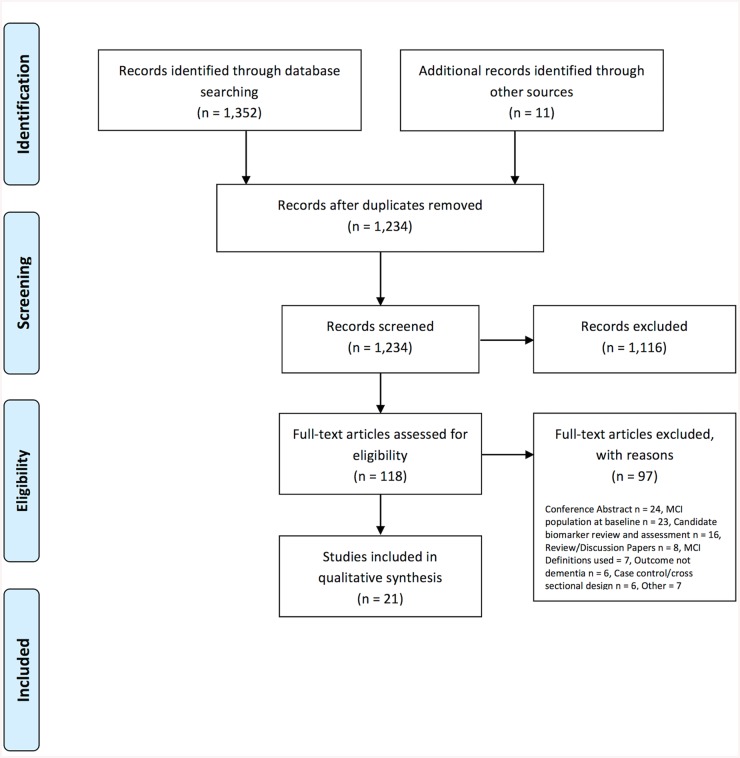
Findings: In total, 1,234 articles were identified from the search; 21 articles met inclusion criteria. New developments in dementia risk prediction include the testing of non-APOE genes, use of non-traditional dementia risk factors, incorporation of diet, physical function and ethnicity, and model development in specific subgroups of the population including individuals with diabetes and those with different educational levels. Four models have been externally validated. Three studies considered time or cost implications of computing the model.
Interpretation: There is no one model that is recommended for dementia risk prediction in population-based settings. Further, it is unlikely that one model will fit all. Consideration of the optimal features of new models should focus on methodology (setting/sample, model development and testing in a replication cohort) and the acceptability and cost of attaining the risk variables included in the prediction score. Further work is required to validate existing models or develop new ones in different populations as well as determine the ethical implications of dementia risk prediction, before applying the particular models in population or clinical settings.
Conflict of interest statement
Figures
References
-
- Liberati A, Altman DG, Tetzlaff J, Mulrow C, Gotzsche PC, Ioannidis JP, et al. The PRISMA statement for reporting systematic reviews and meta-analyses of studies that evaluate health care interventions: explanation and elaboration. Journal of clinical epidemiology. 2009;62(10):e1–34. 10.1016/j.jclinepi.2009.06.006 . - DOI - PubMed
-
- Anstey KJ, Cherbuin N, Herath PM. Development of a new method for assessing global risk of Alzheimer's disease for use in population health approaches to prevention. Prevention science: the official journal of the Society for Prevention Research. 2013;14(4):411–21. Epub 2013/01/16. 10.1007/s11121-012-0313-2 ; PubMed Central PMCID: PMCPmc3696462. - DOI - PMC - PubMed
-
- Wells GA, Shea B, O'Connell B, Peterson J, Welch V, Losos M, et al. The Newcastle-Ottawa scale (NOS) for assessing the quality of nonrandomised studies in meta-analysis [cited 2014 19/03/2014]. Available: http://www.ohri.ca/programs/clinical_epidemiology/oxford.asp.
Publication types
MeSH terms
Grants and funding
LinkOut - more resources
Full Text Sources
Other Literature Sources
Medical
Miscellaneous
