


Antiretroviral Regimen Durability and Success in Treatment-Naive and Treatment-Experienced Patients by Year of Treatment Initiation, United States, 1996-2011
- PMID: 26334737
- PMCID: PMC4713274
- DOI: 10.1097/QAI.0000000000000813
Antiretroviral Regimen Durability and Success in Treatment-Naive and Treatment-Experienced Patients by Year of Treatment Initiation, United States, 1996-2011
Abstract
Background: Although modern combination antiretroviral therapy (cART) regimens are better tolerated and less complex than earlier treatments, regimen modification or discontinuation remains a concern.
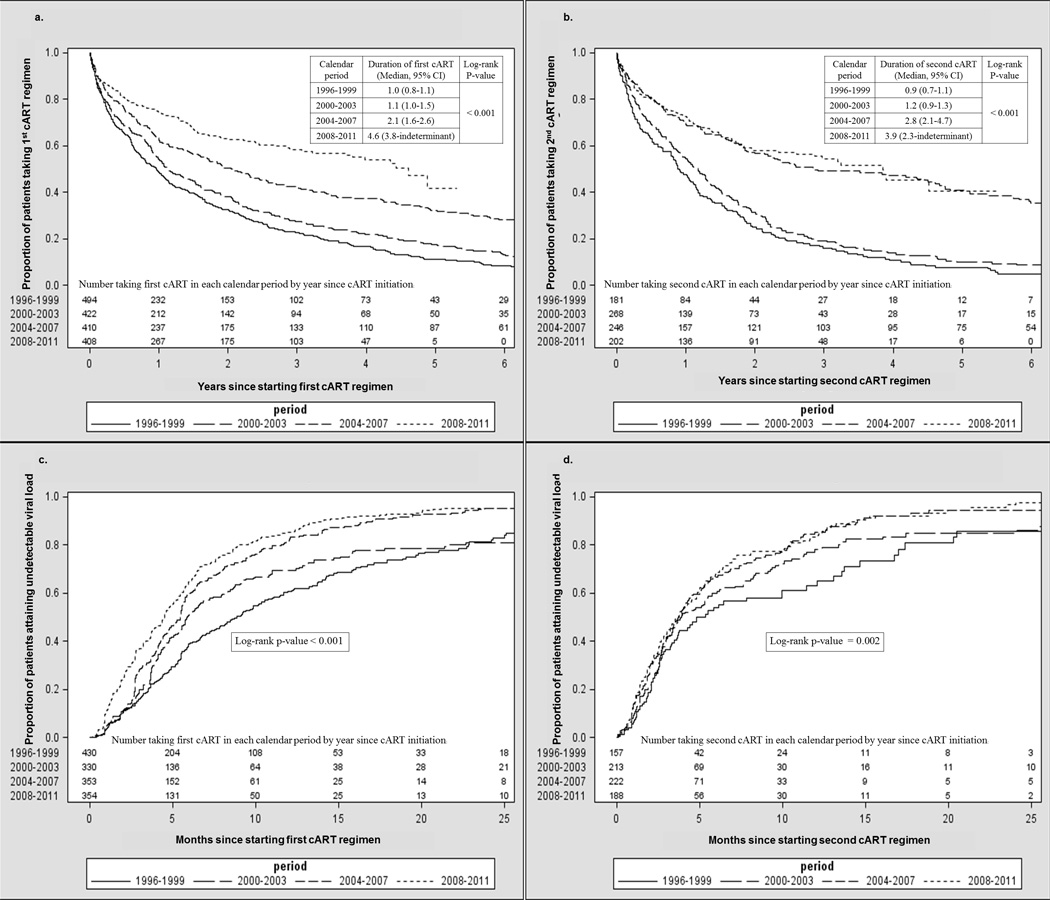
Methods: We studied HIV Outpatient Study (HOPS) participants who initiated the first or second cART regimens during: 1996-1999, 2000-2003, 2004-2007, and 2008-2011. We analyzed regimen durability (time to regimen modification) and success (achieving undetectable plasma HIV RNA) for the first and second cART regimens using Kaplan-Meier curves and log-rank tests, and examined factors associated with durability and success of the first cART regimen using proportional hazards models.
Results: Durability of cART was progressively longer for cART regimens initiated in more recent periods: median first cART regimen durations were 1.0, 1.1, 2.1, and 4.6 years in 1996-1999, 2000-2003, 2004-2007, and 2008-2011, and the median second cART durations were 0.9, 1.2, 2.8, and 3.9 years, respectively (both P < 0.001). Comparing 1996-1999 and 2008-2011, the percentage of patients who achieved an undetectable HIV RNA within 6 months of first cART initiation increased from 65% to 81% and from 63% to 80% on second cART (both P < 0.001). Among patients initiating first cART during 2008-2011, black non-Hispanic/Latino race/ethnicity and ≥ twice-daily dosing were significantly associated with higher rates of regimen modification (P < 0.05), and higher baseline HIV RNA levels were associated with failure to achieve an undetectable HIV RNA (P < 0.001).
Conclusions: Among HIV-infected U.S. adults in routine HIV care, durability of the first and second cART regimens and the likelihood of prompt virological suppression increased during 1996-2011, coincident with the availability of more tolerable, less complex cART options.
Figures
References
-
- Palella FJ, Jr, Delaney KM, Moorman AC, et al. Declining morbidity and mortality among patients with advanced human immunodeficiency virus infection. HIV Outpatient Study Investigators. N.Engl.J Med. 1998;338(13):853–860. - PubMed
-
- Palella FJ, Jr, Chmiel JS, Moorman AC, Holmberg SD. Durability and predictors of success of highly active antiretroviral therapy for ambulatory HIV-infected patients. AIDS. 2002;16(12):1617–1626. - PubMed
-
- Phillips AN, Miller V, Sabin C, et al. Durability of HIV-1 viral suppression over 3.3 years with multi-drug antiretroviral therapy in previously drug-naive individuals. AIDS. 2001;15(18):2379–2384. - PubMed
-
- Chen RY, Westfall AO, Mugavero MJ, et al. Duration of highly active antiretroviral therapy regimens. Clin.Infect.Dis. 2003;37(5):714–722. - PubMed
Publication types
MeSH terms
Substances
Grants and funding
LinkOut - more resources
Full Text Sources
Other Literature Sources
Medical
