


Crepuscular Behavioral Variation and Profiling of Opsin Genes in Anopheles gambiae and Anopheles stephensi (Diptera: Culicidae)
- PMID: 26334802
- PMCID: PMC4445134
- DOI: 10.1093/jme/tjv024
Crepuscular Behavioral Variation and Profiling of Opsin Genes in Anopheles gambiae and Anopheles stephensi (Diptera: Culicidae)
Abstract
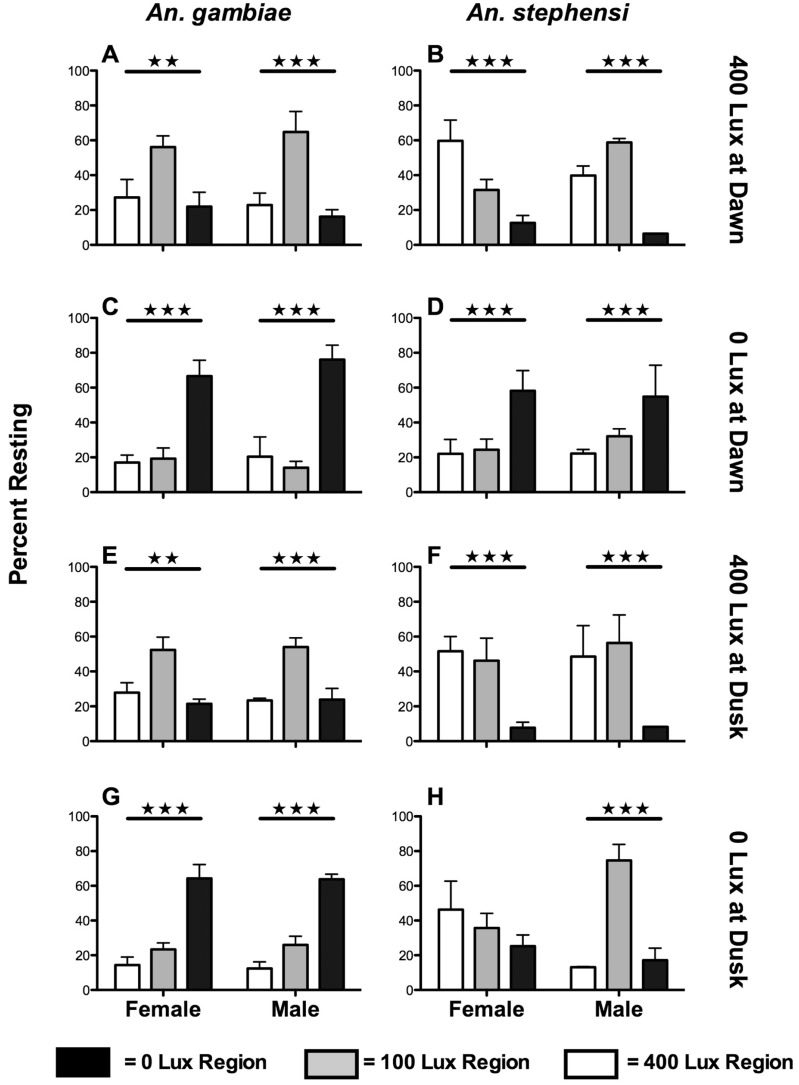
We understand little about photo-preference and the molecular mechanisms governing vision-dependent behavior in vector mosquitoes. Investigations of the influence of photo-preference on adult mosquito behaviors such as endophagy and exophagy and endophily and exophily will enhance our ability to develop and deploy vector-targeted interventions and monitoring techniques. Our laboratory-based analyses have revealed that crepuscular period photo-preference differs between An. gambiae and An. stephensi. We employed qRT-PCR to assess crepuscular transcriptional expression patterns of long wavelength-, short wavelength-, and ultraviolet wavelength-sensing opsins (i.e., rhodopsin-class G-protein coupled receptors) in An. gambiae and in An. stephensi. Transcript levels do not exhibit consistent differences between species across diurnal cycles, indicating that differences in transcript abundances within this gene set are not correlated with these behavioral differences. Using developmentally staged and gender-specific RNAseq data sets in An. gambiae, we show that long wavelength-sensing opsins are expressed in two different patterns (one set expressed during larval stages, and one set expressed during adult stages), while short wavelength- and ultraviolet wavelength-sensing opsins exhibit increased expression during adult stages. Genomic organization of An. gambiae opsins suggests paralogous gene expansion of long wavelength-sensing opsins in comparison with An. stephensi. We speculate that this difference in gene number may contribute to variation between these species in photo-preference behavior (e.g., visual sensitivity).
Keywords: Anopheles gambiae; Anopheles stephensi; crepuscular behavior; photopreference; rhodopsin.
© The Authors 2015. Published by Oxford University Press on behalf of Entomological Society of America.
Figures



References
-
- Ali A., Nayar J. K., Knight J. W., Stanley B. H. 1989. Attraction of Florida mosquitoes (Diptera:Culicidae) to artificial light in the field. 57th Annu. Conf. Calif. Mosq. Vector Control Assoc. Inc. Los Angeles, California, USA.
-
- Allan S. A, Day J. F., Edman J. D. 1987. Visual ecology of biting flies. Annu. Rev. Entomol. 32: 297–316. - PubMed
-
- Alonso P. L., Tanner M. 2013. Public health challenges and prospects for malaria control and elimination. Nat. Med. 19: 150–155. - PubMed
-
- Bentley M. T., Kaufman P. E., Kline D. L., Hogsette J. A. 2009. Response of adult mosquitoes to light-emitting diodes placed in resting boxes and in the field. J. Am. Mosq. Control Assoc. 25: 285–291. - PubMed
-
- Bray P. G., Mungthin M., Ridley R. G., Ward S. A. 1998. Access to hematin: The basis of chloroquine resistance. Mol. Pharmacol. 54: 170–179. - PubMed
Publication types
MeSH terms
Substances
Associated data
LinkOut - more resources
Full Text Sources
Other Literature Sources
