. 2015 Nov;17(6):740-8.
doi: 10.1016/j.jmoldx.2015.06.007. Epub 2015 Sep 1.

CYP2D6 Haplotype Determination Using Long Range Allele-Specific Amplification: Resolution of a Complex Genotype and a Discordant Genotype Involving the CYP2D6*59 Allele

Affiliations

CYP2D6 Haplotype Determination Using Long Range Allele-Specific Amplification: Resolution of a Complex Genotype and a Discordant Genotype Involving the CYP2D6*59 Allele

Andrea Gaedigk et al. J Mol Diagn. 2015 Nov.

Abstract

Cytochrome P450 (CYP) 2D6, a major contributor to the metabolism and bioactivation of many clinically used drugs, is encoded by a complex, highly polymorphic gene locus. To aid in the characterization of CYP2D6 allelic variation, we developed allele-specific long-range PCR (ASXL-PCR) to amplify only the allele of interest for further characterization by PCR. This development was achieved utilizing single-nucleotide polymorphisms in the upstream region of CYP2D6 and a universal CYP2D6-specific reverse primer. This approach was assessed and optimized on samples with known genotypes. The application of ASXL-PCR clarified a case with a complex genotype (CYP2D6*2x2/*4N+*4) by amplifying the duplicated gene units separately for subsequent analysis. Furthermore, ASXL-PCR and subsequent sequence analysis also resolved genotype discord in a mother/daughter relationship by revealing the presence of the CYP2D6*59 allelic variant in both individuals. Finally, we demonstrated that the 2939G>A single-nucleotide polymorphism present on CYP2D6*59 interfered with the TaqMan genotype assay that detected 2850C>T, causing false genotype assignments. Assay interference was resolved using an alternative TaqMan genotype assay currently available as a custom-made assay. These examples demonstrate the utility of ASXL-PCR for improved CYP2D6 allele/haplotype characterization. This fast, easy-to-perform method is not limited to CYP2D6 but can be adapted to any gene locus for which polymorphic sites are known.


Figures

Figure 1
Figure 1
Principle and optimization of allele-specific amplification combined with long-range (ASXL)-PCR. A: The sequence context of the -1584C>G single-nucleotide polymorphism (SNP) (black; SNP is in bold). Primer sequences amplifying either -1584C or -1584G are shown in gray, with matching and mismatching nucleotides at their respective -3′ ends in black and bold. The arrow indicates that a perfectly matching primer is extended; primers with mismatches are not extended, as indicated by an X in the arrow. B: Summary of SNP positions that can be utilized to discriminate CYP2D6*1, *2A, and *4 alleles. SNP positions are shown in reference to AY545216 (+1 = A in the ATG translation start codon). The nucleotide for which AS amplification was achieved is in bold. Gray boxes denote the primers designed based on sequence information for that allele and the alleles that will be amplified with a given AS primer. For example, the CYP2D6*1 and *4 alleles can be separated utilizing positions -2609 (amplifies *4), -2523 (amplifies *1), -2421 (amplifies *4), -2178 (amplifies *1), -1426 (amplifies *1), and -1000 (amplifies *1). CYP2D6*1/*1 and *2A/*2A gDNA samples were amplified with primer -1584C>G (C). The -1584C>G primer amplified a 6358-bp fragment from the CYP2D6*1 (-1584C), but not the CYP2D6*2A (-1584G) allele. D: Real-time ASXL-PCR with primer -740C>T amplifies from the CYP2D6*4 allele (-740C) but not the *1 allele (-740T). Nucleotides providing AS amplification are underlined. var, variant; wt, wild type.
Figure 2
Figure 2
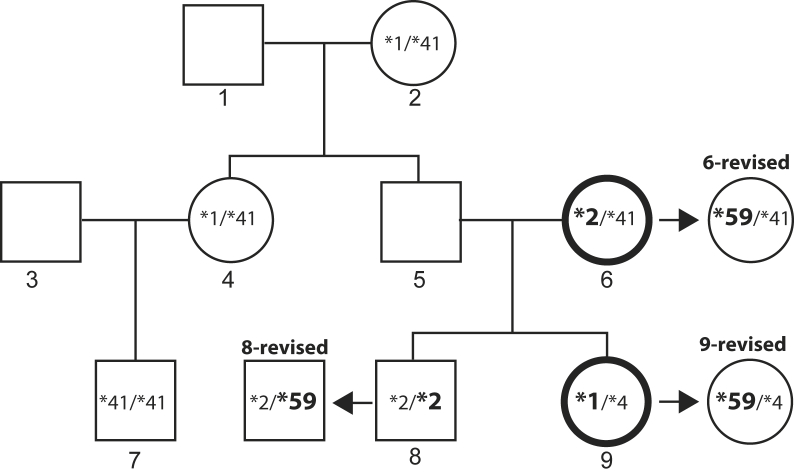
Pedigree of a family with initial genotype discord. The genotypes of subjects 6 and 9, mother and daughter, shown with bold circles, were discordant when originally tested. The son's (subject 8) genotype was initially not discordant. Revised genotypes for subjects 6, 8, and 9 containing a CYP2D6*59 allele are indicated with an arrow. Alleles revised are shown in bold and larger font.
Figure 3
Figure 3
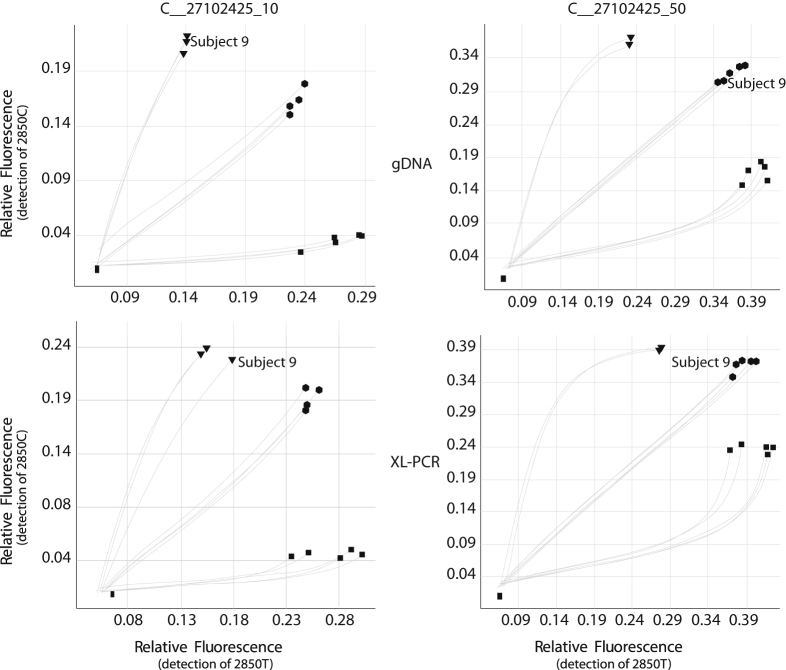
TaqMan (Life Technologies Corporation, Carlsbad, CA) cluster plots with the original (C__27102425_10) and alternate (C__27102425_50) assays for 2850C>T (rs16947). The x and y axes show relative fluorescence for 2850T (variant) and 2850C (wild type), respectively. Clusters are shown with trajectory lines. Pedigree subject 9 clusters with other homozygous wild-type samples (2850C/C) with the initial assay (C__27102425_10) while clustering with heterozygous samples (2850C/T) when run with the alternate assay (C__27102425_50). The homozygous variant cluster (2850T/T) is also shown. gDNA, genomic DNA; XL-PCR, long-range PCR.
Figure 4
Figure 4
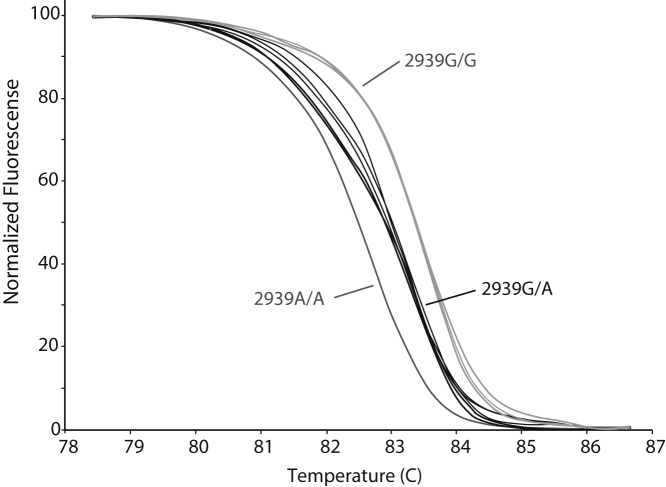
Normalized high-resolution melt curve analysis of the CYP2D6*59 2939G>A tag single-nucleotide polymorphism. Curves represent individuals with 2939G/G, 2939G/A, and 2939A/A genotypes, as indicated. The assay was performed on long-range PCR templates.
Figure 5
Figure 5
Overview of a complex CYP2D6 genotype that was resolved using allele-specific long-range PCR. The graph displays the two allelic variants of the subject. CYP2D6, 2D7, and 2D8 are shown in different gray shades. REP denotes repetitive sequences located downstream of CYP2D6 and 2D7. REP-DUP refers to the REP sequence found downstream of a duplicated gene. REP7 is interrupted from common downstream sequences (dark-gray boxes) by a 1.6-Kb region, referred to as spacer. Extra-long PCR fragments are shown as lines under the genes that support their amplification; the X indicates that this fragment was not generated from this gene copy. The hatched line for fragment D indicates that amplification from the CYP2D6*4 allele was poor due to more efficient amplification from the CYP2D6*2 allele. Exon 1 (ex1) and intron 6 (in6) denote the regions amplified by quantitative PCR to determine gene copy number (regions in intron 5 and exon 9 that were also assessed are not shown).

References

    1. Zhou S.F. Polymorphism of human cytochrome P450 2D6 and its clinical significance: part I. Clin Pharmacokinet. 2009;48:689–723. - PubMed
    1. Zhou S.F. Polymorphism of human cytochrome P450 2D6 and its clinical significance: part II. Clin Pharmacokinet. 2009;48:761–804. - PubMed
    1. Sim S.C., Ingelman-Sundberg M. Update on Allele Nomenclature for Human Cytochromes P450 and the Human Cytochrome P450 Allele (CYP-Allele) Nomenclature Database. Methods Mol Biol. 2013;987:251–259. - PubMed
    1. Teh L.K., Bertilsson L. Pharmacogenomics of CYP2D6: molecular genetics, interethnic differences and clinical importance. Drug Metab Pharmacokinet. 2012;27:55–67. - PubMed
    1. Zanger U.M., Raimundo S., Eichelbaum M. Cytochrome P450 2D6: overview and update on pharmacology, genetics, biochemistry. Naunyn Schmiedebergs Arch Pharmacol. 2004;369:23–37. - PubMed

Publication types

Substances

LinkOut - more resources