


Specificity of the comparative skin test for bovine tuberculosis in Great Britain
- PMID: 26338518
- PMCID: PMC4602248
- DOI: 10.1136/vr.102961
Specificity of the comparative skin test for bovine tuberculosis in Great Britain
Abstract
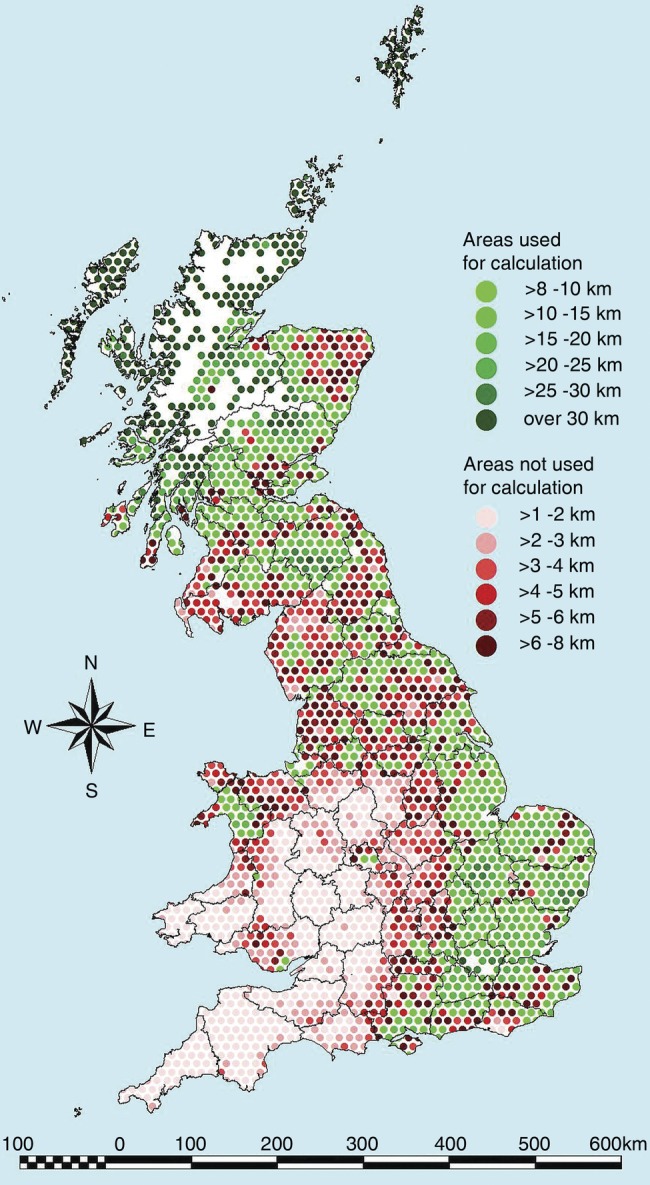
A novel method for estimating specificity of the Single Intradermal Comparative Cervical Tuberculin (SICCT) test for bovine tuberculosis (bTB) using surveillance tests results is reported. The specificity of the SICCT test at three cut-offs was estimated from the dates, locations and skinfold measurements of all routine tests carried out in Officially TB Free (OTF) cattle herds in Great Britain (GB) between 2002 and 2008, according to their separation (by distance and time) from known infected (OTF-withdrawn) herds. The proportion of animals that tested positive was constant (P>0.20) when the distance between tested herds and nearest infected herd exceeded 8 km. For standard cut-off, calculated specificity was 99.98 per cent (95 per cent confidence interval ±0.004 per cent), equating to one false positive result per 5000 uninfected animals tested. For severe cut-off it was 99.91 per cent (±0.013 per cent) and for ultrasevere cut-off (selecting all reactors and inconclusive reactors) it was 99.87 per cent (±0.017 per cent). The estimated positive predictive value of the test averaged 91 per cent and varied by regional prevalence. This study provides further evidence of the high specificity of the SICCT test under GB conditions, suggests that over 90 per cent of cattle currently culled using this test in GB were infected, and endorses slaughter of at least these cattle for bTB control.
Keywords: Bovine tuberculosis; Cattle; Comparative Tuberculin Skin Test; Diagnostics; Great Britain; Specificity.
British Veterinary Association.
Figures


Comment in
-
Bovine tuberculosis: how likely is a skin test reactor to be uninfected?Vet Rec. 2015 Sep 12;177(10):256-7. doi: 10.1136/vr.h4760. Vet Rec. 2015. PMID: 26358451 No abstract available.
References
-
- ADVISORY COMMITTEE ON THE MICROBIOLOGICAL SAFETY OF FOOD. (2010) The possible health risks to consumers associated with Mycobacterium bovis and milk: Part 1 – Pasteurised milk and milk products. Report ID ACM/995 http://acmsf.food.gov.uk/sites/default/files/multimedia/pdfs/committee/a..., (accessed 23 Sep 2014)
-
- AHMED A. (2013) Fisher's Exact Test Calculator (2×2 Contingency Table). http://scistatcalc.blogspot.co.uk/2013/11/fishers-exact-test-calculator.... (accessed 28 Aug 2014)
-
- ANIMAL AND PLANT HEALTH AGENCY (APHA). (2014) Bovine tuberculosis: Infection status in cattle in GB, Annual surveillance report for the period January to December 2013. Published by the Animal Health and Veterinary Laboratories Agency (the agency's former name). www.gov.uk/government/uploads/system/uploads/attachment_data/file/413806... (accessed 8 May 2015)
-
- CLEGG T. A., DUIGNAN A., WHELAN C., GORMLEY E., GOOD M., CLARKE J., TOFT N. & MORE S. J. (2011) Using latent class analysis to estimate the test characteristics of the γ-interferon test, the single intradermal comparative tuberculin test and a multiplex immunoassay under Irish conditions. Veterinary Microbiology 151, 68–76 10.1016/j.vetmic.2011.02.027 - DOI - PubMed
-
- COAD M., CLIFFORD D., RHODES S. G., HEWINSON R. G., VORDERMEIER H. M. & WHELAN A. O. (2010) Repeat tuberculin skin testing leads to desensitisation in naturally infected tuberculous cattle which is associated with elevated interleukin-10 and decreased interleukin-1 beta responses. Veterinary Research 41, 14 10.1051/vetres/2009062 - DOI - PMC - PubMed
Publication types
MeSH terms
LinkOut - more resources
Full Text Sources
Other Literature Sources
