. 2015 Sep 1;4(9):534-544.
doi: 10.1089/wound.2015.0647.

Grafix®, a Cryopreserved Placental Membrane, for the Treatment of Chronic/Stalled Wounds

Affiliations

Grafix®, a Cryopreserved Placental Membrane, for the Treatment of Chronic/Stalled Wounds

Gary W Gibbons. Adv Wound Care (New Rochelle). .

Abstract

Objective: To discuss the use of Grafix®, a commercially available, cryopreserved placental membrane, for the treatment of chronic/stalled wounds of different etiologies. Approach: To describe the unique composition of Grafix, to provide an overview of the existing clinical evidence supporting the benefits of Grafix for wound treatment, and to share the experience of the South Shore Hospital Center for Wound Healing (Weymouth, MA) with Grafix for the treatment of nonhealing wounds. Results: Clinical evidence supports the safety and efficacy of Grafix for the treatment of chronic/stalled wounds, including those that have failed other advanced treatment modalities. Innovation: Grafix is a cryopreserved placental membrane manufactured utilizing a novel technology that enables the preservation of all placental membrane components in their native state. Placental membranes have a unique composition of extracellular matrix, growth factors, and cells (including mesenchymal stem cells), which makes this tissue unique among other advanced biological wound treatment modalities. Conclusion: Clinical evidences support the benefits of Grafix for head-to-toe wound treatment.


Figures

None
Gary W. Gibbons, MD, FACS
<b>Figure. 1.</b>
Figure. 1.
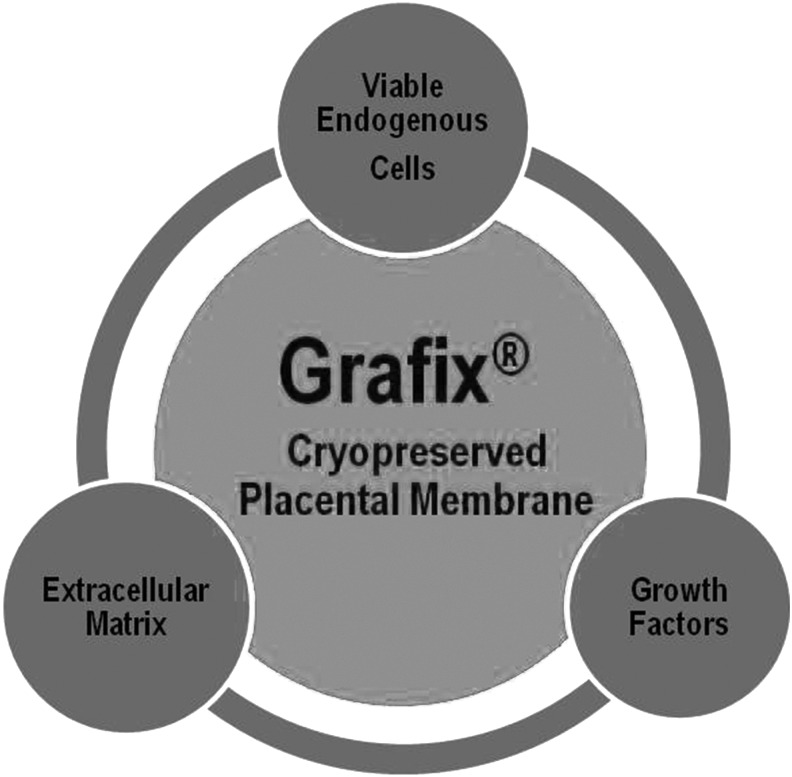
Grafix®, a cryopreserved placental membrane, maintains all components of fresh placental tissue, which includes extracellular matrix, growth factors, and viable endogenous cells (epithelial cells, fibroblasts, and mesenchymal stem cells), in their native state.
<b>Figure. 2.</b>
Figure. 2.
Preparation and application of Grafix. This preparation and application guide is provided by Osiris Therapeutics, Inc., the manufacturer of Grafix.
<b>Figure. 3.</b>
Figure. 3.
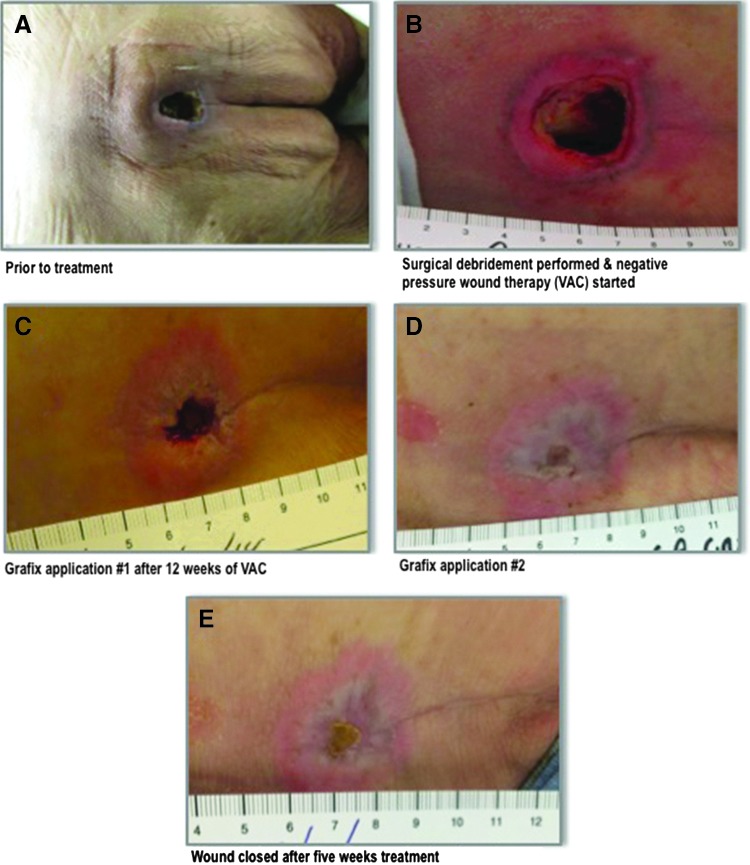
(A) A 2.5×2.5×1.6 cm stage IV sacral wound persisting for 3 months in an 82-year-old male before treatment. (B) Wound was surgically debrided to a 2 cm depth. A negative pressure wound vacuum (VAC), off-loading cushion, and air alternating mattress were prescribed. (C) First Grafix applied after 12 weeks of VAC, which was discontinued at this time. (D) Three weeks after first Grafix application. (E) Complete wound closure was recorded after two Grafix applications over 5 weeks.
<b>Figure. 4.</b>
Figure. 4.
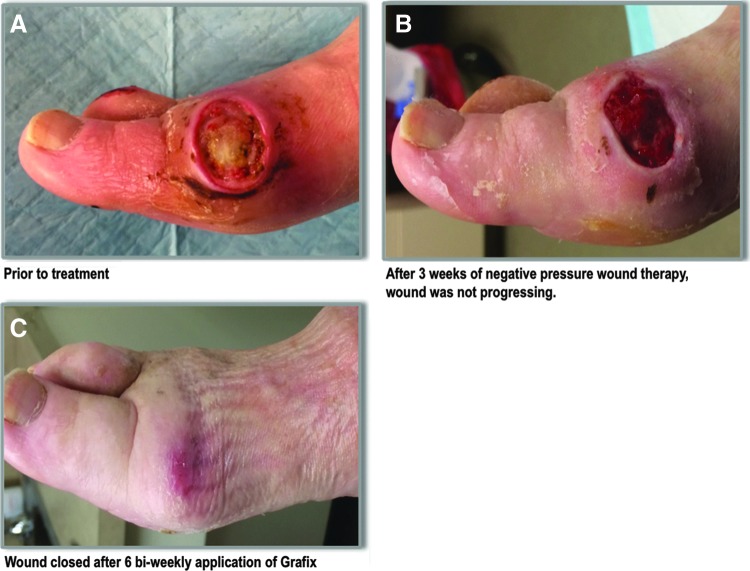
(A) An ulceration on the medial aspect of the right first metatarsal head from wearing a new shoe in a 69-year-old insulin-dependent diabetic female before treatment. Cellulitis extending up the lower extremity was noted. The wound probed down to capsule, but not to the joint. (B) She received 3 weeks of continuous negative pressure wound therapy. The wound bed showed signs of granulation, but was not progressing to closure. (C) Bi-weekly applications of Grafix were started. After six applications, the wound was completely closed.
<b>Figure. 5.</b>
Figure. 5.
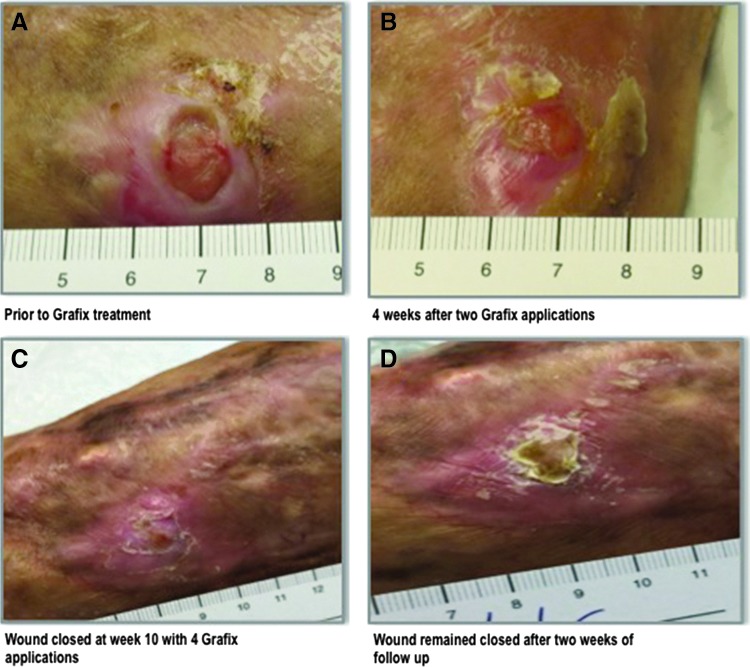
A 68-year-old Vietnam veteran who sustained shrapnel injury and open fractures resulting in a wound on the right lower leg in 1966. Over a period of 49 years, the wound was never completely closed. (A) 1.1×1.2×0.1 cm wound before Grafix application. (B) Four weeks post-treatment at the time of third Grafix application. (C) Wound closure was achieved after 10 weeks of treatment with four Grafix applications. (D) Wound remained closed during follow-up.

References

    1. Eming SA, Martin P, Tomic-Canic M. Wound repair and regeneration: mechanisms, signaling, and translation. Sci Transl Medicine 2014;6:265sr266 - PMC - PubMed
    1. Sen CK, Gordillo GM, Roy S, et al. Human skin wounds: a major and snowballing threat to public health and the economy. Wound Repair Regene 2009;17:763–771 - PMC - PubMed
    1. Fife CE, Carter MJ, Walker D, Thomson B. Wound care outcomes and associated cost among patients treated in US outpatient wound centers: data from the US wound registry. Wounds 2012;24:10–17 - PubMed
    1. Rice JB, Desai U, Cummings AK, Birnbaum HG, Skornicki M, Parsons N. Medical, drug, and work-loss costs of venous leg ulcers. Value Health 2013;16:A73 - PubMed
    1. Department of Health and Human Services. Fed. Register “Proposed Rules”. May 3, 2007