


Craniosacral Therapy for the Treatment of Chronic Neck Pain: A Randomized Sham-controlled Trial
- PMID: 26340656
- PMCID: PMC4894825
- DOI: 10.1097/AJP.0000000000000290
Craniosacral Therapy for the Treatment of Chronic Neck Pain: A Randomized Sham-controlled Trial
Abstract
Objectives: With growing evidence for the effectiveness of craniosacral therapy (CST) for pain management, the efficacy of CST remains unclear. This study therefore aimed at investigating CST in comparison with sham treatment in chronic nonspecific neck pain patients.
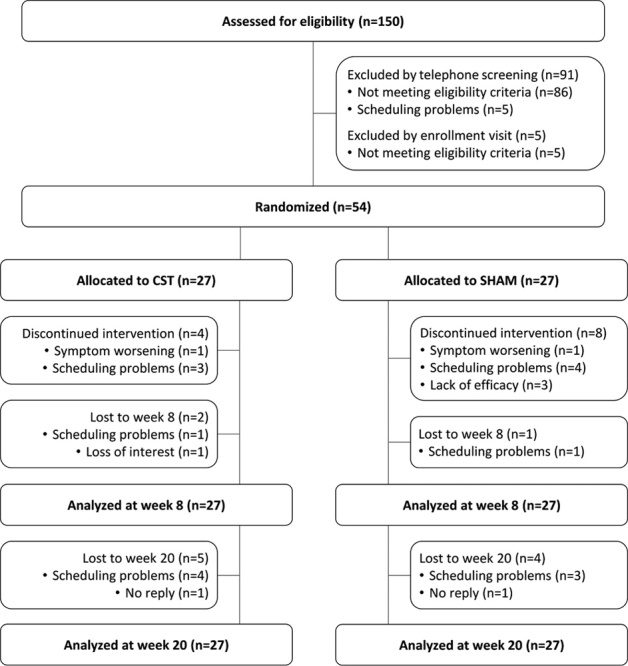
Materials and methods: A total of 54 blinded patients were randomized into either 8 weekly units of CST or light-touch sham treatment. Outcomes were assessed before and after treatment (week 8) and again 3 months later (week 20). The primary outcome was the pain intensity on a visual analog scale at week 8; secondary outcomes included pain on movement, pressure pain sensitivity, functional disability, health-related quality of life, well-being, anxiety, depression, stress perception, pain acceptance, body awareness, patients' global impression of improvement, and safety.
Results: In comparison with sham, CST patients reported significant and clinically relevant effects on pain intensity at week 8 (-21 mm group difference; 95% confidence interval, -32.6 to -9.4; P=0.001; d=1.02) and at week 20 (-16.8 mm group difference; 95% confidence interval, -27.5 to -6.1; P=0.003; d=0.88). Minimal clinically important differences in pain intensity at week 20 were reported by 78% within the CST group, whereas 48% even had substantial clinical benefit. Significant between-group differences at week 20 were also found for pain on movement, functional disability, physical quality of life, anxiety and patients' global improvement. Pressure pain sensitivity and body awareness were significantly improved only at week 8. No serious adverse events were reported.
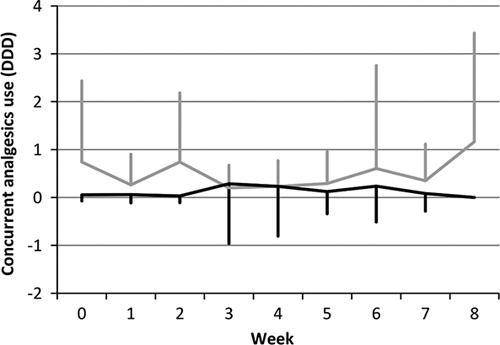
Discussion: CST was both specifically effective and safe in reducing neck pain intensity and may improve functional disability and the quality of life up to 3 months after intervention.
Conflict of interest statement
The authors declare no conflict of interest.
Figures
Comment in
-
Craniosacral Therapy Shown Beneficial in Management of Chronic Neck Pain.J Am Osteopath Assoc. 2016 Jul 1;116(7):486-7. doi: 10.7556/jaoa.2016.095. J Am Osteopath Assoc. 2016. PMID: 27367955 No abstract available.
References
-
- Cote P, van der Velde G, Cassidy JD, et al. The burden and determinants of neck pain in workers: results of the Bone and Joint Decade 2000-2010 Task Force on Neck Pain and Its Associated Disorders. Spine (Phila Pa 1976). 2008;33:S60–S74. - PubMed
-
- Hogg-Johnson S, van der Velde G, Carroll LJ, et al. The burden and determinants of neck pain in the general population: results of the Bone and Joint Decade 2000-2010 Task Force on Neck Pain and Its Associated Disorders. Spine (Phila Pa 1976). 2008;33:S39–S51. - PubMed
-
- Hoy D, March L, Woolf A, et al. The global burden of neck pain: estimates from the global burden of disease 2010 study. Ann Rheum Dis. 2014;73:1309–1315. - PubMed
-
- Childs JD, Cleland JA, Elliott JM, et al. Neck pain: clinical practice guidelines linked to the International Classification of Functioning, Disability, and Health from the Orthopedic Section of the American Physical Therapy Association. J Orthop Sports Phys Ther. 2008;38:A1–A34. - PubMed
Publication types
MeSH terms
LinkOut - more resources
Full Text Sources
Other Literature Sources
Medical
