. 2016 Jan 1;124(Pt A):267-275.
doi: 10.1016/j.neuroimage.2015.08.055. Epub 2015 Sep 2.

Machine-learning to characterise neonatal functional connectivity in the preterm brain

Affiliations

Machine-learning to characterise neonatal functional connectivity in the preterm brain

G Ball et al. Neuroimage. .

Abstract

Brain development is adversely affected by preterm birth. Magnetic resonance image analysis has revealed a complex fusion of structural alterations across all tissue compartments that are apparent by term-equivalent age, persistent into adolescence and adulthood, and associated with wide-ranging neurodevelopment disorders. Although functional MRI has revealed the relatively advanced organisational state of the neonatal brain, the full extent and nature of functional disruptions following preterm birth remain unclear. In this study, we apply machine-learning methods to compare whole-brain functional connectivity in preterm infants at term-equivalent age and healthy term-born neonates in order to test the hypothesis that preterm birth results in specific alterations to functional connectivity by term-equivalent age. Functional connectivity networks were estimated in 105 preterm infants and 26 term controls using group-independent component analysis and a graphical lasso model. A random forest-based feature selection method was used to identify discriminative edges within each network and a nonlinear support vector machine was used to classify subjects based on functional connectivity alone. We achieved 80% cross-validated classification accuracy informed by a small set of discriminative edges. These edges connected a number of functional nodes in subcortical and cortical grey matter, and most were stronger in term neonates compared to those born preterm. Half of the discriminative edges connected one or more nodes within the basal ganglia. These results demonstrate that functional connectivity in the preterm brain is significantly altered by term-equivalent age, confirming previous reports of altered connectivity between subcortical structures and higher-level association cortex following preterm birth.

Keywords: Brain development; Prematurity; Support vector machines; fMRI.


Figures

Fig. S1
Fig. S1
Motion parameters in each group. Mean relative (frame-to-frame) displacement (left panel) and standardised DVARS, before and after FIX processing (right panel) are shown for each group.
Fig. S2
Fig. S2
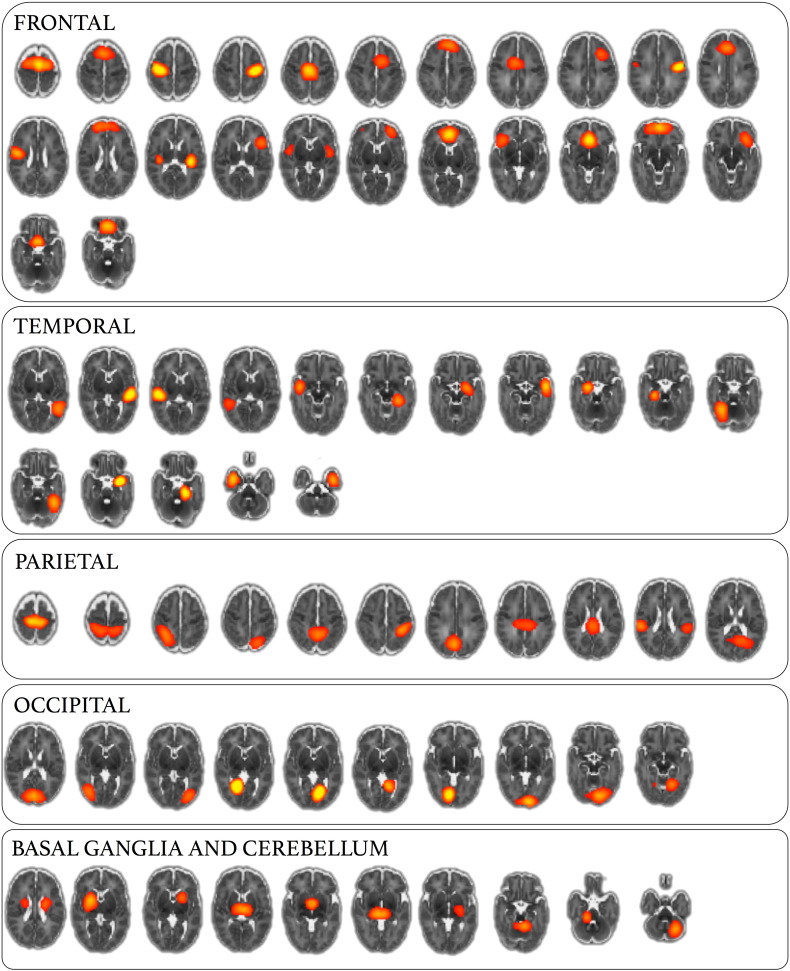
Functional parcellation via higher-order ICA. A total of 71 ICA components used for functional parcellation are shown at Z = 10, ordered according to cortical lobe/region.
Fig. S3
Fig. S3
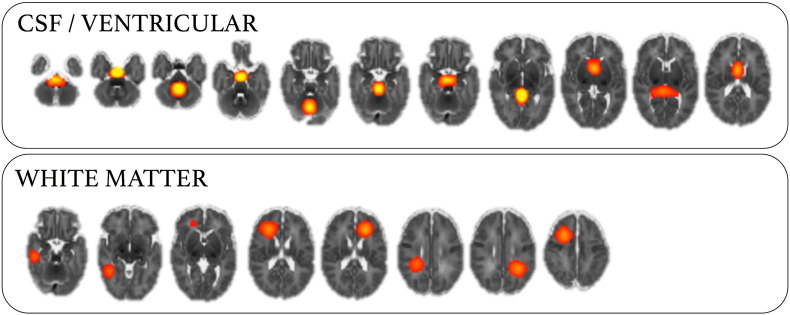
ICA components identified as noise or artefact. A total of 19 ICA components were identified as probable artefacts with non-neuronal source based on manual inspection of the spatial distribution (centred in CSF or WM) and frequency power spectrum (shown at Z = 10).
Fig. S4
Fig. S4
Predicting gestational age using SVM regression. Features selected in the classification model were also used to predict GA at birth using SVM regression (with hyperparameters tuned to minimise MSE). The relationship between predicted GA (averaged over 10 CV repeats) and the true GA of each infant is shown.
Fig. 1
Fig. 1
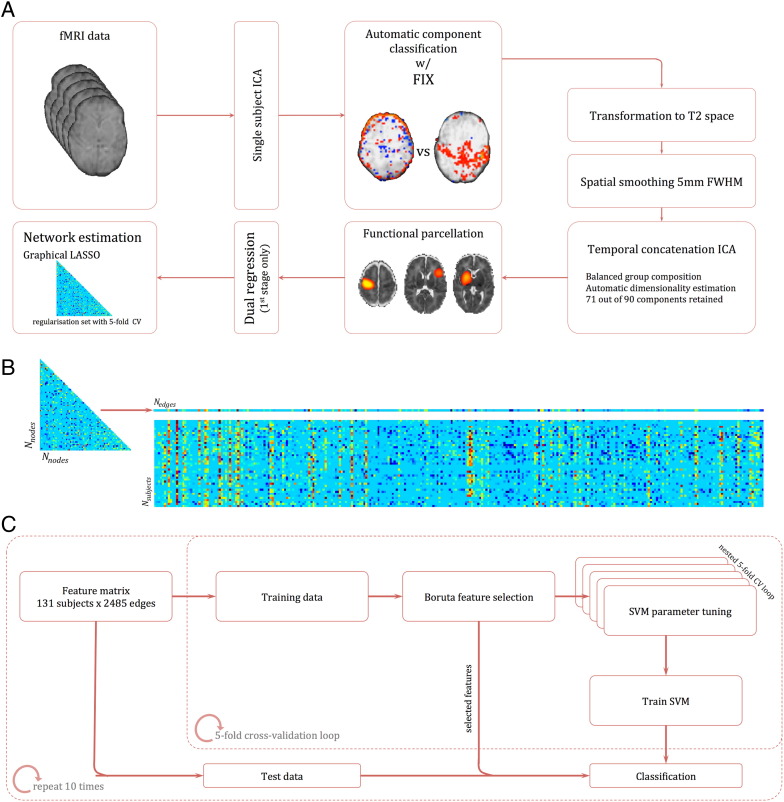
Processing pipeline. (A) Individual fMRI datasets were first denoised following single-subject ICA using FIX. Denoised data were then co-registered to corresponding anatomical T2 scans, smoothed and group ICA was performed in a balanced subset. ICA components were selected and spatially regressed onto individual datasets to extract time courses for each component—one per subject. Regularised partial correlation matrices were estimated for each subject. (B) Each connectivity matrix was reshaped to a vector of length Nedges and concatenated to form a feature matrix. (C) This matrix was repeatedly split into training and test data within a 5-fold cross-validation loop. Discriminative features were selected using a random forest–based, all-relevant selection procedure and passed to a nonlinear SVM for classification. The whole CV loop was repeated ten times.
Fig. 2
Fig. 2
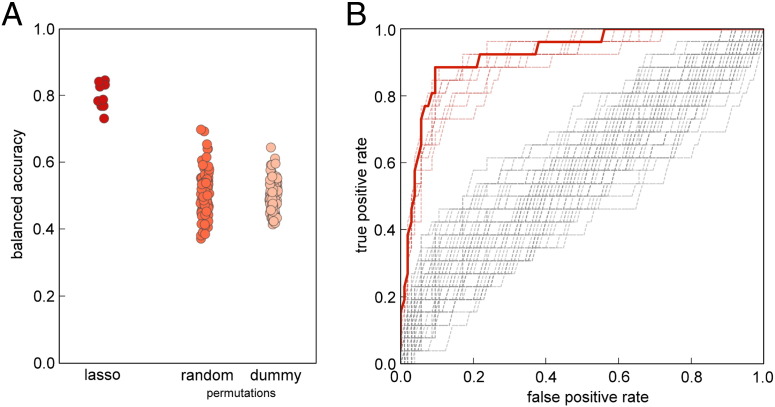
Classification accuracy and feature selection. (A) Balanced classification accuracy estimated over ten 5-fold CV repeats, compared to 100 (out of 1000) random permutations and dummy classifications based on the empirical distribution of class labels. (B) Classification ROC curve in red (showing the mean class probability averaged over all ten repeats), with individual CV repeats shown as red dashed lines. ROC curves from 100 (out of 1000) random permutations are shown in grey.
Fig. 3
Fig. 3
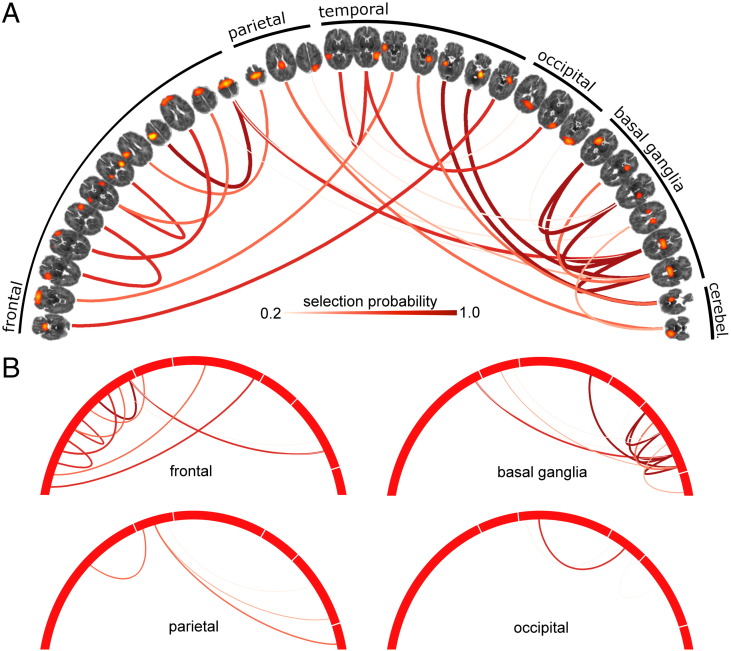
Discriminative edges for the classification of preterm and term infants. (A) Discriminative edges selected by the classification model, visualised with Circos (Krzywinski et al., 2009). Connected nodes are shown ordered according to cortical lobe/region and are thresholded at Z = 10. Edge colour and width reflects selection probability. (B) Edges are clustered according to region, such that all edges that connect to at least one node in each region are shown.
Fig. 4
Fig. 4
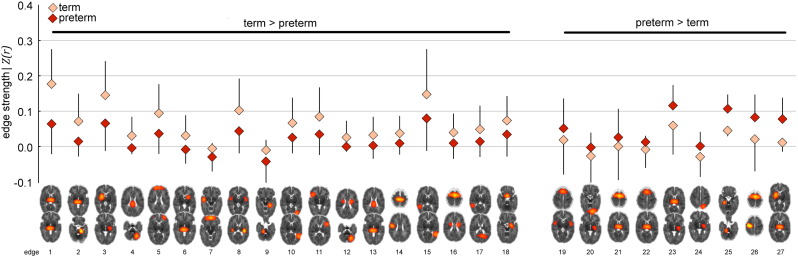
Discriminative edge strength in preterm and term infants. Edge strengths of discriminative edges for each group, ordered by effect size from left to right (see also Table 1).

References

    1. Abou Elseoud A., Littow H., Remes J., Starck T., Nikkinen J., Nissilä J., Timonen M., Tervonen O., Kiviniemi V. Group-ICA model order highlights patterns of functional brain connectivity. Front. Syst. Neurosci. 2011;5:37. - PMC - PubMed
    1. Allendoerfer K.L., Shatz C.J. The subplate, a transient neocortical structure: its role in the development of connections between thalamus and cortex. Annu. Rev. Neurosci. 1994;17:185–218. - PubMed
    1. Anblagan D., Bastin M.E., Sparrow S., Piyasena C., Pataky R., Moore E.J., Serag A., Wilkinson A.G., Clayden J.D., Semple S.I., Boardman J.P. Tract shape modeling detects changes associated with preterm birth and neuroprotective treatment effects. NeuroImage Clin. 2015;8:51–58. - PMC - PubMed
    1. Anjari M., Srinivasan L., Allsop J.M., Hajnal J.V., Rutherford M.A., Edwards A.D., Counsell S.J. Diffusion tensor imaging with tract-based spatial statistics reveals local white matter abnormalities in preterm infants. NeuroImage. 2007;35:1021–1027. - PubMed
    1. Arichi T., Fagiolo G., Varela M., Melendez-Calderon A., Allievi A., Merchant N., Tusor N., Counsell S.J., Burdet E., Beckmann C.F., Edwards A.D. Development of BOLD signal hemodynamic responses in the human brain. NeuroImage. 2012;63:663–673. - PMC - PubMed

Publication types