Review
. 2015 Mar 26;3(2):239-62.
doi: 10.3390/vaccines3020239.

Developing Universal Influenza Vaccines: Hitting the Nail, Not Just on the Head

Affiliations
Review

Developing Universal Influenza Vaccines: Hitting the Nail, Not Just on the Head

Lidewij C M Wiersma et al. Vaccines (Basel). .

Abstract

Influenza viruses have a huge impact on public health. Current influenza vaccines need to be updated annually and protect poorly against antigenic drift variants or novel emerging subtypes. Vaccination against influenza can be improved in two important ways, either by inducing more broadly protective immune responses or by decreasing the time of vaccine production, which is relevant especially during a pandemic outbreak. In this review, we outline the current efforts to develop so-called "universal influenza vaccines", describing antigens that may induce broadly protective immunity and novel vaccine production platforms that facilitate timely availability of vaccines.

Keywords: MVA; influenza; universal vaccine.


Figures
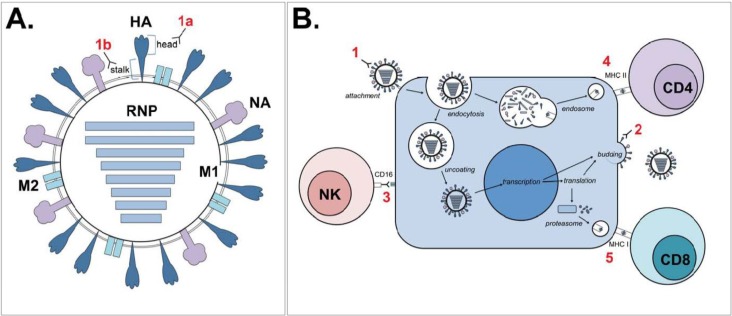
Figure 1
Figure 1
Schematic representation of possible immunological correlates of protection. Numerals in red show various immunological correlates of protection as indicated below. (A) Cartoon of an influenza virion, showing the hemagglutinin (HA) surface glycoprotein (stem and head), the neuraminidase (NA) surface glycoprotein, the matrix 2 (M2) ion channel, the matrix 1 (M1) structural protein and the ribonucleoproteins (RNPs: the combination of genomic RNA, viral polymerases PA, PB1 and PB2 and nucleoproteins (NP)). Antibodies directed against HA can either target the globular head (1A) or stem region (1B). (B) Interference of production of progeny virus by infected cells by various immunological correlates of protection, including (1) antibodies against HA head, interfering with binding or HA stem, potentially interfering with post-entry functions of HA, like endosomal membrane fusion; (2) antibodies against NA, limiting the production of progeny virus; (3) antibodies against M2e, HA or NA, followed by ADCC through CD16 signaling in NK cells (or phagocytosis, not shown); (4) virus-specific CD4+ T lymphocytes; and (5) virus-specific CD8+ T lymphocytes that possess cytolytic activity.

References

    1. Palese P.S., Shaw M.L. Fields Virology. 5th ed. Volume 2. Lippincott Williams & Wilkins; Philadelphia, PA, USA: 2007. Orthomyxoviridae: The viruses and their replication; pp. 1647–1689.
    1. Vijaykrishna D., Holmes E.C., Joseph U., Fourment M., Su Y.C., Halpin R., Lee R.T., Deng Y.M., Gunalan V., Lin X., et al. The contrasting phylodynamics of human influenza B viruses. eLife. 2015;4:e05055. doi: 10.7554/eLife.05055. - DOI - PMC - PubMed
    1. Dykes A.C., Cherry J.D., Nolan C.E. A clinical, epidemiologic, serologic, and virologic study of influenza C virus infection. Arch. Intern. Med. 1980;140:1295–1298. doi: 10.1001/archinte.1980.00330210043021. - DOI - PubMed
    1. Matsuzaki Y., Katsushima N., Nagai Y., Shoji M., Itagaki T., Sakamoto M., Kitaoka S., Mizuta K., Nishimura H. Clinical features of influenza C virus infection in children. J. Infect. Dis. 2006;193:1229–1235. doi: 10.1086/502973. - DOI - PubMed
    1. Molinari N.A., Ortega-Sanchez I.R., Messonnier M.L., Thompson W.W., Wortley P.M., Weintraub E., Bridges C.B. The annual impact of seasonal influenza in the US: Measuring disease burden and costs. Vaccine. 2007;25:5086–5096. doi: 10.1016/j.vaccine.2007.03.046. - DOI - PubMed
