


Optimization of Ultrasonic-Assisted Extraction of Flavonoid Compounds and Antioxidants from Alfalfa Using Response Surface Method
- PMID: 26343617
- PMCID: PMC6332291
- DOI: 10.3390/molecules200915550
Optimization of Ultrasonic-Assisted Extraction of Flavonoid Compounds and Antioxidants from Alfalfa Using Response Surface Method
Abstract
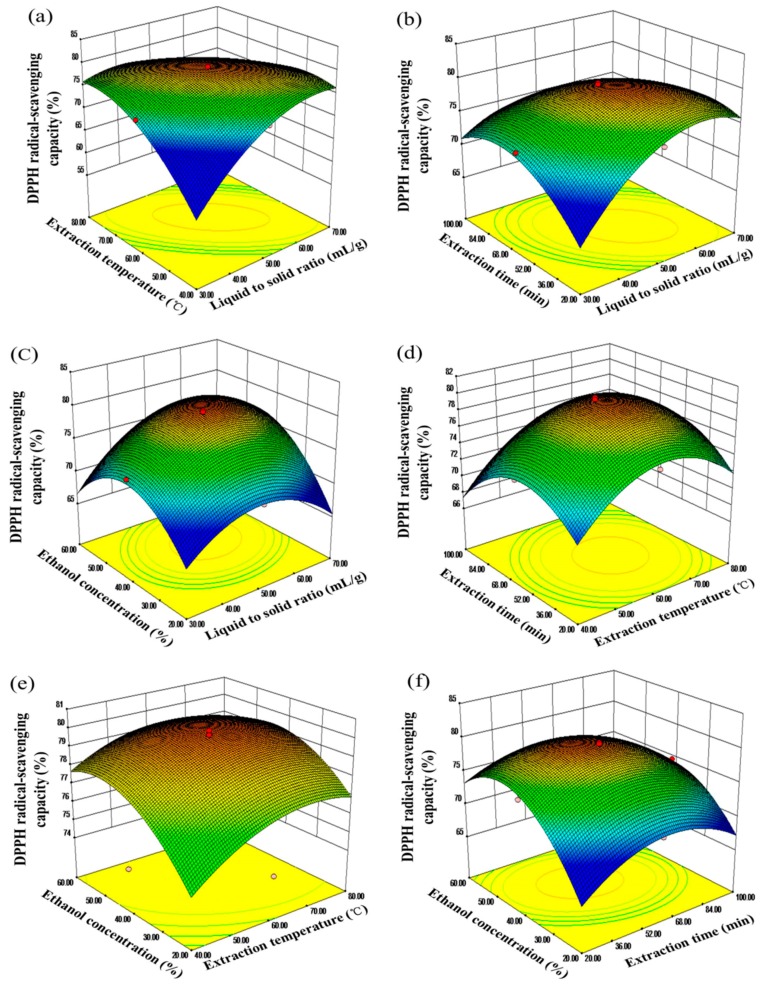
Ultrasonic-assisted extraction (UAE) was used to extract flavonoid-enriched antioxidants from alfalfa aerial part. Response surface methodology (RSM), based on a four-factor, five-level central composite design (CCD), was employed to obtain the optimal extraction parameters, in which the flavonoid content was maximum and the antioxidant activity of the extracts was strongest. Radical scavenging capacity of the extracts, which represents the amounts of antioxidants in alfalfa, was determined by using 2,2'-azino-bis (3-ethylbenzothiazoline-6-sulphonicacid) (ABTS) and 2,2'-diphenyl-1-picrylhydrazyl (DPPH) methods. The results showed good fit with the proposed models for the total flavonoid extraction (R² = 0.9849), for the antioxidant extraction assayed by ABTS method (R² = 0.9764), and by DPPH method (R² = 0.9806). Optimized extraction conditions for total flavonoids was a ratio of liquid to solid of 57.16 mL/g, 62.33 °C, 57.08 min, and 52.14% ethanol. The optimal extraction parameters of extracts for the highest antioxidant activity by DPPH method was a ratio of liquid to solid 60.3 mL/g, 54.56 °C, 45.59 min, and 46.67% ethanol, and by ABTS assay was a ratio of liquid to solid 47.29 mL/g, 63.73 °C, 51.62 min, and 60% ethanol concentration. Our work offers optimal extraction conditions for total flavonoids and antioxidants from alfalfa.
Keywords: alfalfa; antioxidant capacity; flavonoid compounds; response surface methodology; ultrasonic-assisted extraction.
Conflict of interest statement
The authors declare no conflict of interest.
Figures


References
-
- Karimi E., Oskoueian E., Oskoueian A., Omidvar V., Hendra R., Nazeran H. Insight into the functional and medicinal properties of Medicago sativa (Alfalfa) leaves extract. J. Med. Plant Res. 2013;7:290–297.
-
- Gaweł E. Chemical compositions of lucerne leaf extract (EFL) and its applications as a phytobiotic in human nutrition. Acta Sci. Pol. Technol. Aliment. 2012;11:303–309. - PubMed
-
- Zhu J.M., Li N., Zhang Y.J., Li X.D., Wang C.Z. The research progress of alfalfa flavonoids. Pratac. Sci. 2009;26:156–162.
Publication types
MeSH terms
Substances
LinkOut - more resources
Full Text Sources
Other Literature Sources
Medical
Miscellaneous
