. 2013 Aug 22;1(3):367-83.
doi: 10.3390/vaccines1030367.

Enhanced Delivery and Potency of Self-Amplifying mRNA Vaccines by Electroporation in Situ

Affiliations

Enhanced Delivery and Potency of Self-Amplifying mRNA Vaccines by Electroporation in Situ

Yen Cu et al. Vaccines (Basel). .

Abstract

Nucleic acid-based vaccines such as viral vectors, plasmid DNA (pDNA), and mRNA are being developed as a means to address limitations of both live-attenuated and subunit vaccines. DNA vaccines have been shown to be potent in a wide variety of animal species and several products are now licensed for commercial veterinary but not human use. Electroporation delivery technologies have been shown to improve the generation of T and B cell responses from synthetic DNA vaccines in many animal species and now in humans. However, parallel RNA approaches have lagged due to potential issues of potency and production. Many of the obstacles to mRNA vaccine development have recently been addressed, resulting in a revival in the use of non-amplifying and self-amplifying mRNA for vaccine and gene therapy applications. In this paper, we explore the utility of EP for the in vivo delivery of large, self-amplifying mRNA, as measured by reporter gene expression and immunogenicity of genes encoding HIV envelope protein. These studies demonstrated that EP delivery of self-amplifying mRNA elicited strong and broad immune responses in mice, which were comparable to those induced by EP delivery of pDNA.

Keywords: HIV; T cell responses; antibodies; vaccine.


Figures
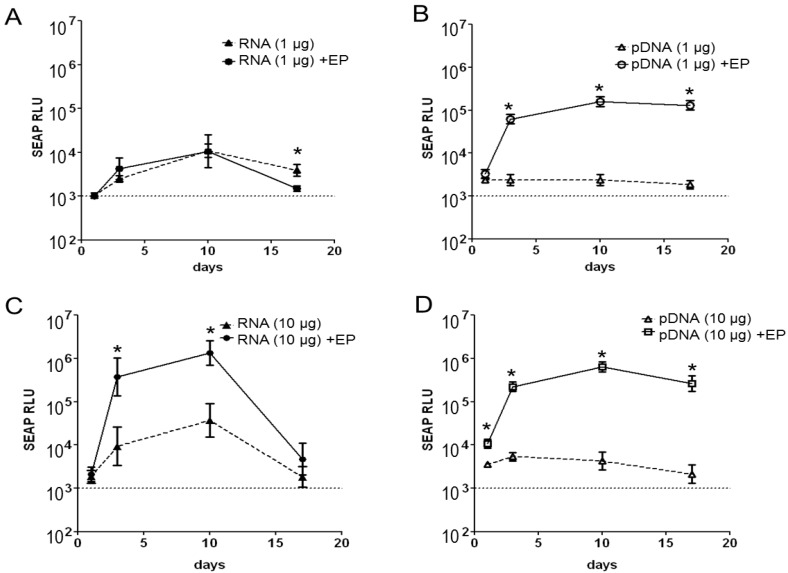
Figure 1
Figure 1
In vivo expression of secreted embryonic alkaline phosphatase (SEAP) after intramuscular njection of self-amplifying mRNA (RNA, 1 µg or 10 µg, panels A,C) or pDNA (DNA, 1 µg or 10 µg, panels B,D). The vectors were delivered by bilateral intramuscular injection with (+EP) or without electroporation. Serum SEAP expression was measured on days 1, 3, 10 and 17 after treatment, and represented as the log of mean relative luminescence (RLU)±SEM, n = 5/group. * Statistically significant (student-t test, p < 0.05).
Figure 2
Figure 2
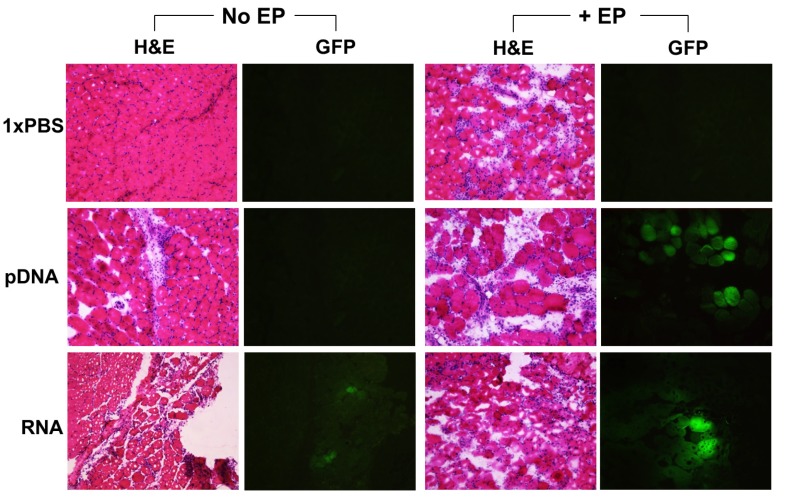
Histology of muscle tissues (transverse) by hematoxylin and eosin (H&E) staining, and expression of reporter protein (GFP) as delivered by intramuscular injection without EP (No EP) or with EP (+EP). Mice were injected intramuscularly with 50 µL of 1xPBS, pDNA or self-amplifying RNA vectors (pDNA or RNA, 5 µg/site). Images were obtained 2 days following treatment and are shown as representative of 6–8 slides taken per area, n = 4 muscles per group.
Figure 3
Figure 3
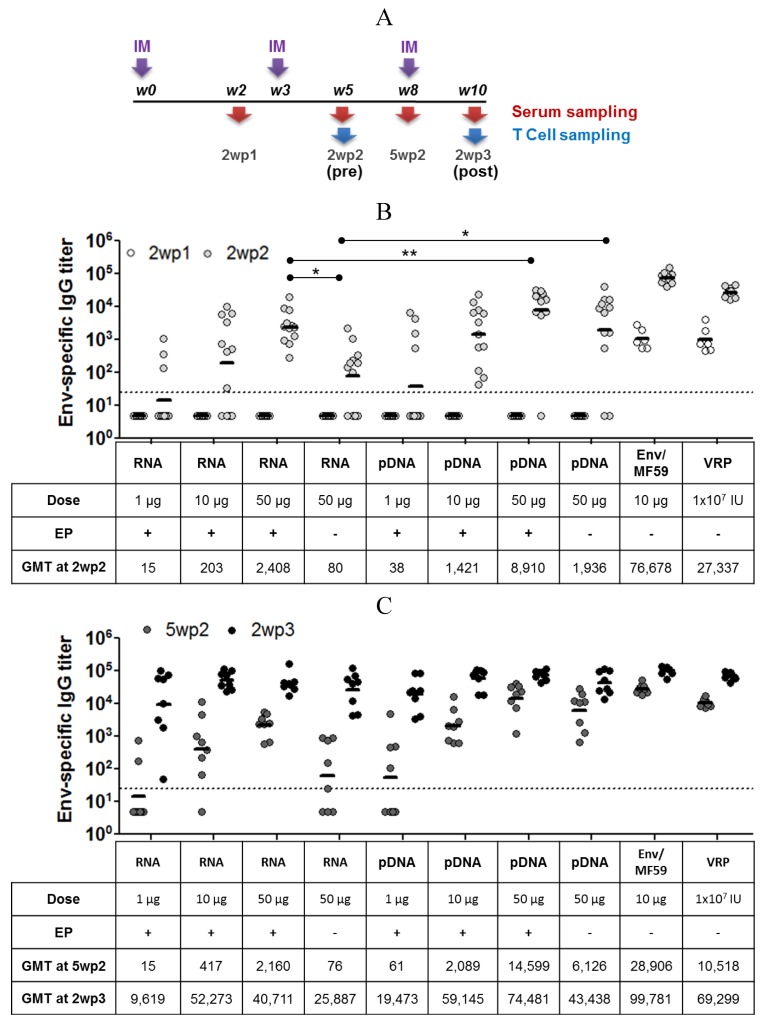
Study timeline for assessment of self-amplifying mRNA vector in an HIV immunogenicity model. (A) Female Balb/C mice received 2 treatments of RNA or pDNA vectors with or without EP (RNA or pDNA, 1, 10 and 50 µg), MF59-adjuvanted gp140.SF162 HIV envelope protein (Env/MF59, 10 µg) or viral replicon particles (VRP, 1 × 10⁷ IU) expressing the HIV Env-protein at weeks 0 and 3. All groups then received a single injection of 10 µg Env/MF59 at week 8. Serum and mucosal samples, and spleens for T-cell quantitation were collected on week 2 (2wp1), 5 (2wp2, pre-protein boost) 8 (5wp2) and 10 (2wp3, post-protein boost). Env-specific total IgG titer for all groups at 2wp1 and 2wp2 (B) and 5wp2 and 3wp2 (C) is plotted as log of mean titer, and the horizontal bar represents geometric mean titer (GMT). Titers < 25 (dotted line) were assigned a value of 5 for calculation of GMT. n = 6 at 2wp1, n = 12 at 2wp2, and n = 8 at 5wp2 and 2wp3. * denotes statistical significance with p < 0.05; ** denotes statistical significance with p < 0.005.
Figure 4
Figure 4
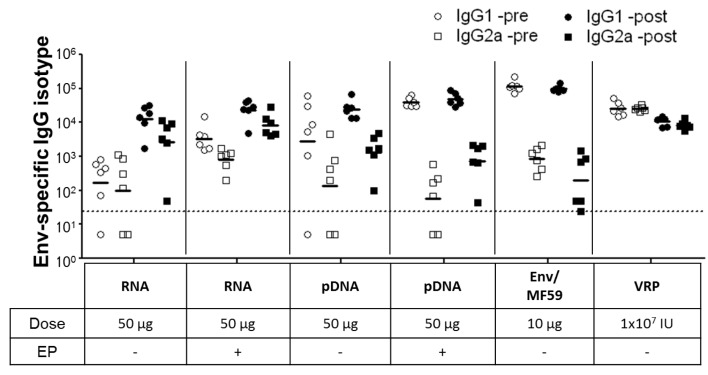
Env-specific IgG1 and IgG2a titers in mice sera were measured at 2wp2 (pre-) and 2wp3 (post-protein boost) for nucleic acid vectors with or without EP (RNA and pDNA; 50 µg), MF59-adjuvanted Env (Env/MF59, 10 µg) or viral replicon particles (VRP, 1 × 10⁷ IU) primed groups. Individual titers are plotted and the horizontal bar represents geometric mean titer (GMT) for each group (n = 6 per group). Titers <25 (dotted line) were assigned a value of 5 for calculation of GMT.
Figure 5
Figure 5
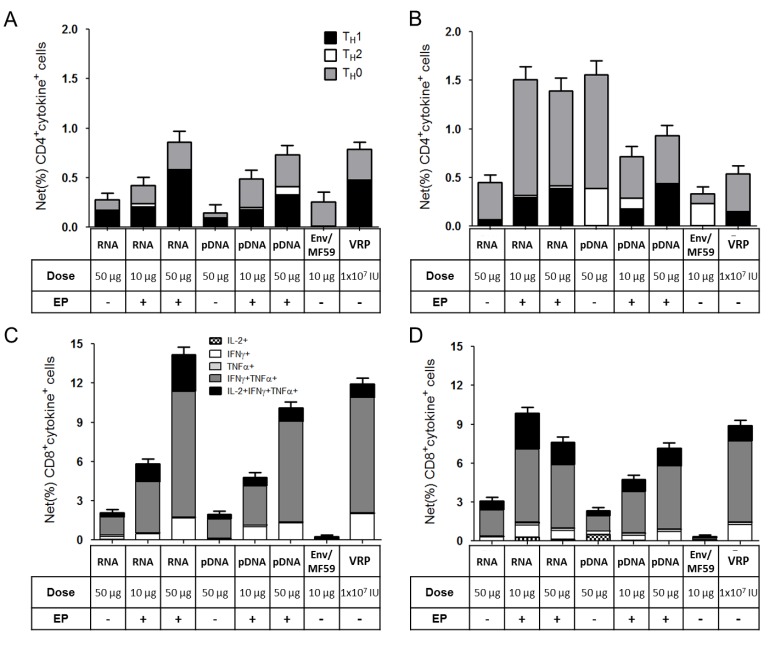
T-cell responses for groups treated with self-amplifying mRNA (RNA, 10 and 50 µg), pDNA (pDNA, 10 and 50 µg), MF59-adjuvanted Env (Env/MF59, 10 µg) or viral replicon particles (VRP, 1 × 10⁷ IU) at weeks 5 (A,C) and 10 (B,D). Pooled splenocytes (6 spleens/pool) were stimulated with HIV Env-derived antigenic peptides, stained for intra-cellular cytokines, and subjected to flow cytometry (methods). Graphs show the Env-specific (%) frequencies of CD4+ (A,B) and CD8+ (C,D) T-cells with error bars denoting 95% confidence limits.

References

    1. Wolff J.A., Malone RW., Williams P., Chong W., Acsadi G., Jani A., Felgner P.L. Direct gene transfer into mouse muscle in vivo. Science. 1990;247:1465–1468. - PubMed
    1. Davis B.S., Chang G.J., Cropp B., Roehrig J.T., Martin D.A., Mitchell C.J., Bowen R., Bunning M.L. West Nile virus recombinant DNA vaccine protects mouse and horse from virus challenge and expresses in vitro a noninfectious recombinant antigen that can be used in enzyme-linked immunosorbent assays. J. Virol. 2001;75:4040–4047. doi: 10.1128/JVI.75.9.4040-4047.2001. - DOI - PMC - PubMed
    1. Garver K.A., LaPatra S.E., Kurath G. Efficacy of an infectious hematopoietic necrosis (IHN) virus DNA vaccine in Chinook Oncorhynchus tshawytscha and sockeye O. nerka salmon. Dis. Aquat. Org. 2005;64:13–22. doi: 10.3354/dao064013. - DOI - PubMed
    1. Grosenbaugh D.A., Leard A.T., Bergman P.J., Klein M.K., Meleo K., Susaneck S., Hess P.R., Jankowski M.K., Jones P.D., Leibman N.F., et al. Safety and efficacy of a xenogeneic DNA vaccine encoding for human tyrosinase as adjunctive treatment for oral malignant melanoma in dogs following surgical excision of the primary tumor. Am. J. Vet. Res. 2011;72:1631–1638. doi: 10.2460/ajvr.72.12.1631. - DOI - PubMed
    1. Draghia-Akli R., Li X., Schwartz R.J. Enhanced growth by ectopic expression of growth hormone releasing hormone using an injectable myogenic vector. Nat. Biotechnol. 1997;15:1285–1289. doi: 10.1038/nbt1197-1285. - DOI - PubMed