Review
. 2015 Oct:27:154-64.
doi: 10.1016/j.pbi.2015.07.005. Epub 2015 Sep 5.

RNA Pol IV and V in gene silencing: Rebel polymerases evolving away from Pol II's rules

Affiliations
Review

RNA Pol IV and V in gene silencing: Rebel polymerases evolving away from Pol II's rules

Ming Zhou et al. Curr Opin Plant Biol. 2015 Oct.

Abstract

Noncoding RNAs regulate gene expression at both the transcriptional and post-transcriptional levels, and play critical roles in development, imprinting and the maintenance of genome integrity in eukaryotic organisms [1,2,3]. Therefore, it is important to understand how the production of such RNAs are controlled. In addition to the three canonical DNA dependent RNA polymerases (Pol) Pol I, II and III, two non-redundant plant-specific RNA polymerases, Pol IV and Pol V, have been identified and shown to generate noncoding RNAs that are required for transcriptional gene silencing via the RNA-directed DNA methylation (RdDM) pathway. Thus, somewhat paradoxically, transcription is required for gene silencing. This paradox extends beyond plants, as silencing pathways in yeast, fungi, flies, worms, and mammals also require transcriptional machinery [4,5]. As plants have evolved specialized RNA polymerases to carry out gene silencing in a manner that is separate from the essential roles of Pol II, their characterization offers unique insights into how RNA polymerases facilitate gene silencing. In this review, we focus on the mechanisms of Pol IV and Pol V function, including their compositions, their transcripts, and their modes of recruitment to chromatin.


Figures

Figure 1
Figure 1. An RNA polymerase-centric view of the RNA-directed DNA methylation (RdDM) pathway highlighting several self-reinforcing loops
Biogenesis of the methylation-targeting siRNAs is initiated by the activity of RNA polymerase IV (Pol IV). Pol IV transcripts are processed by the activities of RDR2, DCL3, and HEN1 into 24-nt siRNAs, which are loaded into argonaute (AGO) effector proteins. Independent of Pol IV activity, another RNA polymerase, Pol V, generates long intergenic noncoding (IGN) transcripts. Both Pol V itself, as well as the transcripts it produces, facilitated the recruitment of siRNA-loaded AGO proteins (and additional components not shown) to chromatin, ultimately leading to recruitment of the de novo DNA methyltransferase DRM2. Investigation into the mechanisms for Pol IV and Pol V recruitment to RdDM targets have identified several necessary proteins (and protein complexes) and uncovered interconnected and self-reinforcing loops between DNA and histone methylation as detailed below. The association of Pol IV at many genomic loci depends on SHH1 and its H3K9me binding activity, and H3K9 methylation requires a family of SET domain histone methyltransferases (SUVH4, SUVH5, and SUVH6) that also function as methyl-DNA binding proteins. Together these factors generate a self-reinforcing loop of DNA and histone methylation (peach dashed oval) wherein DNA methylation mediates the association of SUVH4/5/6 with chromatin, leading to the deposition H3K9 methylation that is bound by SHH1, facilitating Pol IV recruitment and siRNA production and ultimately leading to the establish DNA methylation to complete the loop. The association of Pol V at chromatin depends on members of the DDR complex and two associated methyl-DNA binding proteins, SUVH9 and SUVH2, generating a self-reinforcing loop in which DNA methylation deposited via the RdDM pathway is required for Pol V localization and the establishment of additional DNA methylation (grey dashed oval). Currently defined features of Pol IV and Pol V dependent transcripts are indicated in cartoon format above the dashed arrows in purple and in red, respectively. ( formula image) Histone Methylation, ( formula image) DNA methylation, ( formula image) RNA methylation.
Figure 2
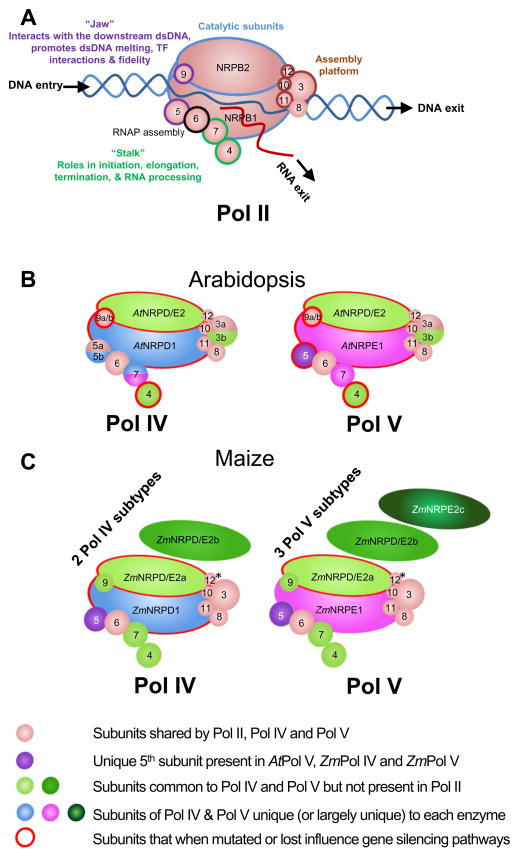
Figure 2. Subunit composition summary for Pol IV and Pol V in Arabidopsis and maize
(A) Cartoon representation of RNA polymerase II, showing the 12 core subunits (1–12) along with the DNA entry, DNA exit and RNA exit channels. Polymerase features and associated functions in yeast Pol II are labeled much as described in [50]. (B and C) Cartoon representations of RNA Pol IV and Pol V in Arabidopsis (At) and maize (Zm), respectively, modeled after diagrams in [51]. Subunit compositions are based on the totality of mass spectrometry data from [–46] and likely represent multiple polymerase subtypes with different combinations of subunits. The individual polymerase subunits are color coded as indicated in the legend. *Subunit 12: Although subunit 12 is conserved in Pol I, II, and III as well as in AtPol IV and AtPol V, no peptides were identified from the maize affinity purifications thus it remains unclear if this subunit is truly absent or was not detectable for technical reasons [46].

References

    1. Wierzbicki AT. The role of long non-coding RNA in transcriptional gene silencing. Curr Opin Plant Biol. 2012;15:517–522. - PubMed
    1. Fatica A, Bozzoni I. Long non-coding RNAs: new players in cell differentiation and development. Nat Rev Genet. 2014;15:7–21. - PubMed
    1. Holoch D, Moazed D. RNA-mediated epigenetic regulation of gene expression. Nat Rev Genet. 2015;16:71–84. - PMC - PubMed
    1. Moazed D. Small RNAs in transcriptional gene silencing and genome defence. Nature. 2009;457:413–420. - PMC - PubMed
    1. Cecere G, Grishok A. A nuclear perspective on RNAi pathways in metazoans. Biochim Biophys Acta. 2014;1839:223–233. - PMC - PubMed

Publication types

LinkOut - more resources