


COMPARISON OF ECCENTRIC AND CONCENTRIC EXERCISE INTERVENTIONS IN ADULTS WITH SUBACROMIAL IMPINGEMENT SYNDROME
- PMID: 26346332
- PMCID: PMC4527192
COMPARISON OF ECCENTRIC AND CONCENTRIC EXERCISE INTERVENTIONS IN ADULTS WITH SUBACROMIAL IMPINGEMENT SYNDROME
Abstract
Background: Researchers have demonstrated moderate evidence for the use of exercise in the treatment of subacromial impingement syndrome (SAIS). Recent evidence also supports eccentric exercise for patients with lower extremity and wrist tendinopathies. However, only a few investigators have examined the effects of eccentric exercise on patients with rotator cuff tendinopathy.
Purpose: To compare the effectiveness of an eccentric progressive resistance exercise (PRE) intervention to a concentric PRE intervention in adults with SAIS.
Study design: Randomized Clinical Trial.
Methods: Thirty-four participants with SAIS were randomized into concentric (n = 16, mean age: 48.6 ± 14.6 years) and eccentric (n = 18, mean age: 50.1 ± 16.9 years) exercise groups. Supervised rotator cuff and scapular PRE's were performed twice a week for eight weeks. A daily home program of shoulder stretching and active range of motion (AROM) exercises was performed by both groups. The outcome measures of the Disabilities of the Arm, Shoulder, and Hand (DASH) score, pain-free arm scapular plane elevation AROM, pain-free shoulder abduction and external rotation (ER) strength were assessed at baseline, week five, and week eight of the study.
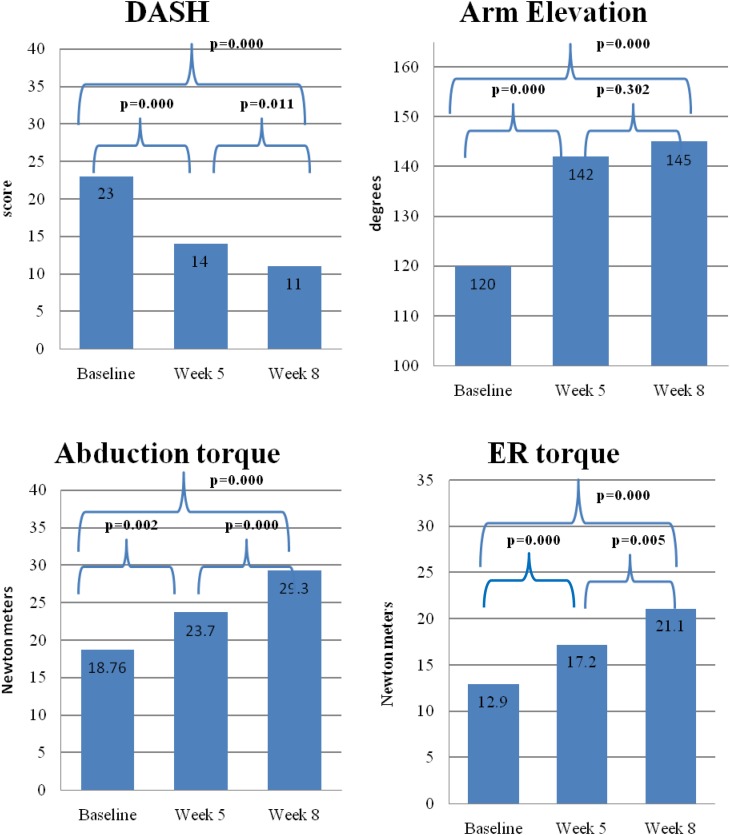
Results: Four separate 2x3 ANOVAs with repeated measures showed no significant difference in any outcome measure between the two groups over time. However, all participants made significant improvements in all outcome measures from baseline to week five (p < 0.0125). Significant improvements also were found from week five to week eight (p < 0.0125) for all outcome measures except scapular plane elevation AROM.
Conclusion: Both eccentric and concentric PRE programs resulted in improved function, AROM, and strength in patients with SAIS. However, no difference was found between the two exercise modes, suggesting that therapists may use exercises that utilize either exercise mode in their treatment of SAIS.
Level of evidence: Therapy, level 1b.
Keywords: Physical therapy; rotator cuff; shoulder; strengthening.
Figures



References
-
- Dinnes J Loveman E McIntyre, et al. The effectiveness of diagnostic tests for the assessment of shoulder pain due to soft tissue disorders: A systematic review. Health Technol.Assess. 2003;7(29):iii‐1‐166. - PubMed
-
- Pribicevic M Pollard H Bonello R. An epidemiologic survey of shoulder pain in chiropractic practice in australia. J. Manipulative Physiol. Ther. 2009;32(2):107‐117. - PubMed
-
- Kelly SM Wrightson PA Meads CA. Clinical outcomes of exercise in the management of subacromial impingement syndrome: A systematic review. Clin Rehabil. 2010;24(2):99‐109. - PubMed
LinkOut - more resources
Full Text Sources
Medical
Research Materials