


Long-term exposure to circulating platinum is associated with late effects of treatment in testicular cancer survivors
- PMID: 26347114
- PMCID: PMC4621032
- DOI: 10.1093/annonc/mdv369
Long-term exposure to circulating platinum is associated with late effects of treatment in testicular cancer survivors
Abstract
Background: The success of cisplatin-based (Platinol, Bristol-Myers Squibb Company, New York, NY, USA) chemotherapy for testicular cancer comes at the price of long-term and late effects related to healthy tissue damage. We assessed and modelled serum platinum (Pt) decay after chemotherapy and determined relationships between long-term circulating Pt levels and known late effects.
Patients and methods: In 99 testicular cancer survivors, treated with cisplatin-based chemotherapy, serum and 24-h urine samples were collected during follow-up (1-13 years after treatment). To build a population pharmacokinetic model, measured Pt data were simultaneously analysed, together with cisplatin dose, age, weight and height using the NONMEM software. Based on this model, area under the curve between 1 and 3 years after treatment (Pt AUC1-3 years) was calculated for each patient. Predicted long-term Pt exposure was related to renal function and to late effects of treatment assessed median 9 (3-15) years after chemotherapy.
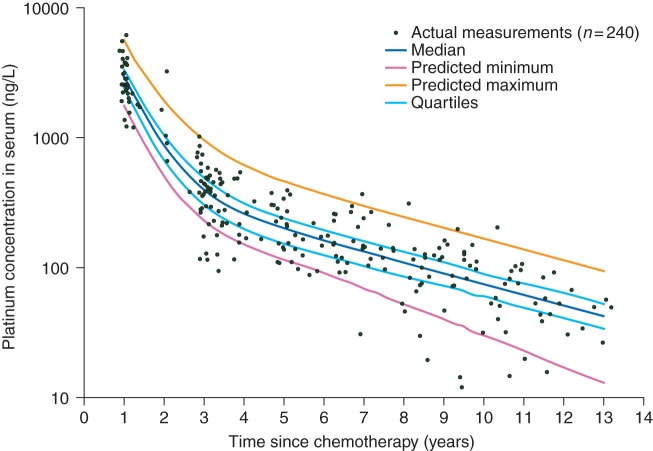
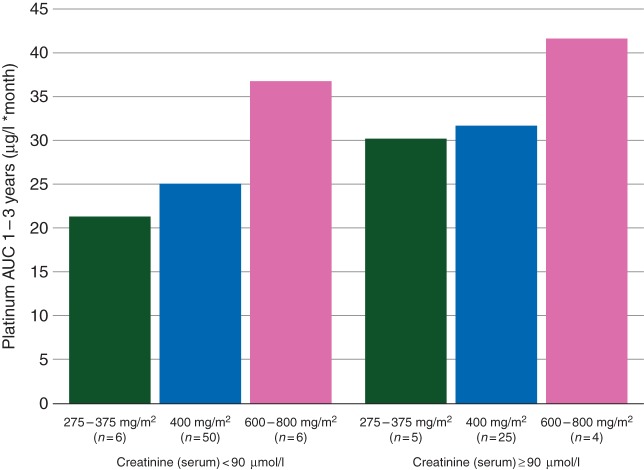
Results: Decay of Pt was best described by a two-compartment model. Mean terminal T1/2 was 3.7 (range 2.5-5.2) years. Pt AUC1-3 years correlated with cumulative cisplatin dose, and creatinine clearance before and 1 year after treatment. Patients with paraesthesia had higher Pt AUC1-3 years (30.9 versus 27.0 µg/l month) compared with those without paraesthesia (P = 0.021). Patients with hypogonadism, elevated LDL-cholesterol levels or hypertension also had higher Pt AUC1-3 years.
Conclusions: Renal function before and after cisplatin treatment is an important determinant of long-term Pt exposure. Known long-term effects of testicular cancer treatment, such as paraesthesia, hypogonadism, hypercholesterolaemia and hypertension, are associated with long-term circulating Pt exposure.
Keywords: BEP; germ cell cancer; long-term toxicity; nephrotoxicity; platinum.
© The Author 2015. Published by Oxford University Press on behalf of the European Society for Medical Oncology.
Figures
References
-
- Haugnes HS, Bosl GJ, Boer H et al. . Long-term and late effects of germ cell testicular cancer treatment and implications for follow-up. J Clin Oncol 2012; 30: 3752–3763. - PubMed
-
- Nuver J, Smit AJ, Wolffenbuttel BH et al. . The metabolic syndrome and disturbances in hormone levels in long-term survivors of disseminated testicular cancer. J Clin Oncol 2005; 23: 3718–3725. - PubMed
-
- Haugnes HS, Aass N, Fosså SD et al. . Components of the metabolic syndrome in long-term survivors of testicular cancer. Ann Oncol 2007; 18: 241–248. - PubMed
-
- de Haas EC, Altena R, Boezen HM et al. . Early development of the metabolic syndrome after chemotherapy for testicular cancer. Ann Oncol 2013; 24: 749–755. - PubMed
-
- Gietema JA, Meinardi MT, Messerschmidt J et al. . Circulating plasma platinum more than 10 years after cisplatin treatment for testicular cancer. Lancet 2000; 355: 1075–1076. - PubMed
Publication types
MeSH terms
Substances
LinkOut - more resources
Full Text Sources
Other Literature Sources
Medical
