


Defining the relationship between infection prevalence and clinical incidence of Plasmodium falciparum malaria
- PMID: 26348689
- PMCID: PMC4569718
- DOI: 10.1038/ncomms9170
Defining the relationship between infection prevalence and clinical incidence of Plasmodium falciparum malaria
Abstract
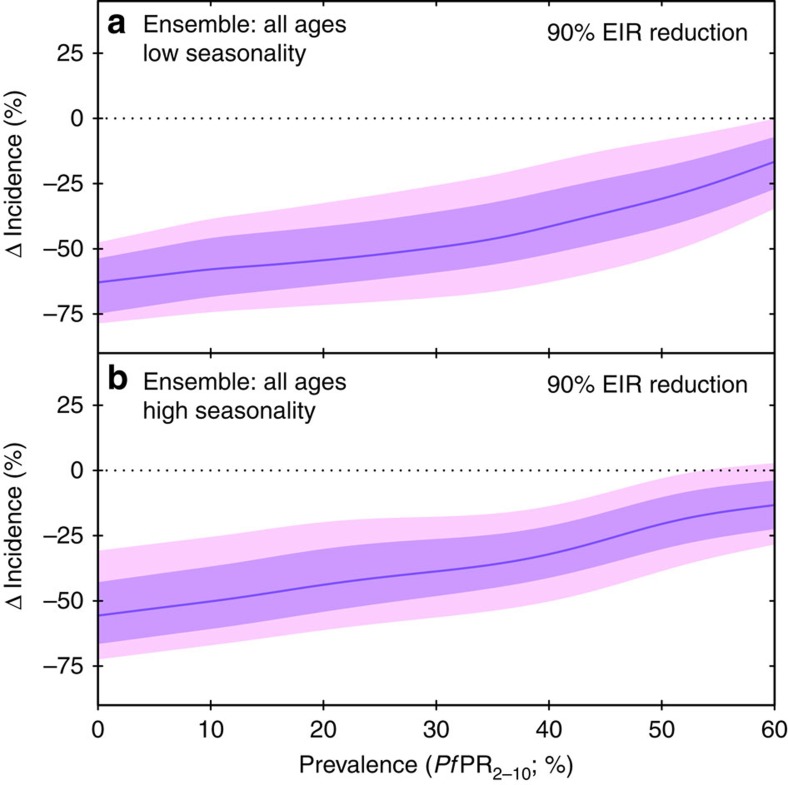
In many countries health system data remain too weak to accurately enumerate Plasmodium falciparum malaria cases. In response, cartographic approaches have been developed that link maps of infection prevalence with mathematical relationships to predict the incidence rate of clinical malaria. Microsimulation (or 'agent-based') models represent a powerful new paradigm for defining such relationships; however, differences in model structure and calibration data mean that no consensus yet exists on the optimal form for use in disease-burden estimation. Here we develop a Bayesian statistical procedure combining functional regression-based model emulation with Markov Chain Monte Carlo sampling to calibrate three selected microsimulation models against a purpose-built data set of age-structured prevalence and incidence counts. This allows the generation of ensemble forecasts of the prevalence-incidence relationship stratified by age, transmission seasonality, treatment level and exposure history, from which we predict accelerating returns on investments in large-scale intervention campaigns as transmission and prevalence are progressively reduced.
Figures


References
-
- World Health Organisation. World Malaria Report 1-227 WHO, Switzerland (2014).
-
- Craig M. H., Snow R. W. & le Sueur D. A climate-based distribution model of malaria transmission in sub-Saharan Africa. Parasitol. Today 15, 105–111 (1999). - PubMed
Publication types
MeSH terms
Grants and funding
LinkOut - more resources
Full Text Sources
Other Literature Sources
