


Symptoms of depression and anxiety predict treatment response and long-term physical health outcomes in rheumatoid arthritis: secondary analysis of a randomized controlled trial
- PMID: 26350486
- PMCID: PMC4710801
- DOI: 10.1093/rheumatology/kev306
Symptoms of depression and anxiety predict treatment response and long-term physical health outcomes in rheumatoid arthritis: secondary analysis of a randomized controlled trial
Abstract
Objective: The aim of this analysis is to examine the longitudinal impact of symptoms of depression/anxiety on treatment response, long-term disease activity and physical disability in RA.
Methods: Secondary analysis of clinical trial data was performed. Data were collected at baseline and at 6-monthly intervals for 2 years. The EuroQoL (EQ-5D(TM)) indicated depression/anxiety symptom severity. Our primary outcomes of interest were (i) DAS-28 and (ii) physical disability measured via the HAQ. Secondary outcomes were: tender and swollen joint counts, patient global assessment, ESR and odds of reaching clinical remission. Multilevel models were used to assess the impact of baseline and persistent depression/anxiety on outcomes over 2 years.
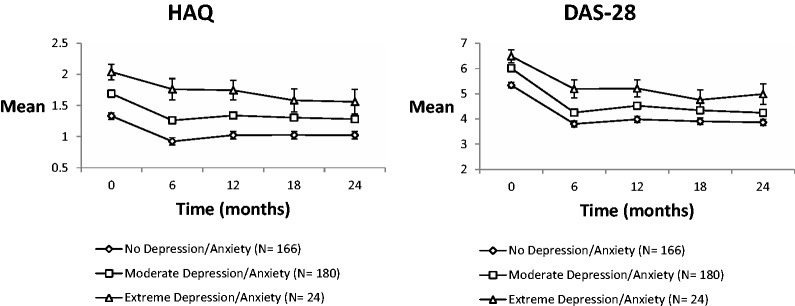
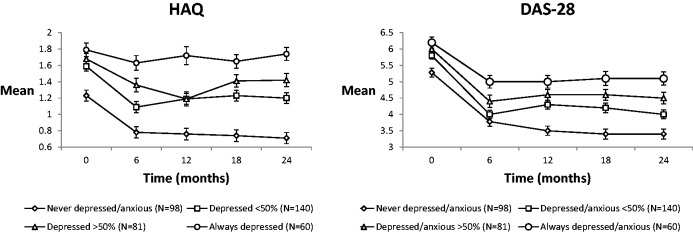
Results: Data from 379 patients were included. After adjusting for covariates, baseline depression/anxiety symptoms were associated with increased DAS-28 outcomes and increased tender joint counts. Persistent depression/anxiety symptoms were associated with increased DAS-28 scores, HAQ scores, tender joint counts and patient global assessment of disease activity, and reduced odds of reaching clinical remission. Patients with symptoms of depression/anxiety at baseline also showed a 50% reduction in prednisolone treatment effect, in comparison with patients with no symptoms of depression/anxiety at baseline.
Conclusion: Baseline and persistent symptoms of depression/anxiety are associated with poorer health outcomes over time, as well as reduced treatment response. Mental health should be routinely measured both in clinical practice and in research, and managed alongside rheumatological disease to optimize health outcomes. Further research is required to examine whether treatment of mental disorders can improve rheumatological outcomes.
Keywords: HAQ; anxiety; depression; disease activity; joint erosion; longitudinal; pain; remission; rheumatoid arthritis (RA).
© The Author 2015. Published by Oxford University Press on behalf of the British Society for Rheumatology.
Figures
References
-
- Waraich P, Goldner EM, Somers JM, Hsu L. Prevalence and incidence studies of mood disorders: a systematic review of the literature. Can J Psychiatry 2004;49:124–38. - PubMed
-
- Spitzer RL, Kroenke K, Williams JB, Lowe B. A brief measure for assessing generalized anxiety disorder: the GAD-7. Arch Intern Med 2006;166:1092–7. - PubMed
-
- Rayner L, Matcham F, Hutton J, et al. Embedding integrated mental health assessment and management in general hospital settings: feasibility, acceptability and the prevalence of common mental disorder. Gen Hosp Psychiatry 2014;36:318–24. - PubMed
-
- Norton S, Sacker A, Young A, Done J. Distinct psychological distress trajectories in rheumatoid arthritis: findings from an inception cohort. J Psychosom Res 2011;71:290–5. - PubMed
Publication types
MeSH terms
Substances
Grants and funding
LinkOut - more resources
Full Text Sources
Other Literature Sources
Medical
Miscellaneous
