Review
. 2015 Oct 10;33(29):3293-304.
doi: 10.1200/JCO.2015.61.1509. Epub 2015 Sep 8.

Immunology and Immunotherapy of Head and Neck Cancer

Affiliations
Review

Immunology and Immunotherapy of Head and Neck Cancer

Robert L Ferris. J Clin Oncol. .

Abstract

The immune system plays a key role in the development, establishment, and progression of head and neck squamous cell carcinoma (HNSCC). A greater understanding of the dysregulation and evasion of the immune system in the evolution and progression of HNSCC provides the basis for improved therapies and outcomes for patients. HNSCC cells evade the host immune system through manipulation of their own immunogenicity, production of immunosuppressive mediators, and promotion of immunomodulatory cell types. Through the tumor's influence on the microenvironment, the immune system can be exploited to promote metastasis, angiogenesis, and growth. This article provides a brief overview of key components of the immune infiltrating cells in the tumor microenvironment, reviewing immunological principles related to head and neck cancer, including the concept of cancer immunosurveillance and immune escape. Current immunotherapeutic strategies and emerging results from ongoing clinical trials are presented.


Conflict of interest statement

Author's disclosures of potential conflicts of interest are found in the article online at www.jco.org. Author contributions are found at the end of this article.

Figures

Fig 1.
Fig 1.
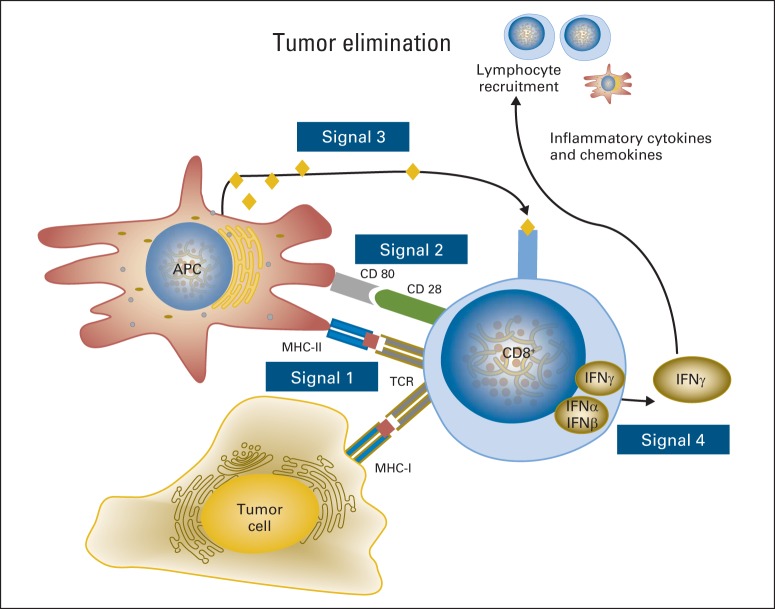
Immune escape from each step required for the development of strong antitumor immunity. Signal 1 represents TCR:HLA-peptide antigen interactions, Signal 2 represents co-stimulatory (or co-inhibitory) signals, Signal 3 indicates cytokine secretion, which may be proinflammatory, type 1 (Th1) antitumor mediators, or tumor-permissing type 2 (Th2) cytokines. Signal 4 represents cell extrinsic attracting chemokine signals to recruit cellular immune populations into the tumor microenvironment and augment/amplify or suppress antitumor immunity.
Fig 2.
Fig 2.
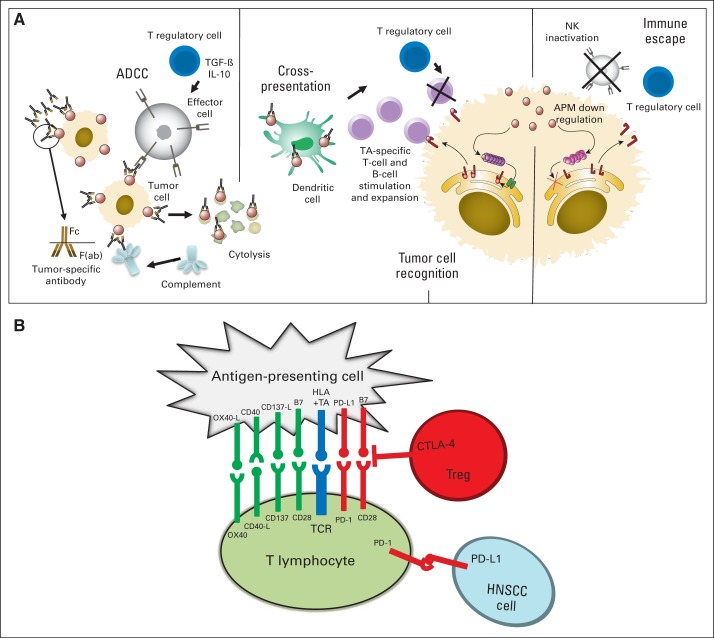
(A) Immune escape pathways at baseline in head and neck squamous cell carcinoma (HNSCC) and during monoclonal antibody therapy. Dysfunction of natural killer (NK) cells, dendritic cells (DCs), and T cells are present, with suppressive cytokines, regulatory T cells (Treg), and myeloid derived suppressor cells. During oncologic therapy, immune escape reversal is portrayed through a proposed model of cellular cascades triggered by activation of NK cells with cetuximab-coated head and neck cancer targets. Cetuximab-mediated NK cell–dependent tumor cell lysis results in the generation of epidermal growth factor receptor–cetuximab immune complexes, which are taken up by DC, processed, and presented to tumor antigen (TA) –specific T cells. Cytotoxic T lymphocytes (CTLs) recognize and eliminate tumor cells. Treg may downregulate NK activity, DC functions, and/or CTL activity, leading to tumor immune escape. In addition, defects in the human leukocyte antigen (HLA) and antigen-processing machinery (APM) component expression in HNSCC cells contribute to tumor escape from CTL recognition. Adapted from Ferris RL, et al: J Clin Oncol 28:4390-4399, 2010. Reprinted with permission from Kansy BA, et al: Curr Otorhinolaryngol Rep 3:63-72, 2015. (B) Costimulatory (green) and coinhibitory (red) signals modify antigen specific stimulation through the T-cell receptor (TCR). Intrinsic suppressive signals on tumor-specific T cells or exerted by suppressive extrinsic Tregs may impair antitumor activity in the tumor microenvironment. Adapted from Bauman JE, et al: Cancer 120:624-632, 2014. ADCC, antibody-dependent cell-mediated cytotoxicity; IL-10, interleukin-10; PD-1, programmed death-1; TGF-β, transforming growth factor-β.
Fig 3.
Fig 3.
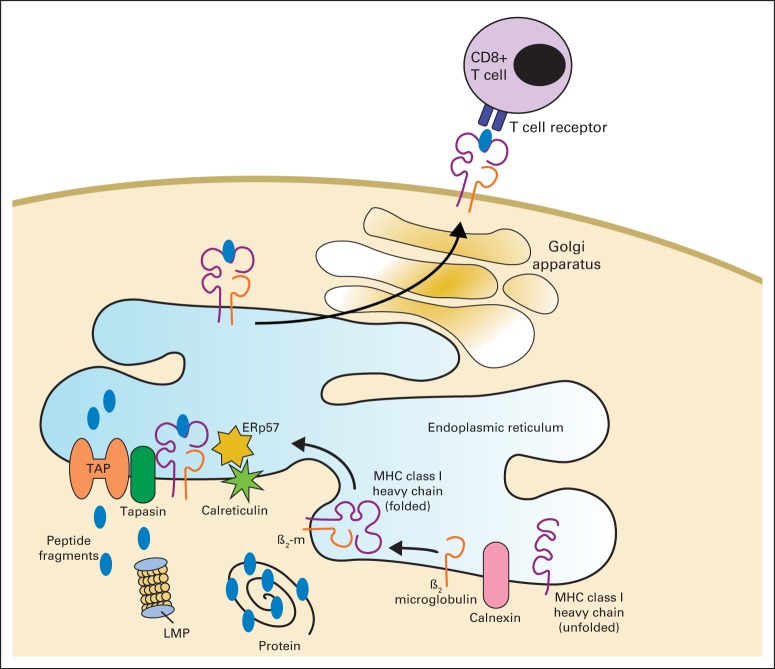
The process of antigen presentation for recognition of tumor cells by the immune system requires fully functional antigen-processing machinery (APM).

References

    1. Leibowitz MS, Andrade Filho PA, Ferrone S, et al. Deficiency of activated STAT1 in head and neck cancer cells mediates TAP1-dependent escape from cytotoxic T lymphocytes. Cancer Immunol Immunother. 2011;60:525–535. - PMC - PubMed
    1. Leibowitz MS, Srivastava RM, Andrade Filho PA, et al. SHP2 is overexpressed and inhibits pSTAT1-mediated APM component expression, T-cell attracting chemokine secretion, and CTL recognition in head and neck cancer cells. Clin Cancer Res. 2013;19:798–808. - PMC - PubMed
    1. Kuss I, Hathaway B, Ferris RL, et al. Decreased absolute counts of T lymphocyte subsets and their relation to disease in squamous cell carcinoma of the head and neck. Clin Cancer Res. 2004;10:3755–3762. - PubMed
    1. Bauernhofer T, Kuss I, Henderson B, et al. Preferential apoptosis of CD56dim natural killer cell subset in patients with cancer. Eur J Immunol. 2003;33:119–124. - PubMed
    1. Dasgupta S, Bhattacharya-Chatterjee M, O'Malley BW, Jr, et al. 2005. Inhibition of NK cell activity through TGF-beta 1 by down-regulation of NKG2D in a murine model of head and neck cancer. J Immunol. 2005;175:5541–5550. - PubMed

Publication types